
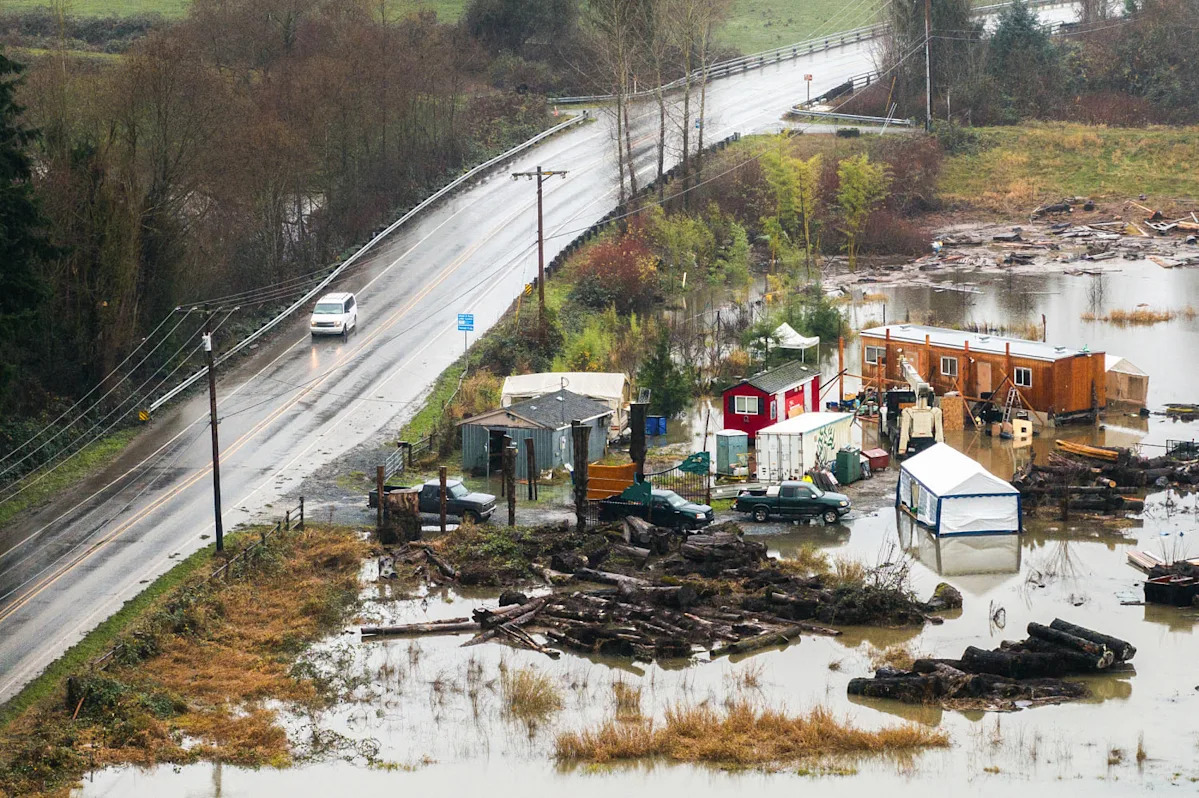
Some dams failedmore than a dozen highways were shuttered and one person died in Washington state. Atmospheric river storms continue to hit the region and test its infrastructure.
The state's dams and dams largely survived the first wave of storms last week, but the rain continued to fall, so some began to become overloaded.
At the same time, a patchwork of low-lying areas in western Washington remains filled with slowly receding floodwaters.
Gov. Bob Ferguson said at a news conference Tuesday that there have been more than 1,200 rescues in 10 counties since Dec. 8. Thirteen state highways are still closed, and one of the main arteries through the Cascade Mountains, Highway 2, could remain closed for months. The largest artery, Interstate 90, which crosses the state, was also closed due to severe landslides.
“Our infrastructure was compromised,” Ferguson said. “This infrastructure is under enormous strain.”
Flooding on Francis Road in Skagit County, Washington on Friday. (Evan Bush/NBC News)
A 33-year-old man died in Snohomish County, north of Seattle, early Tuesday after driving into a ditch next to a flooded farm road in a rural area.
“We believe this is the first fatality as a result of these storms,” Ferguson said, adding that it was a minor miracle that there weren't more deaths.
Courtney O'Keefe, director of public affairs for the Snohomish County Sheriff's Office, said the man's car, a Chevy Tahoe, drove past the roadblocks and that the victim called a friend after his car was submerged in floodwaters. This friend called 911.
“There's a ditch that falls down the side of the road. With the flood waters, it would be hard to tell where the ditch ends and the road begins,” O'Keefe said, adding that the death is still under investigation.
Over the past two days, two dams have broken in the Seattle area.
The latest incident occurred Tuesday morning in the town of Pacific, near the White River.
“A fire hose sized leak was discovered around 12:30 last night,” said Sheri Badger, public information officer for the King County Office of Emergency Management. “Then it grew to about 120 feet long.”
The semi-permanent dam was constructed using HESCO barriers, a tool made of wire mesh and fabric filled with sand, soil or gravel. The barriers were stacked on top of each other, with water flowing through the gaps between them, Badger said.
The county sent out an evacuation warning to 1,300 residents in the area. Crews worked to add sandbags and “superbags” — large nylon bags filled with sand — to shore up damaged areas.
On Monday, a 6-foot section of another levee washed out in the city of Tukwila, south of Seattle, along the Green River. King County sent out evacuation notices to about 1,100 people, but workers quickly filled the damaged area, limiting the damage.
The dam was damaged during a flood about four years ago and has not yet been fully repaired.
At least two dams are being inspected for cracks and potential violations, according to the state Department of Ecology. One of them, the Lake Sylvia Dam, was listed as “poor condition” with “significant” danger after the last inspection in November 2024, according to the National Dam Inventory. It was built in 1918.
Andrew Weinke, a department spokesman, said if the dam fails, several roads would be at risk, but no homes or people would be directly affected.
Much of western Washington is covered by rivers that descend steeply from the Cascade Mountains. These streams, which flow into Puget Sound, once formed meandering paths along wide floodplains. But starting more than a century ago, people began erecting and leveling many of them to provide drinking water, flood control and hydroelectric power. Streams became run-of-river rivers—superhighways for flowing water.
Since then, people have strengthened levee systems to hold back water, often building residential and industrial buildings as close to the edge as floodplain planners will allow.
Some areas were heavily damaged by flooding it has flooded before and will flood again.

A house is surrounded by floodwaters on Monday in Sumas. (Brandon Bell/Getty Images)
Atmospheric rivers like recent storm systems can look like fire hoses from the tropics on weather radar.
Such storms are called “Pineapple Express” because they sometimes draw moisture and heat from the Pacific Ocean near Hawaii and other parts of the tropics.
The Pacific Northwest usually handles one or two of these storms without much trouble, but it has had three major rain events since Dec. 8.
“Atmospheric river events were large, but not historic,” said state climatologist Guillaume Mauger. “What’s remarkable is that they went back to back.”

Family members in Semas repair their home on Monday after it was flooded during last week's rainstorm. (Brandon Bell/Getty Images)
He said more river flooding was expected in the future as rising temperatures meant more precipitation was falling as rain rather than snow. A warmer atmosphere also causes more intense rainfall.
By the end of the century, one study could expect flooding on the Skagit River. once every 100 years could increase in volume by almost 50% by the 2080s. Flood control measures given the river's dams would be “largely ineffective”, the study found.
The best option to reduce future risk is to give rivers more space, Mauger said.
With more storms on the horizon, dam operators have been forced to release water from upstream dams to prevent them from flooding.
John Taylor, King County natural resources and parks director, said workers are monitoring a number of levees that are a concern and strengthening those they know are weak.
“You're seeing levees that normally work well during floods start to fail because the levees are saturated and there's a lot of pressure on them,” he said.
The Skagit and Snoqualmie rivers are expected to reach or exceed major flood stage by Thursday morning.
This article was originally published on NBCNews.com



