

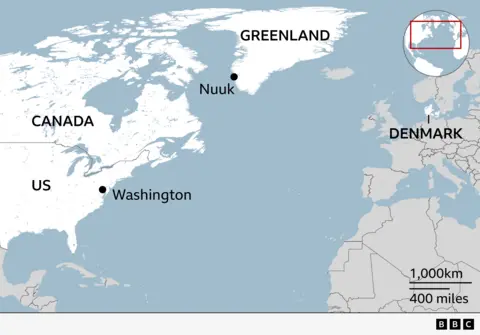
US President Donald Trump is discussing a “range of options” for acquiring Greenland, including the use of military forces, the White House said.
The White House told the BBC that acquiring Greenland, a semi-autonomous region of NATO member Denmark, was a “national security priority.”
The statement came hours after European leaders issued a joint statement supporting Denmark, which opposes Trump's ambitions for the Arctic island.
Over the weekend, Trump repeated that the US “needs” Greenland for security reasons, prompting Danish Prime Minister Mette Frederiksen to warn that any US attack would mean the end of NATO.
The White House said Tuesday: “The President and his team are discussing a range of options to achieve this important foreign policy objective, and, of course, the use of U.S. military forces is always an option at the commander in chief's disposal.”
NATO is a transatlantic military grouping where allies must come to each other's aid in the event of an external attack.
On Tuesday, six European allies expressed support for Denmark.
“Greenland belongs to its people, and only Denmark and Greenland can decide matters affecting their relationship,” the leaders of Britain, France, Germany, Italy, Poland, Spain and Denmark said in a joint statement.
Stressing that they have the same interest in Arctic security as the United States, the European countries that signed the joint statement said this must be achieved by NATO allies, including the United States, “collectively.”
They also called for “upholding the principles of the UN Charter, including sovereignty, territorial integrity and the inviolability of borders.”
Greenland's Prime Minister Jens-Frederik Nielsen welcomed the announcement and called for “respectful dialogue.”
“The dialogue must respect the fact that Greenland's status is based on international law and the principle of territorial integrity,” Nielsen said.
The question of Greenland's future has resurfaced following the US military intervention in Venezuela, during which elite troops moved in to capture the country's President Nicolas Maduro and bring him to New York to face drug and weapons charges.
A day after the raid, Katie Miller, the wife of one of Trump's senior aides, posted a map of Greenland in the colors of the American flag next to the word “SOON” on social media.
Her husband, Stephen Miller, said Monday that “the official position of the U.S. government is that Greenland should be part of the United States.”
Asked repeatedly in an interview with CNN whether America would rule out the use of force to annex it, Miller responded: “Nobody is going to fight the United States over the future of Greenland.”
US Secretary of State Marco Rubio told lawmakers at a secret briefing on Capitol Hill on Monday that the Trump administration was not planning to invade Greenland but wanted to buy the island from Denmark, the Wall Street Journal reported.
An unnamed senior US official told Reuters that US options include purchasing Greenland outright or entering into a Compact of Free Association with the territory.
Greenland and Denmark earlier said they had asked Rubio to meet quickly to discuss American claims to the island.
Danish Foreign Minister Lars Lokke Rasmussen said a conversation with America's top diplomat should resolve “certain misunderstandings.”
Senator Eric Schmitt, R-Missouri, emphasized the national security aspect when he spoke to the BBC about Greenland on Tuesday.
“I think they are in the process of negotiating right now,” he said. “I hope that Europe will understand that a strong America is good, it is good for Western civilization.”
Trump floated the idea of acquiring Greenland as a strategic US hub in the Arctic during his first term, saying in 2019: “It's essentially a massive real estate deal.”
Interest from Russia and China in the island, which has untapped deposits of rare earth metals, is growing as melting ice opens up opportunities for new trade routes.
In March, Trump said America would “go as far as we possibly can” to gain control of the territory.
During congressional hearings last summer, Defense Secretary Pete Hegseth was asked whether the Pentagon planned to seize Greenland by force if necessary, and he responded that they “have contingency plans.”
Greenland, which has a population of 57,000, has had broad self-government since 1979, although defense and foreign policy remain in Danish hands.
Although most Greenlanders favor eventual independence from Denmark, opinion polls show that the vast majority of Greenlanders oppose joining the United States, which already has a military base on the island.
Morgan Angaju, 27, an Inuit living in Ilulissat in the west of the country, told the BBC it was “horrible to listen to the leader of the free world laugh at Denmark and Greenland and just talk about us as if we deserve something.”
“The Greenlandic people are already laying claim to us. Kalaallit Nunaat means the land of the Greenlandic people,” Morgan said.
He added that he was worried about what would happen next: whether Greenland's prime minister could suffer the same fate as Maduro, or even the US “invading our country.”



