
WASHINGTON — The Trump administration faced scrutiny this week over its approach to Venezuela after focusing its attention on the besieged country and weighing U.S. military strikes against the Latin American nation for the first time in more than 35 years.
President Trump has scheduled a meeting with top generals and Cabinet officials on the issue at the White House for Monday evening, discussing target options now available with the deployment more than a dozen warships to the Caribbean Sea.
Trump has sent mixed signals to the country's dictatorial President Nicolas Maduro, whose power grab since 2013, it has destroyed the Venezuelan economy and provoked a large-scale migration crisis. Before his phone call with Maduro over the weekend, Trump warned that air traffic would be kept out of Venezuelan skies, only to caution reporters trying to interpret his actions against predicting his next moves.
The question of whether Trump will decide to go to war with Venezuela has become a source of anxiety on Capitol Hill as new revelations emerge about his team's tactics to escalate the conflict.
The White House accused Maduro of smuggling migrants and drugs across America's borders and began pressuring his government to launch military strikes against shipping vessels (in international waters but leaving Venezuela) that the Defense Department said were used to smuggle illegal drugs.
The first of these attacks on suspected drug traffickers, carried out on September 2, included a second strike under orders from Defense Secretary Pete Hegseth to “kill them all,” according to a Washington Post report.
The Post's reporting prompted Republican-led House and Senate committees that control the Pentagon to promise “rigorous oversight” of boat strikes. Trump told reporters on Sunday that he “wouldn't want” the military to launch a second strike to kill those who survived the first attack.
“The first strike was very lethal, it was normal, and if there were two people around,” Trump said, before quickly adding, “but Pete said that didn't happen. I have a lot of confidence in Pete.”
However, White House press secretary Caroline Leavitt confirmed Monday that Hegseth authorized multiple strikes on the facility that day.
Hegseth authorized Adm. Frank M. Bradley, commander of U.S. Special Operations Command, to carry out the strikes “to the extent of his authority and the law to ensure the destruction of the boat and the threat to the United States,” Leavitt said at a press briefing.
Trump also confirmed that he spoke by phone with Maduro, but declined to detail what was discussed.
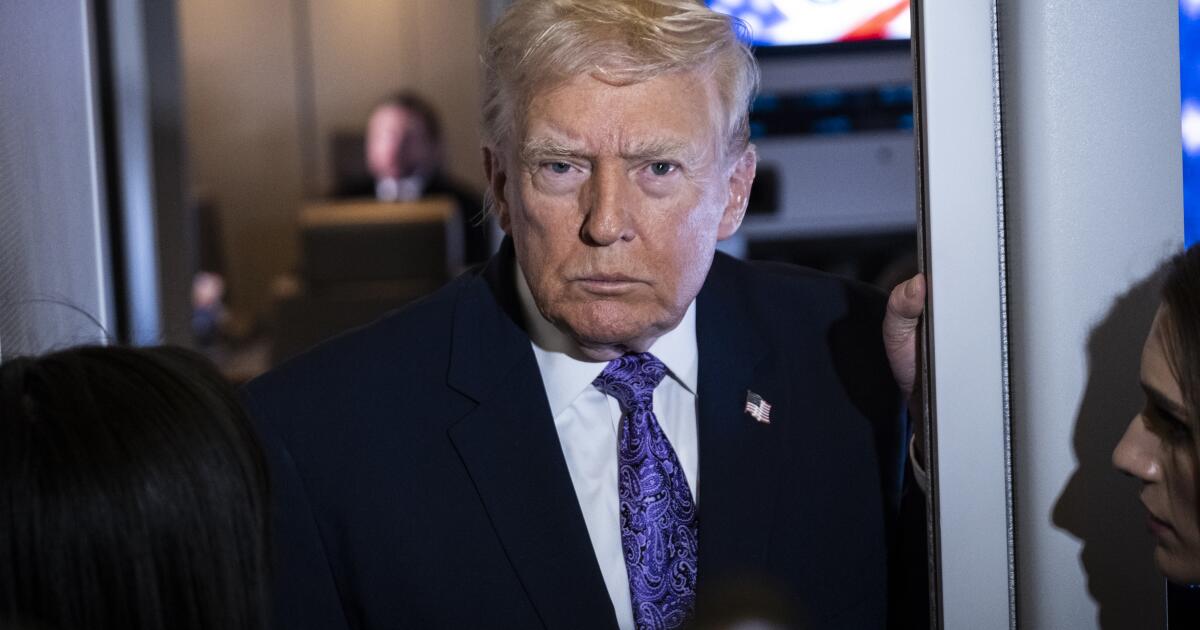
“I wouldn't say it went well or badly,” Trump told reporters aboard Air Force One. “It was a call.”
The conversation came as the administration stepped up its pressure campaign on Caracas over the holiday weekend, starting with the president issuing a series of warnings.
On Saturday, Trump warned airlines and pilots that the airspace over and around Venezuela should be considered.”COMPLETELY CLOSED”
Trump told reporters he made the announcement “because we don't think Venezuela is a very friendly country.” But when asked whether his warning signaled an imminent U.S. airstrike on Venezuela, Trump demurred, telling a reporter: “Don't put any weight on it.”
There is no guarantee that talks with Maduro will lead to his departure or that the Trump administration will be satisfied with any other outcome, said Jeff Ramsey, a Venezuela expert at the Atlantic Council, a think tank in Washington.
Maduro could offer Trump access to US oil companies (perhaps at the expense of Russian and Chinese rivals) without making any moves towards democratization in Venezuela, an outcome that would disappoint many seeking leadership change in Caracas.
“The obvious sticking point here is what kind of negotiations Caracas and Washington want. The Trump administration has so far expressed interest in negotiating which flight Maduro will take out of the country,” Ramsey said. “This is clearly a bad option for Maduro. So until we see a clear sense of flexibility from Washington and Caracas, I think this stalemate will continue.”
Maduro has consistently refused to leave office despite U.S. sanctions, mass protests and various offensive moves during the first Trump administration that Caracas considered coup attempts. “The reality is that many previous attempts to condition negotiations on Maduro’s immediate departure have come to nothing,” Ramsey added.
There is no sign of waning support for Maduro within the military, nor have there been the kind of large-scale defections seen among his security forces in 2019, when Trump initially sought to topple Maduro during his first term. At that time he refrained from direct military attack.
Hours after the president's speech, Hegseth posted a modified image of the children's book character. Franklin the Turtle reimagined as a paramilitary figure fired a machine gun at suspected drug boats. The cover of the book was titled: “The Classic Franklin Story: Franklin Targets Narco-Terrorists.”
Hegseth posted the image on social media with the caption: “For your Christmas wish list…”
A spokesperson for Kids Can Press, publisher of the Franklin Turtle books, condemned Hegseth's use of his “beloved Canadian symbol that has inspired generations of children and stands for kindness, empathy and inclusivity.”
“We strongly condemn any defamatory, violent or unauthorized use of Franklin’s name or image that directly contradicts these values,” the spokesperson said in a statement.
Trump sparked more controversy in the region when he announced his pardon plan on Friday. Juan Orlando Hernandezthe former president of Honduras, who was convicted last year on cocaine trafficking charges and sentenced to 45 years in prison in the United States.
US Attorneys said Hernandez accepted millions of dollars in bribes to help traffickers smuggle 400 tons of cocaine into the United States. Once, they claimed, the right-wing president boasted that he had “put drugs up the gringo’s nose.”
Trump said Hernandez was the victim of political persecution, although he offered no evidence for that claim.
News of the pardon shocked many in Latin America and raised new doubts about Trump's military campaign in the region, which White House officials say is aimed at fighting drug cartels they liken to terrorist groups such as al-Qaeda.
Rep. Joaquin Castro (D-Texas) accused Trump of hypocrisy for freeing a convicted drug smuggler and suggested the ongoing U.S. military campaign in the region was politically motivated.
“Don’t tell me Donald Trump is killing people on boats in the Caribbean to stop the drug trade,” Castro said on X.
While Trump's endgame in Venezuela is unclear, he has made his desires clear in Honduras.
Ahead of Sunday's presidential election in the Central American country, Trump endorsed conservative candidate Nasri “Tito” Asfura of the National Party, to which Hernandez also belonged. Monday's early vote count showed Asfoura leading Liberal Party candidate Salvador Nasrallah by a narrow margin.
Times staff writers Wilner and Ceballos reported from Washington, Linthicum and McDonnell from Mexico City.


:quality(85):upscale()/2025/12/01/598/n/49352476/9ec3dc4f692d9646762c30.82222541_.jpg?w=150&resize=150,150&ssl=1 "Best Cyber Monday Deals 2025")

