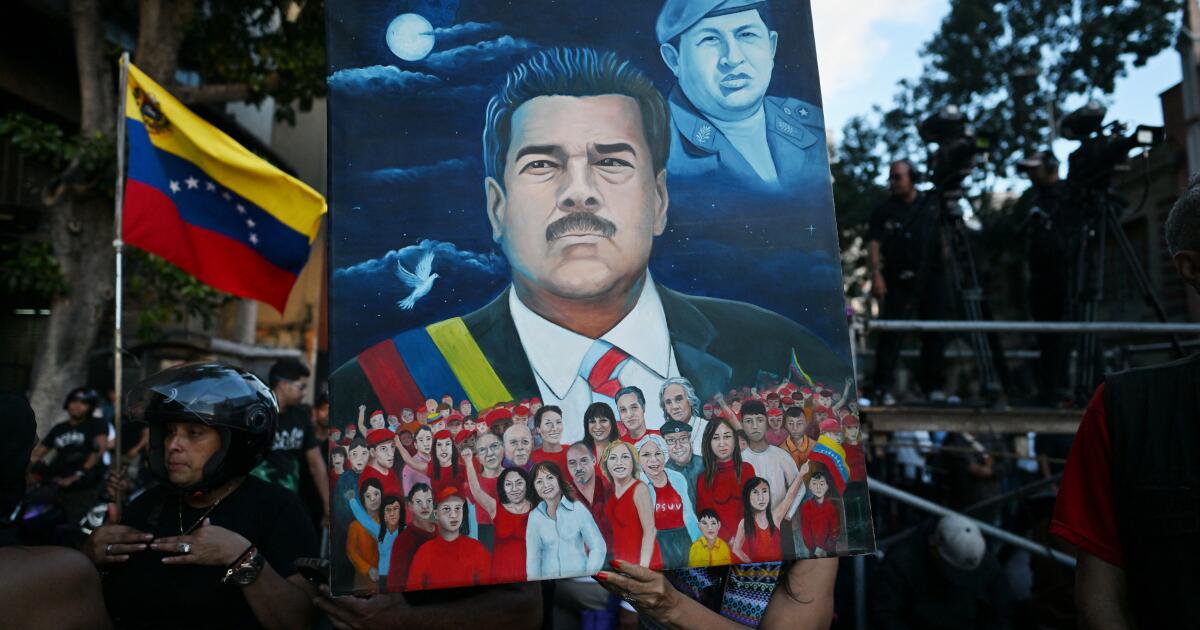
The United States launched a “large-scale strike” on Venezuela early Saturday and said its president had been captured and taken out of the country after months of intense pressure on Nicolas Maduro's government – an extraordinary overnight operation that President Donald Trump announced on social media hours after the attack.
The legal basis for the attack and whether Trump consulted Congress beforehand were not immediately clear. The stunning US military action, which removed the country's sitting leader from office, echoed the US invasion of Panama that led to the surrender and capture of its leader Manuel Antonio Noriega in 1990 – exactly 36 years ago Saturday.
U.S. Attorney General Pam Bondi said Maduro and his wife Cilia Flores will face charges following their arraignment in New York. Ms Bondi vowed in a social media post that the couple would “soon face the full wrath of American justice on American soil in American courts.”
Mr Maduro and other Venezuelan officials were charged in 2020 with conspiracy to commit “narco-terrorism”, but it was not previously known that his wife had been charged and it was unclear whether Ms Bondi was referring to the new charge.
Early Saturday morning there were multiple explosions and low-flying planes flew over the Venezuelan capital. Mr Maduro's government blamed the United States for attacks on civilian and military targets, calling it an “imperialist attack” and calling on citizens to take to the streets.
Since the whereabouts of the Venezuelan leader are unknown, Vice President Delcy Rodriguez will assume power in accordance with Venezuelan law. There was no confirmation that this happened, although she issued a statement after the strike demanding evidence of the lives of Mr Maduro and his wife.
Mr. Maduro, according to President Trump, “was captured along with his wife and taken out of the country. This operation was carried out jointly with US law enforcement agencies.” He scheduled a press conference for Saturday morning.
The attack itself lasted less than 30 minutes, and the explosions – at least seven explosions – sent people running into the streets, while others took to social media to report what they saw and heard. Some Venezuelan civilians and military personnel were killed, Vice President Ms. Rodriguez said, without giving a number.
It is unclear whether there will be more action ahead, although Mr. Trump said in his post that the strikes were a “success.” The Pentagon referred questions about the safety of American personnel involved in the operation to the White House.
The White House did not immediately respond to questions about where Maduro and his wife were flying.
Maduro last appeared on state television on Friday during a meeting with a delegation of Chinese officials in Caracas.
The strike follows a months-long pressure campaign by the Trump administration against the Venezuelan leader, including a massive buildup of U.S. forces in South American waters and attacks on ships in the eastern Pacific and Caribbean accused of carrying drugs. Last week, the CIA was behind a drone strike on a pier allegedly used by Venezuelan drug cartels. It is the first known direct operation on Venezuelan soil since the US began strikes in September.
As of Friday, the Trump administration said the number of known boat strikes stood at 35, with the death toll at least 115. Trump said the U.S. was engaged in “armed conflict” with drug cartels and justified the boat strikes as a need to stop the flow of drugs into the United States.
Mr Maduro has condemned the US military operations as a thinly veiled attempt to remove him from power.
Some Caracas streets are crowded
The Venezuelan government responded to the attack with a call to action: “People in the streets!”
Armed men and uniformed civilian militia members took to the streets of a Caracas neighborhood long considered a stronghold of the ruling party.
At a pro-Maduro protest in the capital, Caracas Mayor Carmen Melendez joined the crowd demanding Mr. Maduro's return.
“Maduro, hold on, the people are rising!” the crowd chanted. They also said: “We are here, Nicolas Maduro. If you can hear us, we are here!”
Elsewhere in the city, streets remained empty for hours after the attack as residents absorbed the events. Some areas were left without electricity, but transport moved freely.
“What do I feel? Scared, like everyone else,” said Caracas resident Noris Prada, who sat on an empty avenue and looked at his phone. “Venezuelans woke up scared, many families couldn’t sleep.”
Video from Caracas and an unidentified coastal city showed tracers and smoke clouding the landscape as repeated, muffled explosions lit up the night sky. Other footage shows cars driving along a highway as explosions light up the hills behind them. The video was reviewed by The Associated Press.
Smoke was seen rising from a hangar at a military base in Caracas, while another military facility in the capital was left without power.
The Venezuelan government said in a statement that Mr. Maduro had “ordered the implementation of all national defense plans” and declared a state of emergency that gives him the power to suspend people’s rights and expand the role of the military.
The website of the US Embassy in Venezuela, a post that has been closed since 2019, urged American citizens to shelter in place.
The reaction begins to appear
The FAA warned all U.S. commercial and private pilots that airspace over Venezuela and the small island nation of Curacao, located off the country's coast, is closed “due to aviation safety risks associated with ongoing military activities.”
The Armed Services Committees in both houses of Congress, which have jurisdiction over military matters, were not notified by the administration of any action, according to a person familiar with the matter who granted anonymity to discuss it.
Lawmakers from both political parties in Congress have expressed deep reservations and strong opposition to U.S. attacks on suspected drug-smuggling vessels off the coast of Venezuela, and Congress has not specifically authorized the use of military force for such operations in the region.
Connecticut Rep. Jim Himes, the top Democrat on the House Intelligence Committee, said he had seen no evidence to justify Trump striking Venezuela without congressional approval and demanded an immediate briefing from the administration on “its plan to promote stability in the region and the legal rationale for this decision.”
Deputy Secretary of State Christopher Landau said the military action and Maduro's capture marked a “new dawn for Venezuela,” saying “the tyrant is gone.” He posted X hours after the strike. His boss, Secretary of State Marco Rubio, issued a July post saying Maduro “is NOT the president of Venezuela and his regime is NOT a legitimate government.”
Cuba, a supporter of Maduro's government and a longtime adversary of the United States, called on the international community to respond to what President Miguel Diaz-Canel Bermudez called a “criminal attack.”
“Our zone of peace is being brutally attacked,” he said on X. Iran's Foreign Ministry also condemned the strikes.
Argentine President Javier Milley praised his close ally Trump's announcement that Maduro had been captured, using a political slogan he often uses to trumpet right-wing achievements: “Long live freedom, damn it!”
Associated Press reports. Konstantin Toropin and AP writer Lisa Mascaro reported from Washington.