

Data from NASA's Cassini mission to Saturn initially led researchers to suspect the presence of a large underground ocean of liquid water on Titan. However, when University of Washington scientist Baptiste Journot and his colleagues simulated the Moon with an ocean, the results did not match the physical properties described in the data. Instead of an open ocean like here on Earth, we're probably looking at something more like Arctic sea ice or aquifers.
This composite image shows an infrared view of Titan. In this image, blue represents wavelengths centered at 1.3 microns, green at 2.0 microns, and red at 5.0 microns. A visible wavelength view would show only Titan's hazy atmosphere; The near-infrared wavelengths in this image allow Cassini's vision to penetrate the haze and reveal the Moon's surface. The view looks at an area that is mostly in Titan's Saturn-facing hemisphere. Image credit: NASA/JPL-Caltech/Space Science Institute.
The Cassini mission, which began in 1997 and lasted nearly 20 years, provided enormous amounts of data about Saturn and its 274 moons.
Titan is the only world other than Earth that has liquid on its surface.
Temperatures hover around minus 183 degrees Celsius (minus 297 degrees Fahrenheit). Instead of water, liquid methane forms lakes and falls as rain.
As Titan orbited Saturn in an elliptical orbit, scientists observed how the Moon stretched and contracted depending on where it was in relation to Saturn.
In 2008, they suggested that Titan must have a huge ocean beneath the surface to allow such significant deformation.
“The degree of deformation depends on the internal structure of Titan,” Dr. Journeau said.
“A deep ocean would allow the crust to bend more under Saturn's gravitational pull, but if Titan were completely frozen, it would not deform as much.”
“The deformation we discovered during initial analysis of Cassini mission data may have been consistent with a global ocean, but we now know that this is not the whole story.”
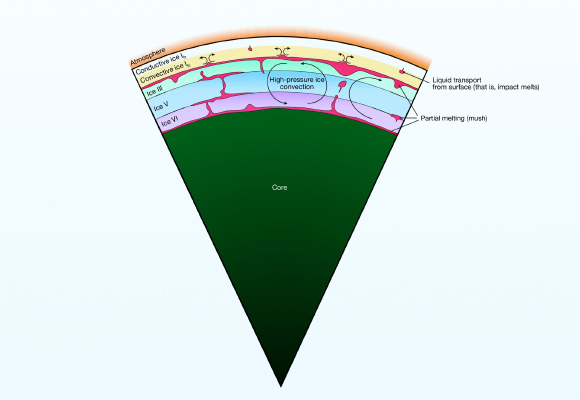
Schematic internal structure of Titan, revealed by Petrichka etc.. Image credit: Petrikka etc.., doi: 10.1038/s41586-025-09818-x.
In the new study, Dr. Journeau and his co-authors introduce a new level of subtlety: timing.
Titan's shape change lags about 15 hours behind Saturn's peak gravitational pull.
Like a spoon stirring honey, moving a thick, viscous substance requires more energy than moving liquid water.
Measuring the delay showed scientists how much energy it took to change Titan's shape, allowing them to draw conclusions about the viscosity of the subsurface.
The amount of energy lost or dissipated on Titan was much greater than researchers expected to see in a global ocean scenario.
“No one expected the very strong dissipation of energy inside Titan,” said Dr. Flavio Petricca, a scientist at NASA's Jet Propulsion Laboratory.
“This was a clear indication that Titan's interior was different from what had been inferred from previous analyses.”
Instead, the model the scientists propose has more slush and slightly less liquid water.
The slush is thick enough to account for the delay, but still contains water, allowing the Titan to transform when dashing.
“The water layer on Titan is so thick, the pressure is so enormous, that the physics of water changes,” Dr. Journeau said.
“Water and ice here on Earth behave differently than seawater.”
study was published today in the magazine Nature.
_____
F. Petrichka etc.. 2025. Titan's strong tidal dissipation rules out the emergence of a subsurface ocean. Nature 648, 556-561; two: 10.1038/s41586-025-09818-x



