
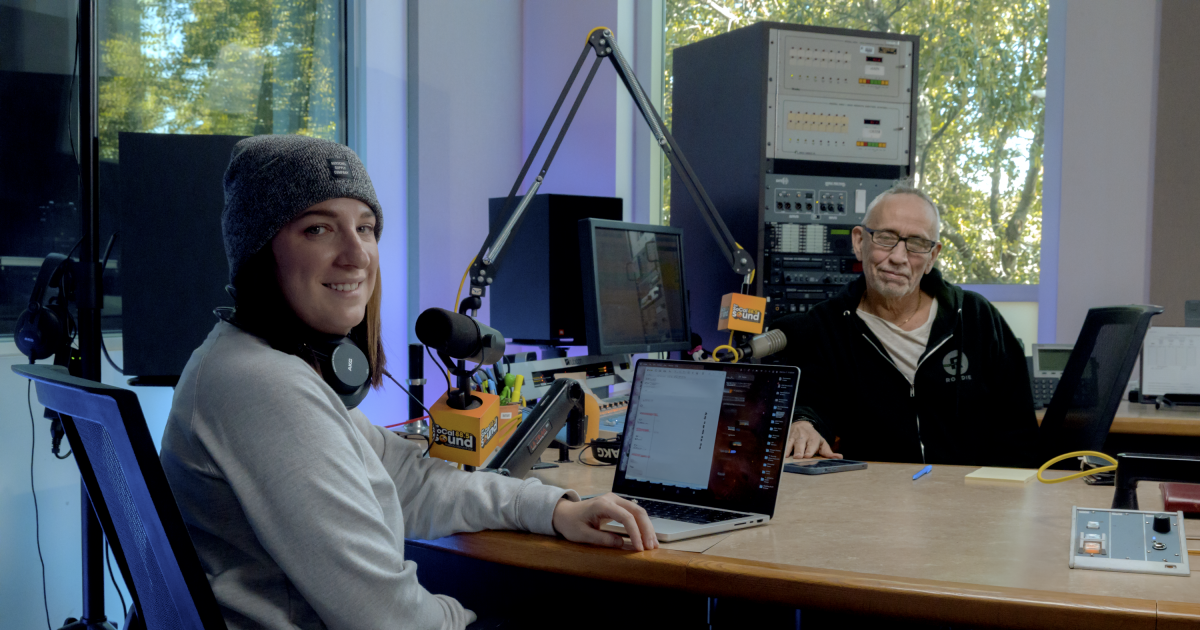
It's another bright, sunny and promising Thursday morning in Los Angeles in early October, but things aren't going well for the morning crew at public radio station KCSN, known as the SoCal Sound.
Morning show hosts Nick Harcourt and Jet Raskin are seven days into an eight-day fundraiser for the station's “gap,” named after the season and the funds the station is trying to make up after its nearly $250,000 grant from the Corporation for Public Broadcasting was canceled after Congress stripped the organization of its funding in July.
Harcourt and Ruskin were confronted with their own disadvantage this morning. They fall short of their goal during the first two hours of the show, but still forge ahead, imploring their listeners to contribute to the cause by offering prizes such as concert tickets, vinyl records, and a specially designed long-sleeved hooded T-shirt with the words “Protect Public Radio” written on an image of an acoustic guitar clutched in a fist.
After a passionate plea, new music plays. David Bowie's “Nite Flights,” a Walker Brothers song featured on the late legend's 1993 album Black Tie White Noise, blares from the speakers. This is not the album version, but rather the “Mood Swings Remix” released in 2010. It's followed by “Ico,” a new song from the upcoming album from up-and-coming Canadian indie band Jo Passed, which was designated as the “Fresh Condensed Track of the Day.” You're unlikely to hear two songs in a row anywhere, especially on the radio, but that's part of the appeal of the SoCal Sound. The radio station has a playlist, but allows DJs to add their own music to the mix, making for an enjoyable listening experience on the radio's disc.
On-air microphone at 88.5 FM SoCal Sound.
(Matt Blake)
A few hours later, Harcourt and Ruskin breathed a sigh of relief as the promises started pouring in and they were almost back on track. For Harcourt, the ups and downs of a fundraising campaign are nothing new. He estimates he's done more than 60 of them, if you combine his years at KCSN and KCRW, the city's best-known public radio station, which first introduced Los Angeles listeners to the British-born DJ in 1998.
“The old way of doing it was to have two fundraisers a year, in the spring and fall, but in recent years public radio stations have found that that’s not enough, so you find mini-events and pop-ups or a day here or a day there,” Harcourt said in a recent phone interview. (The station also receives support from a number of local sponsors and underwriters, including My Valley Pass, Pantages, Hollywood Bowl and others.) In addition to the morning drive show, Harcourt can also be heard weekdays from 6 to 7 p.m.
He began his radio career at WDST, a small commercial station in Woodstock, New York, after a friend suggested he bring his knowledge and record collection of artists from Australia, where he spent his 20s, to the station for a special show. Harcourt got the job and eventually became morning host and program director.
At KCRW, he became synonymous with emerging new artists as the station's music director and host of “Morning Becomes Eclectic,” and those artists haven't forgotten. At their concert this summer at the Hollywood Bowl, French band Air thanked Harcourt from the stage, years after he gave them their big break in America.
Raskin, his co-host since March 2020, is a relative newcomer. After earning an art history degree from the College of the Canyons in Santa Clarita, she switched her focus to broadcasting after a professor told her that her dreams of becoming chief curator of the Getty Museum were unrealistic. She recalled listening to KCSN in her car, changed her major to broadcasting and transferred to California State University at Northridge, which has SoCal Sound studios. She initially worked on the job until she was offered the night shift. “I said, 'Yes. You don't need to ask me twice. Of course, I want a change,” she recalls. That led to weekends and eventually the morning show. When general manager Patrick Osburn approached Harcourt about adding a co-host, he asked Ruxin. She also flies solo from 6 to 7 a.m. weekdays on “Jet Into Work.”
The rest of the station's regular staff is a mix of radio veterans, as well as most commercial radio refugees who are happy to leave this world behind and move to a public radio station where they will have more freedom. Music director and daytime host Julie Slater includes a long stint at WXRK (K-Rock) in New York, where she followed Howard Stern. Program director Mark Kaczor, nicknamed Mookie after the late rock 'n' roll madman. Mojo Nixon when they both worked at XTRA (91X) San Diego, open from 2 to 4 p.m.
Perhaps the station's most well-known personality, Matt Pinfield is a former MTV VJ and one-time host of the popular alternative music show 120 Minutes. It operates from 16:00 to 18:00 and is glad to be back on air. In January he suffered a life-threatening stroke and contracted MRSA pneumonia while recovering in the hospital.

SoCal Sound program director Mark Kaczor (left) and DJ/MTV legend Matt Pinfield.
(Photo from SoCal Sound)
“I got a lot of my abilities back,” said Pinfield, who returned to the air in June. “I've certainly come a lot further than they ever expected. They told both of my daughters that I would never walk or talk again and would probably need 24-hour care.”
The station also has several specialty shows, including Curator Byron's “Bilingual Sounds,” which airs weekdays from 9 a.m. to 11 p.m., “LA Buzz Bands” and “Rock 'n' Roll Times,” which air Sunday and Wednesday evenings, respectively, and are hosted by former LA Times columnist Kevin Bronson and longtime pop music critic Robert Hilburn. Although the station has 12 paid employees, the weekend staff is primarily made up of volunteers.
Broadcasting from the CSUN campus, the station entered into an agreement in 2017 with KSBR at Saddleback College in Mission Viejo, which uses frequency 88.5. The partnership allows it to be heard in Orange County as well as the San Fernando Valley. However, there are areas of Los Angeles where it is difficult to catch the station on the radio, but it can also be listened to online and on various radio apps. It also has a partnership with another public radio station, KPCC, a news/talk station known as LAist, where SoCal Sound DJs refer their listeners for news.
SoCal Sound staffers are at pains to stress that the station does not broadcast news but has become collateral damage in the Trump administration. apparent war with liberal NPR stations. “We don’t cover the news, but we kind of got caught up in the whole thing,” Raskin noted.
SoCal Sound's ongoing struggle for survival comes at a time when all radio stations are struggling to maintain their audiences amid competition from music streaming services, podcasts and social media apps like TikTok. “It's a big media market, and we're trying to find our place in it with big giants and traditional brands,” Kaczor said. “We've always leaned into localism and all that grassroots stuff, and now we're leaning even more towards it.”
In addition to offering listeners a place to hear a curated mix of new, local and legacy artists, Osburn, who became the station's general manager in 2019 after years in sales at commercial stations in San Diego, notes that SoCal Sound plays a critical role for a certain segment of the music industry.

Los Angeles based band La Lom performs at the SoCal Sound live performance studio.
(Photo from SoCal Sound)
“The labels and the music industry love this format, and they love this station because we're Triple A and we're based in Los Angeles,” he explained. “The industry needs us to survive and to be there to introduce new artists and new music from existing artists,” he added. “They really don't want us to leave.”
Paul Janeway, frontman of St. Paul & the Broken Bones can attest to this. The veteran neo-soul band recently released their sixth studio album, a self-titled album on their own independent label, Oasis Pizza. The album's lead single, “Sushi and Coca-Cola,” recently topped the station's weekly playlist, a big boost for a band that enjoyed major buzz a decade ago when it performed at Coachella and appeared on most late-night TV shows.
“It’s been a long road for us, but we’ve always lived in the world of KCSN and the public radio realm,” Janeway said. “We're not a top 40 artist. This is a platform and a place for us to live. There's nowhere else we can go.”
As for SoCal Sound, the station fell slightly short of its goal of covering the amount of the canceled grant, Kaczor said. “Although we didn't reach our goal, we consider the last trip a success. We really had fun,” he added. “We will do our best to raise even more money in the future. We may have to get creative with this.”



