Join us as we journey back through 2025 via the biggest games industry news stories of the year, including massive takeover deals, the closure of historic studios, big hardware launches, big hardware reveals, and a lot of bother about tariffs.
Sony dials down live service (January)
Following the catastrophic failure of Concord in 2024, Sony pulled back further from the live-service strategy it had embarked upon under the leadership of Jim Ryan, who back in 2022 said that through “close collaboration between Bungie and the PlayStation Studios, we aim to launch more than 10 live service games by the fiscal year ending March 31, 2026.”
In January, Sony confirmed the cancellation of two unannounced live service titles from Bend Studio and Bluepoint Games; this and other high-profile live-service failures and cancellations led Rob Fahey to suggest that the industry's decade-long race for live-service riches was finally over.
Xbox embraces a multiplatform approach (January)
In an interview in January, Phil Spencer, Microsoft's CEO of gaming, gave further details about the plans to make Xbox first-party titles available across other platforms. “There's no reason for me to put a ring fence around any game and say this game will not go to a place where it would find players, where it would have business success for us,” he said.
Indiana Jones and the Great Circle would go on to launch on PS5 in April, and in July it was reported that six of the ten best-selling games on PlayStation from April 6 to July 5 were published by Microsoft. In October, something that would have once been unthinkable happened – Halo: Campaign Evolved was announced for PS5.
Monolith Productions closes (February)
Warner Bros. Games announced the closure of Warner Bros. Games San Diego, Player First Games (maker of MultiVersus), and Monolith Productions in February. Monolith had been in existence for more than 30 years, and was behind such titles as No One Lives Forever, FEAR, and Middle-earth: Shadow of Mordor. At the time of its closure, the studio was working on a new Wonder Woman game, which has now been cancelled.
Although total layoff figures were down by around a third in 2025, the year saw the closure of a number of studios, including Ubisoft Leamington and a range of NetEase developers: see our feature looking back at the year in layoffs for more details.
US tariffs cause confusion (April)
On the same day as Nintendo's Switch 2 Direct presentation (April 2), US president Donald Trump announced punitive tariffs on goods arriving from dozens of countries, causing a rush of speculation on how this would affect the games industry. Nintendo quickly moved to delay Switch 2 pre-orders in the States; they finally went live on April 24, with the console's US price unchanged, but with Switch 2 accessories rising in price “due to changes in market conditions.”
Sony said it was considering manufacturing PlayStation 5 consoles in the US as a result of tariffs, and retro handheld maker Anbernic suspended shipments to the States. Nintendo later hiked the US prices of the original Switch by up to 15%, and the US saw similar price rises for the PS5 and Xbox Series consoles. Rob Fahey suggested the US tariffs “will likely force a strategic shift around the next generation of console hardware.”
App stores open up (May)

In May, a US court enforced an injunction which prohibits Apple from collecting fees on app purchases made outside its App Store; the landmark ruling is likely to change the app landscape. The previous month, Apple was fined €500 million ($568 million) by the EU for deterring third-party payment methods on the App Store.
Similarly, Google made changes in October to allow third-party payment systems after a US court ruling said Google could no longer restrict customers to using Google Play Billing. Then in November, Google and Epic Games agreed on a deal that will potentially pave the way for third-party app stores to be made available on Android worldwide.
Scopely acquires Niantic (May)
The Savvy Games Group subsidiary Scopely officially closed its $3.5 billion acquisition of Niantic's game business on May 29. The deal included Niantic's entire game development team, the games Pokémon Go, Pikmin Bloom, and Monster Hunter Now, and the apps Campfire and Wayfarer.
Scopely was previously acquired by the Saudi Arabian multinational game investment group Savvy Games Group back in July 2023 for $4.9 billion.
Switch 2 launches (June)

Nintendo launched the Switch 2 on June 5, which went on to sell over 3.5 million units in the first four days and 10.36 million units in its first four months, doubling the figures for the original Switch over the same timeframe.
However, questions were soon raised about the relative lack of indie games, the seemingly slow rollout of dev kits, and the use of Game-Key Cards in terms of game preservation. Plus, the Switch 2's initial sales momentum seemed to wind down towards the end of the year: in the US, Circana reported that the combined sales of the Switch and Switch 2 in November were 10% lower than the sales of the Switch in the same period last year.
Peak takes off (June)

The co-op climbing game Peak from Aggro Crab and Landfall became a breakout hit on Steam in the summer, notching up 10 million sales by the end of August. Not bad for a game that evolved from a month-long game jam.
Peak was part of a wave of indie co-op games that hit it big on Steam in 2025, with titles like RV There Yet? shifting 1.3 million units in a week and REPO selling more than 12.3 million (according to Video Game Insights). Other indie titles that became unexpectedly huge on Steam included Dispatch, Megabonk, and the drug-dealing simulator Schedule I.
An almighty row brews between Krafton and the Subnautica 2 developers (July)
The leadership team of Subnautica studio Unknown Worlds was removed by owner and publisher Krafton in July. There followed a very public falling out and subsequent legal action, with claims and counter-claims being thrown back and forth by Krafton and the former Unknown Worlds employees: you can follow the whole saga here.
Sony sues Tencent over Light of Motiram (July)

Another big legal battle kicked off in July when Sony sued Tencent, alleging the latter's game Light of Motiram is a “slavish clone” of its tentpole Horizon series. Tencent subsequently accused Sony of seeking a “monopoly on genre conventions,” before eventually settling with Sony in December.
Microsoft makes massive layoffs (July)

Microsoft initiated a huge round of job cuts in July, affecting around 4% of the company's workforce, and causing a major shake-up in the games division. Studios affected included King, Blizzard, Turn 10, Raven Software, ZeniMax Online Studios, and The Initiative, with the latter being shuttered. Rare's Everwild was cancelled, along with an unannounced ZeniMax MMO. In an opinion piece at the time, Lewis Packwood said: “It's hard to dispel the feeling that these cuts are simply part of a disordered retreat.”
The games industry as a whole saw more than 9,000 layoffs in 2025.
SAG-AFTRA strike concludes (July)
Members of the US actors' union SAG-AFTRA voted to end its 11-month strike in July, after reaching a pay agreement and ensuring “safety guardrails and gains around AI.” The strike began in July 2024 in a bid to protect voice actors as more and more studios explore generative AI.
However, as GamesIndustry.biz revealed in a feature in December, contracts for game actors still remain a nightmare in the UK.
UK Online Safety Act goes into effect (July)
The UK's Online Safety Act (OSA) came into force in July, requiring companies to ensure that their games use highly effective age verification. However, some game firms struggled with the complexities of the OSA, with many having to rethink game features, and Itch blocked adult-oriented games on its store after being unable to find a satisfactory age verification solution in time. Jeremy Peel spoke to a range of people affected by the OSA for an in-depth feature for GamesIndustry.biz.
Adult games delisted from Steam and Itch (July)

Over the summer, a pressure group campaign resulted in a crackdown on adult games on Steam and Itch. It all started with a sexually explicit visual novel called No Mercy: UK technology secretary Peter Kyle had criticised the title in April, and it was subsequently removed from sale in the UK by Zerat Games.
But the Australian group Collective Shout took the campaign to the next level by contacting payment processing companies, which put pressure on Steam and Itch to remove sex-related titles. Jeremy Peel gave a rundown of exactly what happened in this feature for GamesIndustry.biz.
Raven secures union contract (August)
Activision studio Raven Software ratified its first union contract with Microsoft in August. The new agreement guarantees a 10% wage increase over the next two years, as well as seeking to eliminate crunch and provide workers with seven days' notice for any additional mandatory overtime.
A few months later, the ZA/UM Workers' Alliance became the first recognised workers union in the UK games industry.
Hollow Knight: Silksong crashes storefronts (September)

On August 22, Team Cherry announced that Hollow Knight: Silksong would release on September 4, prompting other games companies to rapidly shift their release dates in response.
Such was its popularity that the game's release crashed global stores right across Nintendo, PlayStation, Xbox, and Steam's digital platforms, and it would go on to sell over 7 million copies in three months.
GDC rebrands (September)

In September, the Game Developers Conference announced a rebrand as GDC Festival of Gaming, leaving some to speculate that the conference would now be welcoming consumers as well as industry attendees.
However, in an interview the following month, the organisers indicated that this wouldn't be the case, saying: “The festival part of the GDC Festival is that we're broadening out what the conference is and does, but not into a consumer space.” Reaction to the rebrand was mixed.
EA bought by private equity investors (September)

In late September, it was announced that EA would be purchased by a group of investors comprising Saudi Arabia's Public Investment Fund (PIF), Silver Lake, and Affinity Partners. The total deal is worth $55 billion, but $20 billion of that total is being borrowed by the consortium.
The deal will almost certainly require regulatory approval, and is expected to close during Q1 FY27, if given the go ahead. Mat Piscatella of Circana was one of several industry commentators who expressed worries about the EA deal: “Leveraged buyouts have a certain history that generally hasn't been great for the acquired companies,” he said.
AWS outage causes widespread disruption (October)
A disruption to Amazon Web Services (AWS) in October took thousands of web-based businesses – about a third of the internet – offline, with parts of the US being hardest hit. In the games industry, web-based services affected included Fortnite, Roblox, and PlayStation Network.
Rockstar dismissals spark union busting allegations (October)
The Independent Workers' Union of Great Britain (IWGB) accused Rockstar Games of union busting after the studio dismissed 31 employees who were allegedly attempting to unionise at the end of October. The move led to protests outside Rockstar's offices and the sending of a letter condemning the dismissals that was signed by 220 employees at Rockstar North.
Rockstar disputes the claims of union busting, saying the employees were fired for gross misconduct after discussing “confidential information in a public forum.” However, UK prime minister Keir Starmer described the dismissals as a “deeply concerning case” and said that ministers would investigate.
GTA 6 delayed again (November)

At the start of November, Take Two Interactive delayed GTA 6 for a second time, moving next year's biggest release back six months to November 19, 2026.
The delay caused a wide range of reactions in the games industry. “For many of our clients, it opens up a valuable window,” said Damien Sarrazin, CEO & founder of HomeRun PR, “one that was previously seen as completely dominated by Rockstar's marketing and media gravity.”
Steam Machine announced (November)

Valve announced three new devices in November: the Steam Frame VR headset, a new Steam controller, and the console-like Steam Machine. Of the three, the Steam Machine – set to be released in early 2026 with “pretty competitive” pricing to equivalent PCs – caused the most stir. Rob Fahey suggested it could be an “industry turning point.”
Ubisoft's Tencent deal goes through (November)
On November 21, Ubisoft announced the completion of Tencent's €1.16 billion investment in Vantage Studios, the division in charge of the Assassin’s Creed, Far Cry, and Rainbow Six franchises. Prior to the announcement, Ubisoft had postponed the release of its H1 2025-26 financial results and suspended share trading, prompting widespread speculation.
Warner Bros. to be acquired by Netflix (December)

At the start of December, news emerged that Netflix was buying entertainment giant Warner Bros. in a deal valued at around $82.7 billion. Soon after, Paramount Skydance launched a rival hostile takeover attempt, which Warner's board advised shareholders to reject.
Netflix said that it did not “attribute any value” to Warner Bros' games business as part of its proposed acquisition of the entertainment giant, leaving many to wonder what the deal will mean for Warner Bros. Games.
Call of Duty strategy change (December)
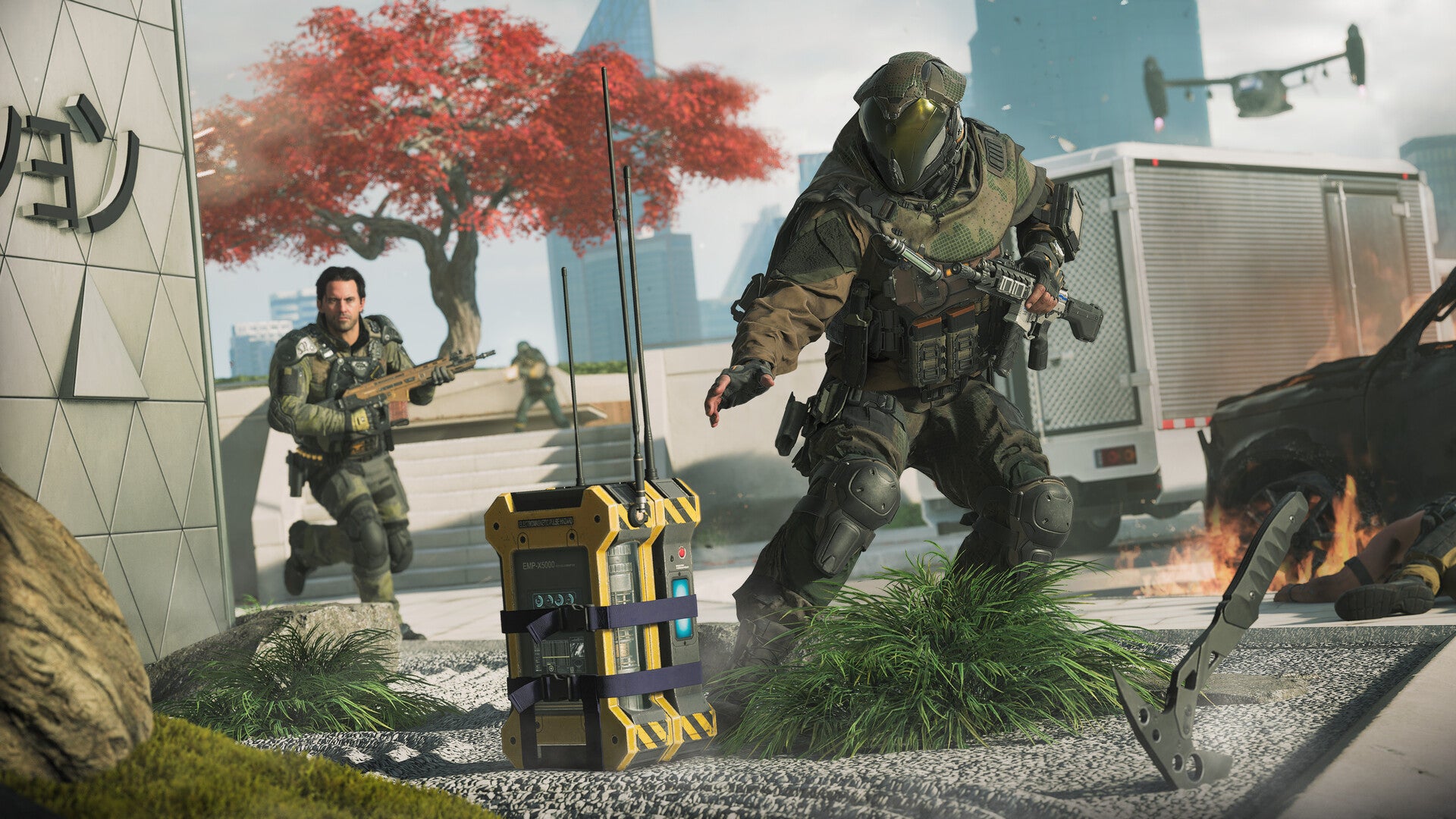
Activision announced it will no longer ship back-to-back releases of Modern Warfare or Black Ops games, following significant underperformance of the latest release in the franchise, Call of Duty: Black Ops 7.
This year, the franchise faced fierce competition from the likes of Battlefield 6 and Arc Raiders. Rhys Elliott at Alinea Analytics said: “For years, Call of Duty was virtually immune to competition, but now the player base is splitting and annoyed, the franchise is creatively drained, and rivals have been more methodical and focused.”
Larian boss sparks huge AI row (December)
.png?width=2048&height=2048&fit=bounds&quality=85&format=jpg&auto=webp)
Finally, comments made about generative AI by Larian Studios head Swen Vincke in a Bloomberg interview sparked an explosion of posts on social media in December. This prompted Vincke to issue a hurried clarification, saying that the Baldur's Gate 3 studio is “not replacing concept artists with AI,” and that it is only using AI at the “very early ideation stages” as a “rough outline for composition.”
The episode came on top of several outbursts of AI outrage throughout 2025, including a row over the use of AI speech in Embark Games' Arc Raiders, which prompted Epic Games' Tim Sweeney to wade into the debate in defence of the technology. See our look back at the games industry's turbulent year in AI for more.