

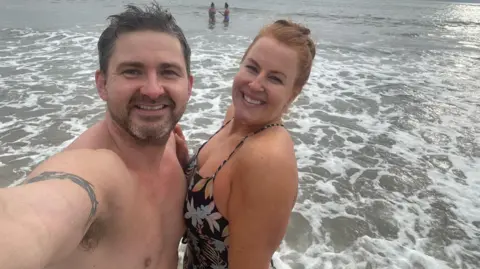
When Dan Richards went swimming on New Year's Eve in 2023, he had no idea how radically his life would change.
In a strange catastrophe he injured his neck when a wave caused him to capsize and hit the sand In Langland Bay, Swansea.
“I knew right away that I was paralyzed,” the 37-year-old said.
“I couldn't move anything.”
Doctors told him he would be bedridden, but two years later he uses a wheelchair and can move his arms and fingers.
He even walked, using artificial intelligence (AI) technology, around Wales and Germany.
Dan and his partner Anna, 40, were celebrating New Year's Eve by swimming in cold water when the accident happened.
“Unfortunately, I remember all this. They pulled me out. And then everything changed,” Dan said.
“I was hit by a wave, it turned me over, threw me back and broke my neck. I knew it was bad.”
 Anna Thomas
Anna remembered hearing Dan screaming for help as she was about to go into the water.
“I just remember looking and seeing Dan's head come up and then go back under the water,” she said.
“We pulled him out. But he was just dead weight, and the sea was approaching very quickly.
“We waited for emergency services and then [I remember] I begged them to let me go by helicopter. It was terrible.”
After the Swansea couple were rushed to hospital in Bristol, they were given life-changing news.

 Anna Thomas
Dan said he was told he was paralyzed from the neck down, would not be able to move and was “very likely” to be bedridden for the rest of his life.
Anna, who had started dating Dan just months before the accident, had to make terrifying phone calls to family members.
“It was New Year's Eve and I was put in a room alone but I could hear people laughing and joking and I had to tell Dan's parents.
“How do you call someone’s mom and tell them their son is paralyzed?”
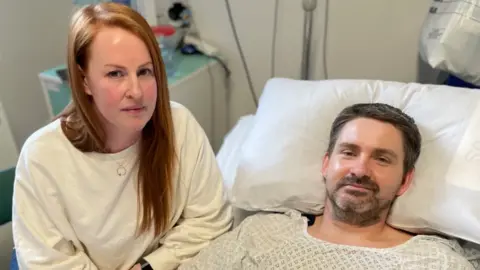
Anna said that every day after the accident brought new challenges.
“This is our reality. Until you're in that situation… you don't realize how much you've lost.”
But in the months after the accident, while Dan was in hospital, even the slightest movement of his toes gave the couple hope that things would change.
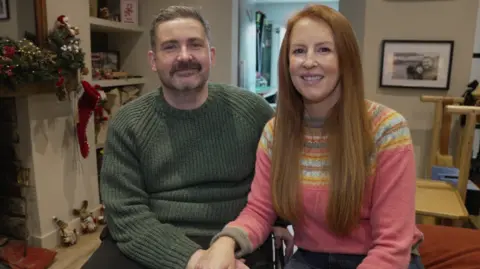
“Luckily, I’m pretty stubborn,” Dan said.
“I just wanted to see physios as soon as possible. I wanted to work. I didn't accept what they said.”
“I'm proud of the progress we've made. It's been a long time since I've been in bed in Bristol, that's for sure.”
He continued: “The sensation in my toes then progressed to full sensation in all my legs and feet, some movement in my right leg. [and] The underlying power that I was told had disappeared began to return. Movements of hands, fingers, ability to hold things.
“I’m still hopeful and still positive. Thanks to modern technology, I don’t give up.”
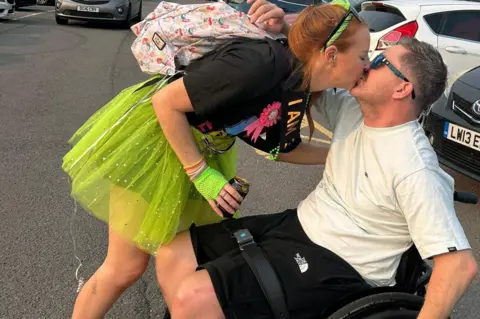
Dan received private physiotherapy at a specialist clinic in South Wales, where a combination treatment was used in a world first to help him walk using a walking machine.
 Anna Thomas
Jakko Brouwers, a neurophysiotherapist at the Morello Clinic in Newport, said Dan was an “extremely motivated guy” when he visited them after being discharged from hospital.
“This technology is twofold,” he explained.
“The first piece we tried with Dan was the robot. The robot will imitate normal human gait as closely as possible.
“The other part of the system we developed is a stimulation suit with sensors. The pants are also equipped with electrodes, and we can stimulate muscle activity at the right time.
“With the help of a small algorithm—dare I say artificial intelligence—it will begin to develop a walking pattern.
“This is very interesting. You don’t see that very often in Wales.”
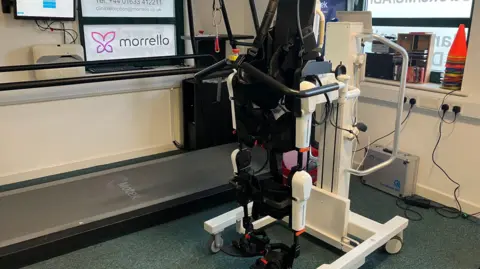
Dan said it was “surreal” but “the best experience ever.”
“It just made me want to work harder. “It’s on our doorstep here in Wales, so that prompted us to do some research and do other things.”
However, private physiotherapy and innovative treatments do not come without costs.
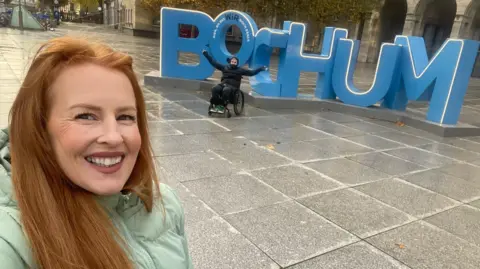
From raffles to ultra-marathons and charity evenings, family and friends have raised funds which means Dan and Anna can travel overseas for the trials in October.
 Anna Thomas
Dan explained that in Germany he tried two different treatments at the same time: stem cell treatment directly in the spinal cord and the use of a hybrid assistive limb (HAL) suit, which is a machine that runs on brain waves.
“This is one of the first times this has been done,” he said.
“The sensors convert the signals into movement, which then makes my legs work, making me walk.
“The more you do this, the stronger the signals become, the faster they become, and eventually you will be able to walk without the suit.”
With six weeks of treatment left in Germany in the new year, Dan will have to apply for an EU medical visa, which he says is another challenge he says he is determined to overcome.
He doesn't know what the future holds for him, but he's determined not to give up.
“Technology is developing so quickly that the situation is no longer the same as it was 10 years ago.
“The new research is incredible. The sky's the limit. I don't want there to be a limit.
“The more progress I can make now, the better our future will be.”



