
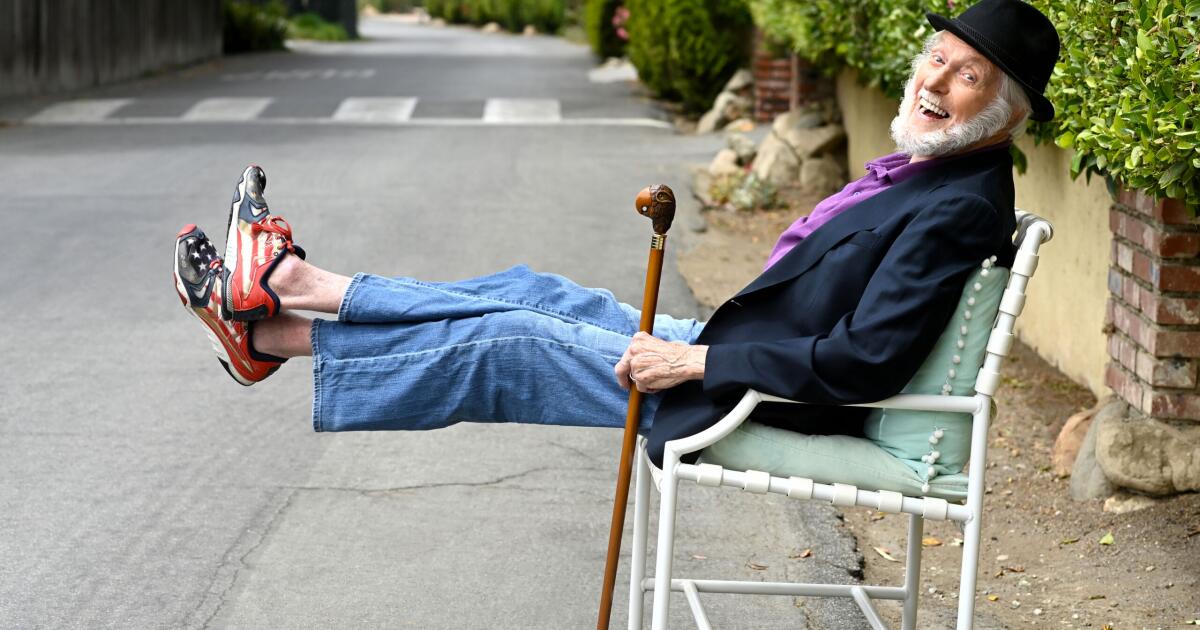
Dick Van Dyke turns 100 on Saturday. This event was so anticipated that it would be cosmically wrong for him not to do so. It might be vain of me to believe that the beauties of The Dick Van Dyke Show and Mary Poppins are known and loved by those who came in their time, but since they are still available for viewing and parents still share them with their children, it seems likely.
Although Van Dyke's professional schedule isn't what it once was (a canceled public appearance in June made headlines, causing a wave of concern across the country), he has remained visible in interviews and social media posts over the past decade, often dancing or playing sports, as well as taking on odd acting jobs. In 2023, he appeared on The Masked Singer as “The Gnome” and guest starred on Days of Our Lives as an amnesiac. (It earned him another Emmy Award.) He celebrated his 99th birthday by appearing in a Coldplay video filmed at his Malibu home. dancing to “All My Love” as Chris Martin sings on the piano. (They went on “Jimmy Kimmel Live!” together.) His latest book, 100 Rules for Living Before 100: An Optimist's Guide to a Happy Life, came out last month, following My Happy Life in and Out of Show Business (2011) and Keep Moving: And Other Tips and Truths About Aging (2015).
The PBS special Starring Dick Van Dyke on American Master airs Friday—and who can deny that he deserves the title? (The unrelated film “Dick Van Dyke's 100th Anniversary” will be shown. exclusively at Regent Theaters on Saturday and Sunday.) Directed by John Scheinfeld (“Reinventing Elvis: The Return of '68.” “USA vs. John Lennon”) is a celebration of an easily celebrated man and entertainer whose signature song is from “Bye Bye, Birdie,” which made him a Broadway star and led to him becoming a movie and TV star: “Put on a Happy Face.” Although the actor's alcoholism is discussed here in a long excerpt from 1974 Interview with Dick Cavett – he's been sober since 1972 – dark times are usually avoided. The end of his first marriage to Margie Willett, the mother of his four children, is expressed only by the words “separation” and the digital erasure of her from the family photograph; It should be said here that Van Dyke has no official connection to this film and is not giving any new interviews here.
Among the performance videos that are the main reason to watch the film are testimonies from famous friends and fans that boil down to this: Van Dyke was a pleasure to know, work with and watch. We hear about Carol Burnett, seen with him in pre-fame clips from “The Harry Moore Show” and together again in his own 1976 variety show “Van Dyke & Company” (brilliantly improvising an unplanned slow-motion fight between a couple of old men). Julie Andrews, his Mary Poppins co-star, doesn't think Van Dyke's controversial Cockney character is all that bad, “and he was so captivatingly interesting and funny and sweet that it didn't even bother.”
Dick Van Dyke in a promotional shot for the Disney musical film Mary Poppins.
(Silver Screen Collection/Getty Images)
Steve Martin awards it a “cuteness quotient of 10,” and Martin Short (inevitably seated next to Martin) recalls writing the word “DVD” in the script, meaning “do Dick Van Dyke.” Ted Danson, another long-legged actor whose comedy series Becker featured Van Dyke in several episodes as his father in a “serious twist,” says that “he did all the human things, but in such an elegant way.” Jim Carrey, known for a certain Van Dyke-like rubberiness, believes that the star's famous trip over the ottoman in the opening credits of his sitcom is “not nonsense, it's a metaphor; if you fall, you have to jump up and laugh at yourself, because you're funny – we're all funny – and life is an obstacle course of unexpected ottomans.”
Conan O'Brien compares him to Gumby and dances with him on his TBS talk show. Larry Matthews, who played son Richie on “The Dick Van Dyke Show,” calls him “cold.” We also have Pat Boone, whose late '50s variety show Van Dyke appeared on; Karen Dotrice, who played little Jane Banks in Poppins; NPR media analyst Eric Deggans providing context; and Victoria Rowell from Van Dyke's 1993 mystery series Diagnosis: Murder, which ran three seasons longer than The Dick Van Dyke Show and is perhaps, in some circles, what he is best known for.
And, of course, there are archival interviews with the late Carl Reiner, who created “The Dick Van Dyke Show” and called its star “the most talented person ever to do situation comedy,” and with Mary Tyler Moore, whose sexual chemistry with Van Dyke as Rob and Laurie Petrie was something new on television in 1961 and has rarely been equaled since. (They may have been the only sitcom couple to dance and sing together.) The series, which ran until 1966 when Reiner and company, not wanting to become stale, took it off the air, became the perfect frame for the star's gifts, an unusually realistic work-family comedy that made room for the physical comedy and reactions of Van Dyke's silent films.
Starring Dick Van Dyke itself does suffer from having to track a 100-year life and a career spanning over eight decades; it's something of an unwieldy mishmash, the course of which, as with many such documentaries, depends on who agrees to say what they want to say, what photographs and films are available (and affordable) and, of course, what interests the filmmakers. Unfortunately, there are no clips from the 1971 sitcom The New Dick Van Dyke Show, which Van Dyke rejects here but I really enjoyed, and surprisingly there is no mention of the 2004 reunion. “Revisiting The Dick Van Dyke Show.” written by Reiner and featuring all surviving actors. (I also have some issues with the weird crop graphics.)
But there's plenty to see (and hear), starting with a snippet of the future star's appearance on local radio in Danville, Illinois, where he began working as a teenager, and footage of him performing in Merry Mutes, the double-talk act that launched his nightclub career in the late 1940s; various unsuccessful stints as a morning show host (with Walter Cronkite), a cartoon show host, and a game show host; and performing “Put on a Happy Face” with Broadway co-star Susan Watson.
Accordingly, the most time is devoted to The Dick Van Dyke Show and Mary Poppins (along with “Mary Poppins Returns” in which Van Dyke, as the aging son of the aging banker he secretly played in the first film, danced on a table – at 93 years old. The photos from the productions and rehearsals are amazing – and a treat to fans of Moore and Andrews – everyone looking young and beautiful. He portrays himself as “lazy” and “lucky”, not goal-oriented (except to earn a living for his family), “not an actor”. But the world decided for itself.
With the exception of 1968's Chitty Chitty Bang Bang, a sort of re-cut of Poppins that itself has considerable coherence, and the Reiner-written and directed The Comic, a 1969 drama about a silent comedian reckoning with talkies, his post-Poppins theatrical films are reduced to a single description and a collage – not even a montage – of posters. More attention is paid to the 1974 TV movie The Morning After, in which Van Dyke played an alcoholic businessman; It was around then that he publicly spoke about his problem with alcohol.
Toward the end, the documentary sometimes plays like an infomercial, with stories about the charities Van Dyke supports. But Van Dyke's two hours of performances can't help but be interesting. All you have to do is install the clamps and get out of the way. A man desperately searching for a handkerchief and trying to stifle a sneeze, the world's oldest magician making a comeback—these are hilarious moments that require no context.
Inevitably, it is also a story of time, given the century of photographs and films marking each stage of life. His long arms, long legs and overall length are not what they used to be. But the elongated (not to say sad) face is as recognizable and expressive as before.



