

Georgina RannardClimate and Science Correspondent
 Natural History Museum/University of Gothenburg
Machines mining for minerals in the deep ocean have been found to be causing significant damage to life on the seafloor, say scientists conducting the largest study of its kind.
They found that the number of animals found in vehicle tracks was reduced by 37% compared to undisturbed areas.
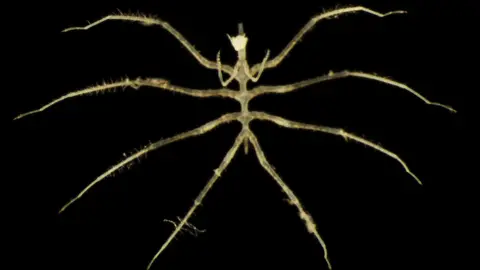
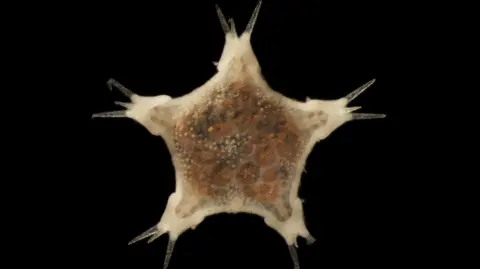
Researchers discovered more than 4,000 animals, 90% of which were new species, living on the seabed in a remote area of the Pacific Ocean.
Vast quantities of critical minerals needed for green technologies may be locked up in the depths of the ocean, but deep sea mining in international waters is highly controversial and is currently not permitted until more is known about the environmental impacts.

 Natural History Museum/University of Gothenburg
The study by scientists from the Natural History Museum in London, the UK's National Oceanographic Center and the University of Gothenburg was commissioned by deep-sea mining company The Metals Company.
The scientists said their work was independent and that the company had the opportunity to review the results before publication but did not have the right to change them.
The team compared biodiversity two years before and two months after a mining trial in which vehicles drove 80 km along the seabed.
They specifically studied animals ranging in size from 0.3 to 2 cm, such as worms, sea spiders, snails and mollusks.
In car tracks, the number of animals decreased by 37%, and species diversity by 32%.
“The machine removes about five centimeters of sediment. This is where most of the animals live. So obviously if you remove sediment, you remove the animals in it,” lead author Eve Stewart, a PhD student at the Natural History Museum and the University of Southampton, told BBC News.
 Natural History Museum/University of Gothenburg
“Even if they don't get killed by machinery, pollution from mining could slowly kill off some less resilient species,” said Dr. Guadalupe Bribiesca-Contreras of the National Oceanographic Center.
Some animals may have left, but “whether they will come back after being disturbed is another matter,” she added.
However, in areas near vehicle tracks where sediment clouds landed, the number of animals did not decrease.
“We expected maybe a little more impact, but [we didn't] We're seeing a lot of things, just a shift in species being dominant over others,” Dr Adrian Glover, a research fellow at the Natural History Museum, told BBC News.
 Natural History Museum/University of Gothenburg
“We are encouraged by these data,” a spokesman for The Metals Company told BBC News.
“After years of concern among activists that our impacts would spread thousands of kilometers beyond the mining site, the data shows that any impacts on biodiversity are limited to the immediate area mined,” they added.
However, some experts don't think this is good news for mining companies.
“I think the research shows that current mining technologies are too destructive to support large-scale commercial exploration,” Dr Patrick Schroeder, senior fellow at the Center for Environment and Society at think tank Chatham House, told BBC News.
“These were just tests and the impact was significant. If they did this on a large scale, it would be even more destructive,” he added.
Deep sea mining is controversial. At the heart of the debate is a difficult issue.
The latest research was carried out in the Clarion-Clipperton zone, an area of the Pacific Ocean with an area of 6 million square meters. km, estimated to contain more than 21 billion tons of polymetallic nodules rich in nickel, cobalt and copper.
The world needs these critical minerals for renewable energy technologies and the fight against climate change. For example, they are important components of solar panels, wind turbines and electric vehicles.
The International Energy Agency predicts that Demand for minerals could at least double by 2040.
Minerals have to come from somewhere, but some scientists and environmental groups are deeply concerned that deep sea mining could cause untold damage.
 Natural History Museum/University of Gothenburg
Some fear that before we have a chance to explore the full nature of life in the uncharted depths of the ocean, it may be under threat.
The oceans play a critical role in regulating our planet and are already at serious risk from rising temperatures.
The International Seabed Authority (ISA), which regulates activities in international waters, has yet to approve commercial mining, although it has issued 31 exploration licenses.
A total of 37 countries, including the UK and France, support a temporary ban on mining.
Norway this week shelved plans for mining in its waters, including the Arctic.
But in April, US President Donald Trump called for domestic and international projects to be accelerated as the US seeks to secure supplies of minerals for use in weapons.
If the ISA concludes that current mining methods are too destructive, companies could try to develop less intrusive ways to extract nodules from the seafloor.
The study was published in the scientific journal Nature Ecology and Evolution.



