

The Qualcomm Snapdragon X2 Plus processor has the same goal as its predecessor: to provide a slightly stripped-down, more compact processor alternative for mid-range Windows on Arm laptops.
But there is a slight difference. While last year's X Plus chip came in 10-core and 8-core variants, Qualcomm is instead offering customers either a 10-core or 6-core Snapdragon X2 Plus chip. Qualcomm is eyeing Intel Core Ultra 200 series chips and also AMD Ryzen AI 300 series as potential targets.
The Qualcomm Plus series of processors essentially fills the same role as the Core i5: Qualcomm uses the same CPU architecture, plus the same GPU (adjusted for power, which reduces speed) and the same NPU. But Qualcomm is much more aggressive in terms of performance comparisons.
At the CES 2026 press conference, Qualcomm invited representatives from Acer, Asus, HP, Lenovo, Microsoft and Samsung on stage to support the launch. I've also seen several laptops based on Snapdragon X2 Elitethe basis for the X2 Plus, which Qualcomm released last fall: the Asus VivoBook S16, ZenBook A14 and A16, as well as the HP Omnibook Ultra and EliteBook X, and the Asus all-in-one PC.
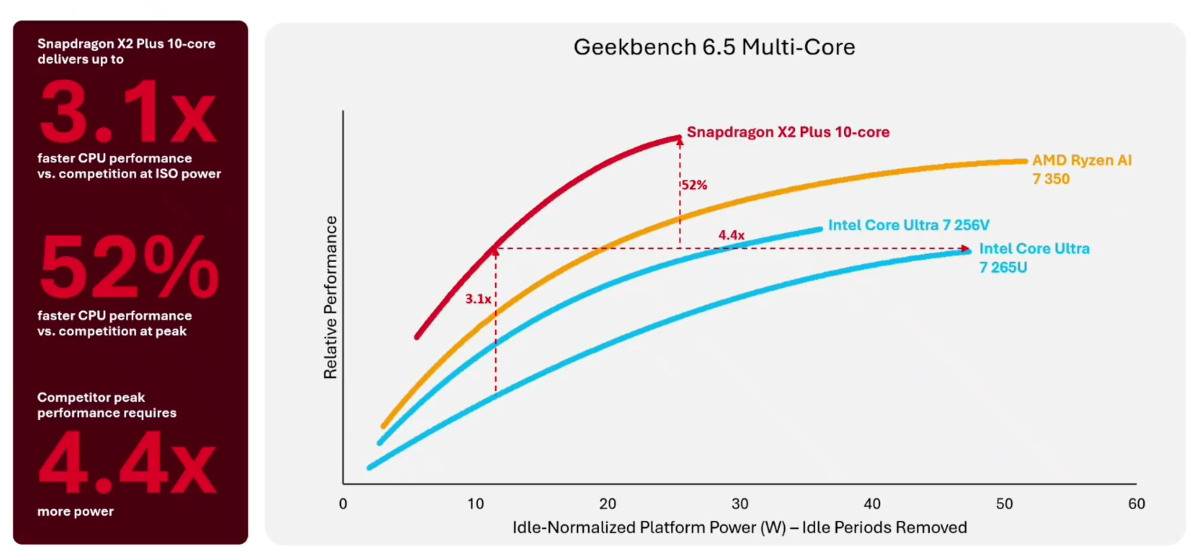
Eighteen months ago, Qualcomm claimed that its X Plus chip delivers 28 percent faster performance at the same power. This time, the company claims that the best 10-core chip in the X2 Plus family delivers faster performance three times Competitor performance: Core Ultra 7 265U.
Qualcomm's first-generation Plus processors have appeared in the Acer Swift 14 AI, Dell Inspiron 14 Plus, and Dell Latitude 7455, among others. The company will reveal more to customers here at CES in Las Vegas. Executives said they expect the X2 Plus to come in the same price range as the X Plus, or devices priced around $799.
Essentially, the mission of the X2 Plus is the same as Qualcomm's first generation: “to really deliver the same technology benefits to more and more users,” said Mandar Deshpande, senior director of product management for Qualcomm's computing business, at a press briefing.
How fast is Snapdragon X2 Plus?
Officially, the two Snapdragon X2 Plus chips are known as the 10-core X2P-64-100 and 6-core X2P-42-100, reflecting Qualcomm's impenetrable naming scheme. Typically you'll see both chips called the 10-core X2 Plus and 6-core X2 Plus.
The 10-core X2 Plus will run at up to 4.0 GHz with an X2-45 GPU, the speed of which Qualcomm has not revealed. The 6-core X2 Plus also runs at the same clock speed and features the same GPU. Both chips also include identical NPUs with 80 TOPS performance.
Why six cores? Deshpande brushed off the question. “Essentially, we are not tied to the number of cores, frequencies or [power]”, he said.
Qualcomm's current list of processors doesn't reflect the new additions, but you can see how they'll fit in: likely slightly below the old Snapdragon X Elite and with similar specs to the first-gen Snapdragon X Plus chips, at least on paper. These chips also included two additional processors with some changes in clock speed; Deshpande declined to comment on whether Qualcomm will do the same with the X2 Plus. We also don't know the clock speed of the GPUs.
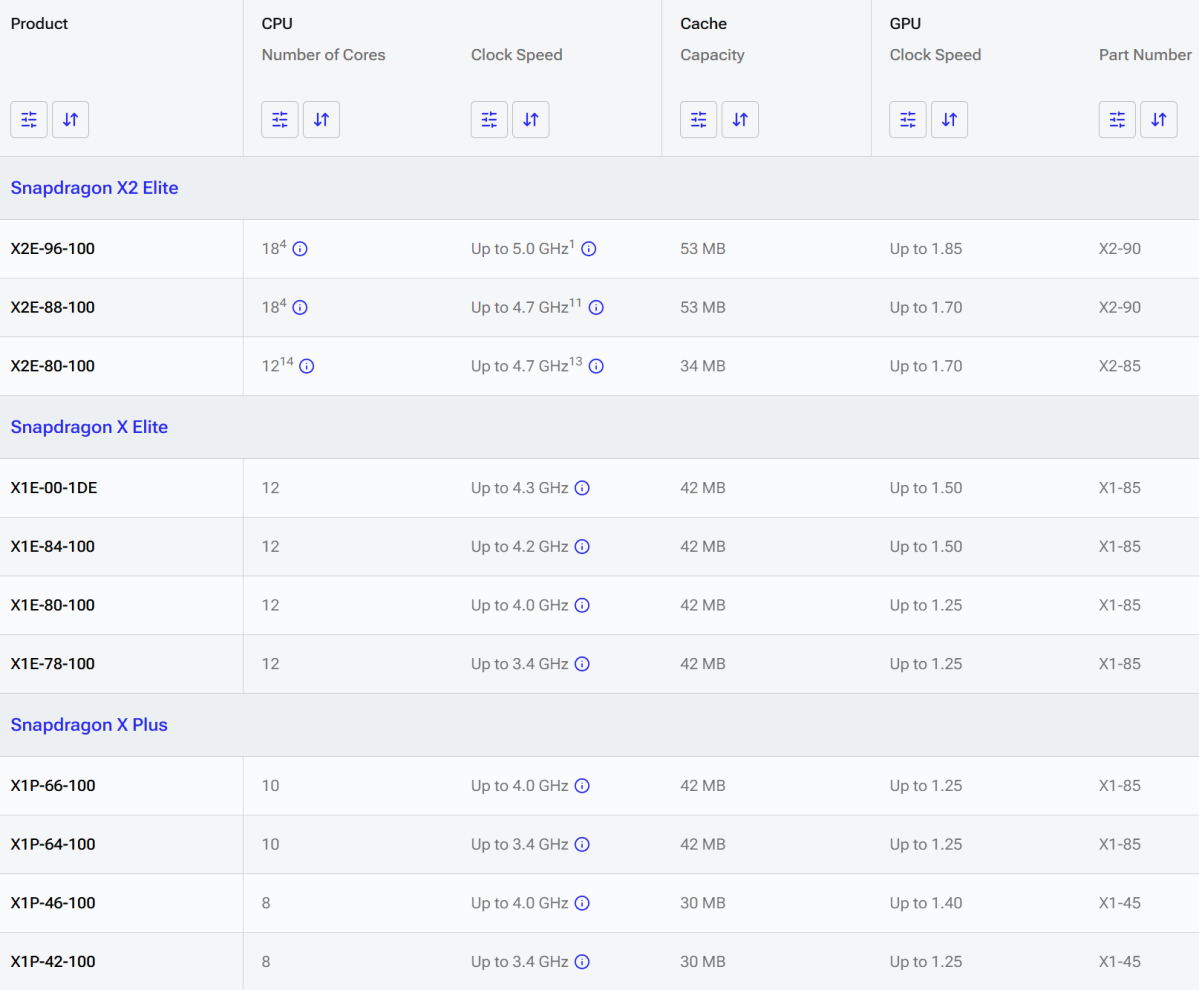
Although the Snapdragon X2 Plus and Snapdragon X1 Plus look similar on paper, the numbers can be deceiving. Like the Snapdragon X2 Elite, the X2 Plus is powered by updated third-generation Oryon processor cores that improve performance.
While the Snapdragon X Elite included a pair of cores that could run at higher “turbo speeds” to complete high-priority tasks faster, the X Plus didn't, and neither did the X2 Plus. On the other hand, the base clock speed of the X2 Plus is as high as the turbo speed of the X1 Plus, a Qualcomm spokesperson noted.
One of the key improvements to Qualcomm's Snapdragon X2 Elite is the inclusion of “performance” and “premium” cores, also tuned for high-performance performance. The X2 Plus has these. The ten-core X2 Plus has six main cores and four performance cores, while the six-core X2 Plus includes six main cores, the spokesperson added.
However, compared to the X1 Plus and X2 Plus, performance improves significantly, with single-threaded CPU performance up to 35 percent faster and GPU performance up to 39 percent faster, while consuming 43 percent less power. (Qualcomm used Geekbench and Steel Nomad 3DMark tests for comparison.)
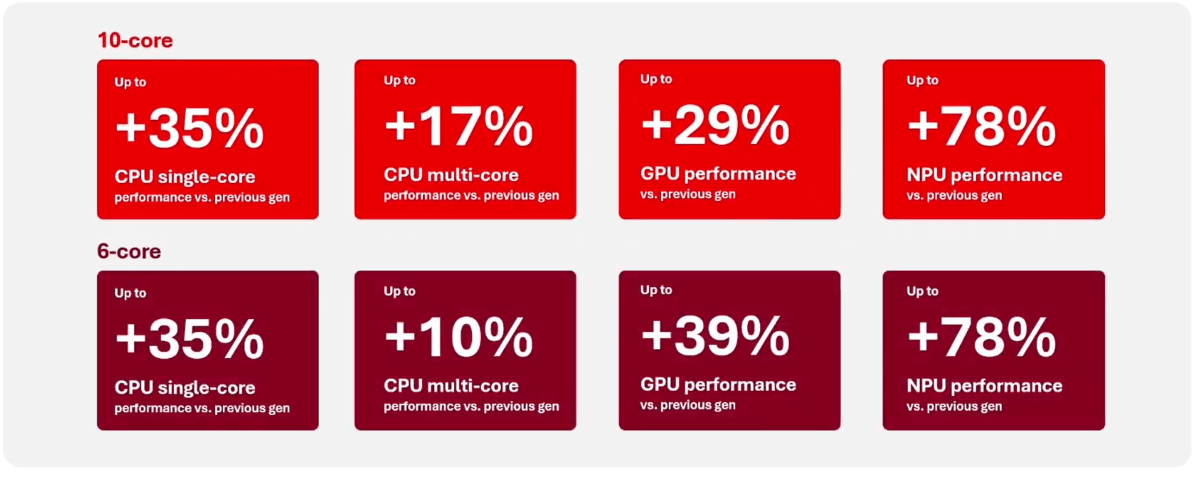
Qualcomm predicts significant advantages over other competing mobile processor platforms, which it classifies as Intel's 7th-class Core Ultra 200 processors, as well as AMD's Ryzen AI 7 350. Like the Snapdragon X2 Elite, the X2 Plus chips run at full speed on battery power as well as when the laptop is plugged in, which is a key differentiator from the competition.
Naturally, Qualcomm compares itself to the existing “Lunar Lake” and “Strix Point” platforms from Intel and AMD; Intel has already announced its next-generation Panther Lake mobile platform, while AMD is expected to unveil its Gorgon Point mobile platform at CES. However, none of these chips have been shipped, so Qualcomm can't test them.
Qualcomm didn't provide any battery life estimates for the Snapdragon Plus laptops; The company said it is still working with customers to optimize these products.
The big question remains the usefulness of NPUs and how receptive application partners and customers are to using local AI on PCs. Since the X2 Plus includes the same 80 TOPS NPU as the X2 Elite, it will allow you to run more NPU functions from Microsoft Windows, Da Vinci Resolve and other applications simultaneously, much in the same way that a powerful CPU or GPU allows you to run multiple applications simultaneously.
The chip's memory bandwidth also reaches 152 Gbit/s, which provides sufficient headroom for LLM. If and when the future of NPU-based AI arrives, Qualcomm will be ready for it.
On the gaming front, Deshpande said the company has tested 1,400 games on the Snapdragon platform and that they run “really well” – that is, at 60Hz and 1080p resolution.
In mid-December, Microsoft published an update to its Prism emulator that provides some additional support. While Qualcomm encourages its partners to write native Arm code that can improve performance, the updated Prism emulator will simply allow a wider range of applications to run on Windows on Arm without specifying which ones.
Qualcomm is exploring other areas as well.
“Now that we're working closely with OEMs, we're really innovating in the form factor, right?” – said Deshpande. “So we're trying to make PCs thinner and lighter. We're looking at devices for panelists. We're looking at desktops that can be made more portable. So, all of these innovations in form factors are very exciting, and you should expect these types of devices to hit the market very soon.”
Updated at 10:11 a.m. PT with additional information.



