Ahmet Alrahmo sat awake in his apartment in Waterloo, Ont., eyes fixed on the news coming out of Syria, the country he once called home.
It was December 2024, just hours after the fall of Bashar al-Assad’s regime. Alrahmo watched as the gates of the notorious Sednaya Prison in Damascus were forced open by opposition forces after more than a decade of civil war. Freed prisoners stumbled into the daylight. Families descended on the country’s jails in a desperate search for their missing loved ones. Mass graves were unearthed across the country.
Every new image brought hope that somewhere in those crowds he would see the unmistakable dimples that marked the smiling face of his eldest son, Omar Alrahmo.
Omar was 22 years old when he vanished in 2013 in Aleppo, minutes after he told his fiancée by phone that he thought someone was following him.
For the families of Omar and tens of thousands of others who were arbitrarily arrested or forcibly disappeared under the Assad regime, the unknown fate of their loved ones remains an open wound. They have lived with the unbearable uncertainty of a disappearance with no trace, no body and no end.
A global reporting project has obtained leaked photos of more than 10,200 bodies of those disappeared by the Assad regime between 2015 and 2024.
The chilling images taken by Syrian military photographers are included in more than 134,000 Syrian security and intelligence records obtained by German broadcaster Norddeutscher Rundfunk (NDR) and shared with the International Consortium of Investigative Journalists (ICIJ) and 24 media partners in 20 countries, including the Star. The files originate from Syria’s Air Force Intelligence and the General Intelligence Directorate. They comprise intelligence reports, death certificates and records of arrests written in Arabic.
The Damascus Dossier investigation offers an unflinching depiction inside the Assad killing machine.
Some photographs show corpses, nearly all men, stacked like firewood, stick-thin arms and legs askew, ribs, collarbones and shoulders jutting from emaciated skin. Tortured bodies ready for disposal.
Until now, the Syrian public did not know about the photos’ existence.
Assad regime estimated to have disappeared more than 160,000
Assad, now reportedly living under asylum in Russia, reigned over Syria during the bloody civil war. Under his rule, authorities moved to extinguish all signs of dissent within the country, abducting people they deemed political opponents and, in many thousands of cases, killing them in prison.
The Syrian Network for Human Rights, a non-governmental organization that tracks Syrian war casualties, estimates that the Assad regime disappeared more than 160,000 people, although the actual number could be far higher.
When the regime fell in December 2024, families could finally search through prisons and hospital morgues for their loved ones. Many found nothing. For some, the Damascus Dossier finally tells the story of what happened to those people.
The Damascus Dossier leaked filed include chilling photographs documenting the deaths of more than 10,200 Syrian prisoners.
Obtained by Norddeutscher Rundfunk
ICIJ and NDR interviewed seven families whose loved ones’ deaths are verified in the records. In some cases, these records were the first evidence the families received that their relatives had died. NDR shared the victims’ names that appear in the Damascus Dossier with four non-governmental organizations and intergovernmental organizations, in the hopes that they may help other families learn what happened to their loved ones.
The Star interviewed several families in Canada whose loved ones vanished or were tortured by the Assad regime. Their accounts cannot be independently verified, but the pieces of memory they’ve clung to in the years since — the last words, the small facial characteristics, the moments leading up to the disappearance and the relentless search that followed — are what fill in the blanks of the intelligence records and speak to the weight of what’s been lost.
In this void of information after the disappearance, Ahmet maintains belief his son could still be alive.
But “if he’s dead, I just want to know where he’s buried and how he died so I can move forward,” he said.
“Sometimes I wish for death just so I can stop thinking about him.”
‘They are not just numbers’
When the prison doors finally opened last year and there was still no news of his son, Ahmet turned to FindSuri.org for answers. Loved ones of more than 3,500 missing Syrians have recorded their data on the Canadian website in hopes of finding some information. Ahmet registered details such as Omar’s photograph, date of birth and the date he was last seen.
The Assad regime’s collapse catalyzed “a huge psychological and emotional earthquake” for the families of those killed or detained, said Habib Nassar, a senior human rights officer with the United Nations’ Independent Institution on Missing Persons in the Syrian Arab Republic.
The opening of the prisons, he said, was “also the moment when tens of thousands of families realized that their loved ones might not come back ever.”

Dima Aldera is the founder of FindSuri, an online platform to help families search for loved ones who went missing during the Syrian war. The website is run by volunteers and supported by the Kindred Credit Union Centre for Peace Advancement at the University of Waterloo.
Peter Power for the Toronto Star
FindSuri’s founder, Dima Aldera, was able to connect ICIJ journalists with the family of one of the victims whose deaths are verified in the Damascus Dossier records. The record — a single sheet of white paper that formed a death certificate dated Aug. 14, 2012 — was the first evidence his family received that he had died 13 years prior, and only 10 days after he had been forcibly taken from his home by Assad’s security forces.
Aldera was driven by her own experience to create a safe online space for families with missing loved ones in 2022.
Her birth in Hama city in 1982 coincided with a massacre that left 40,000 people killed and disabled. Many in her own family vanished, she said. Her extended family was scared to speak openly of those who had gone missing. She remembers the constant burden of waiting in her grandmother’s house for an answer about a missing husband, about a son or about a father.
When she came to Canada in 2018, Aldera found people desperately looking for information about their missing loved ones on Facebook, offering their full names and phone numbers, leaving them ripe for exploitation.

Family members search for clues of missing loved ones in the infamous Sednaya Prison in Damascus following the fall of the Assad regime.
Espen Rasmussen / Verdens Gang
Human rights organizations have long documented how enforced disappearances by the Syrian government gave rise to a black market in which “middlemen” or “brokers” were paid bribes ranging from hundreds to tens of thousands of dollars, by family members desperate to find out the whereabouts of their loved ones or whether they are even still alive.
FindSuri, which is run by volunteers, allows people to share information securely and keeps the family members’ personal data private, Aldera said.
Aldera is seeking funding from Ottawa to build the platform to support families grasping blindly in the silence created by Assad’s authoritarian regime, which systematically tried to conceal from the outside world its torture and murder of Syrian citizens.
The database also serves as a centre that keeps alive the memories of those still missing.
“They are not just numbers. They are people,” she said.
Assad’s archive of death
Each image in the Damascus Dossier was carefully catalogued by Assad officials to include the inmate’s number, the first name of the photographer, the date the photo was taken and, in many cases, the security branch that arrested the prisoner.
In one image, a man lies on a metal surface. He is photographed at multiple angles: up close, his chipped, yellow teeth glowing; from the side, his cloudy eyes like frosted glass. He is labelled No. 3659.
Another man, No. 4038, is strewn in the back of a van, his naked, shrivelled body speckled in blood. Flies feed on him.
Up to 177 photos were taken in a single day.
The images were sent to military courts, where a judge would sign off on the death, essentially granting members of the Assad regime judicial immunity for their crimes, according to a former military officer. The officer served as the head of the Evidence Preservation Unit of the military police in Damascus between 2020 and 2024. He provided the images to a source who then shared them with NDR.
“There are things people need to know,” he said in an interview with NDR. “There are people whose families need to know where they are and what happened to them.”
The dossier photographs are a harrowing sequel to a cache of images depicting prisoners killed between 2011 and 2013, which were smuggled out of Syria more than a decade ago by a military defector code-named Caesar. The Caesar photos, as they became known, set off a series of international prosecutions and sanctions against the Syrian government. They served as evidence in the first-ever torture trial against the Assad regime, in Germany, in 2020.
Despite all the evidence, Assad’s government denied the validity of the Caesar photos.
The new trove of images shows the severity and magnitude at which Syrian authorities continued the killings for 11 more years, as well as the macabre process of photographing and categorizing the prisoners’ bodies.
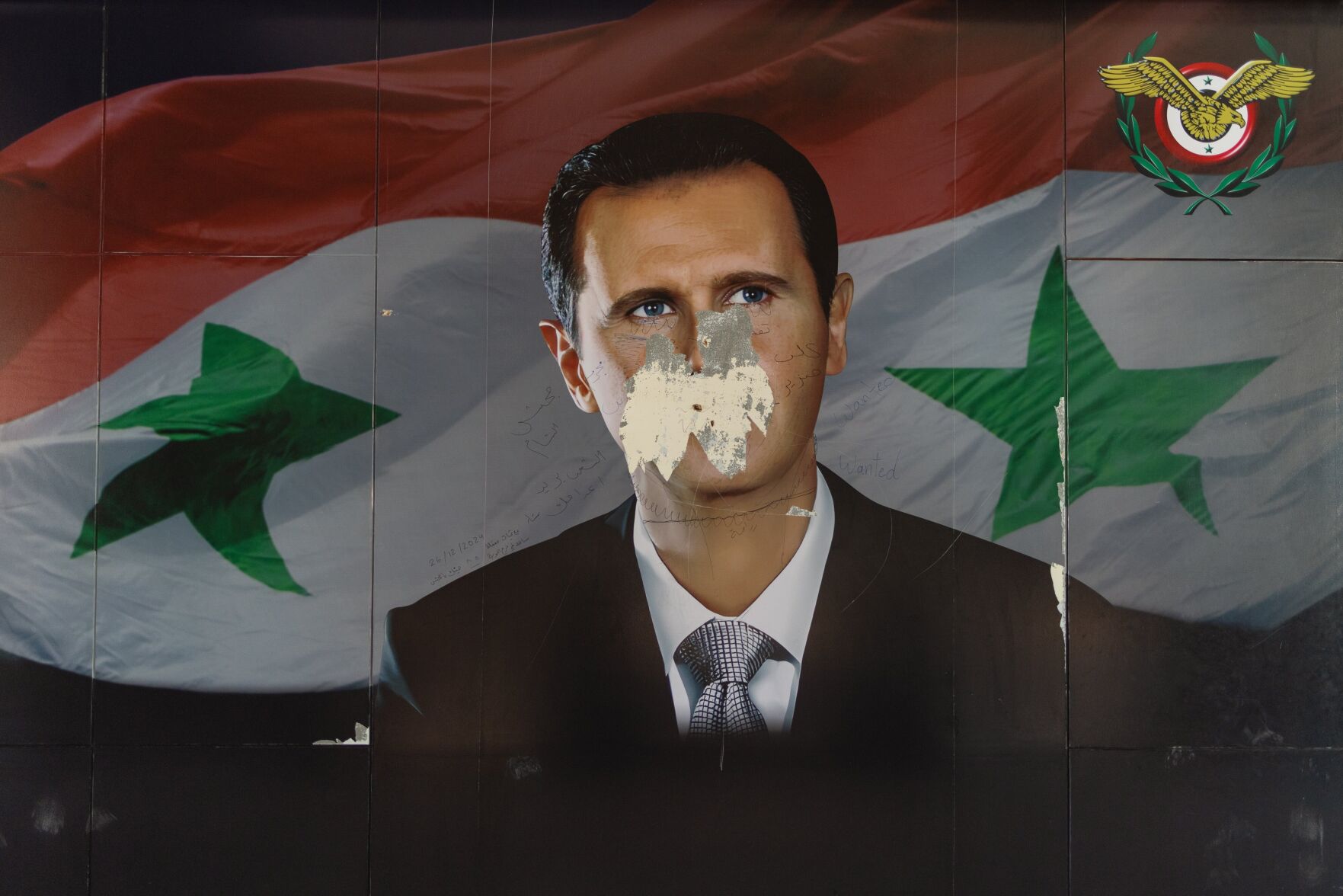
A defaced mural of the deposed Syrian leader Bashar al-Assad.
Kyrre Lien / Verdens Gang
The findings are consistent with what global rights groups including Human Rights Watch and Amnesty International have documented through their own investigations and reporting.
Detainees who died in Damascus prisons were routinely sent to nearby military hospitals, according to a UN investigation, where doctors issued medical reports declaring they died of “cardiorespiratory arrest.”
But the bodies didn’t stay there. Security forces spent years moving thousands of bodies from a mass grave in a Damascus suburb to a secret desert location to prevent their discovery, according to a Reuters report.
Prominent dissident among identified bodies
Though Assad officials mostly reduced the detainees to numbers, some of them are named in the photos. ICIJ and NDR were able to extract roughly 320 names.
Among the prisoners reporters were able to identify was Mazen al-Hamada, considered by many to be an icon of the revolution. Hamada had been detained and tortured following the 2011 uprising, but was released in 2013 and became a refugee in the Netherlands.
“Hamada was one of these young revolutionary guys who decided that their release was not the end of the story,” said Toronto-based activist Noura Aljizawi.
He wanted “to keep telling the story and keep advocating for justice and keep advocating for the release of all political detainees he left behind.”
Aljizawi knows first hand the terror experienced inside the Syrian jails. She spent 85 days inside one after being pulled from the streets of Aleppo at gunpoint in 2012. At the jail, she says the guards went through her phone. By impersonating her, they lured another activist to come visit her and imprisoned him.
Then they tortured him. They forced her to watch as they hanged him from his arms, hit him with electric prods and sexually abused him, she said.
After her release, Aljizawi fled to Turkey and in 2017, she arrived in Canada as a scholar-at-risk at the University of Toronto.
She and Hamada communicated on advocacy issues online.
Early in 2020, Hamada is believed to have been lured back to Syria, where he disappeared.
Family in Canada searches for missing son
The day Omar Alrahmo vanished, he was getting ready to fly to Japan, where he worked as a mechanic for a Syrian company, his father said. At a meeting point in Aleppo with a colleague, Omar stepped away to buy a falafel sandwich before the journey. Minutes later, he called his fiancée to say he felt as though someone was following him.
He hung up, his father said, and has not been heard from since.

A collection of family photos of Omar Alrahmo.
Peter Power for the Toronto Star
Over the months that followed, Ahmet went door to door across different intelligence branches, chasing rumours, names of officers and scraps of second hand information on the whereabouts of his son. One officer told him his son had been taken to Sednaya prison, another insisted he wasn’t there. The Red Cross file he opened in Canada has never produced a lead.
After Assad was deposed, Syria’s new rulers briefly allowed citizens to photograph documents in the former regime’s security branches but forbade anyone from removing the original documents.
As they consolidated power, the new regime closed access to the old archives. By shutting down access, the government has concealed records that name not only the victims but also the men culpable in their deaths.
And while they have launched a commission to uncover the fates of the disappeared, families like the Alrahmos have been left with no sense of when they might receive the most basic information.
Ahmet Alrahmo, who came to Canada as a refugee in 2016, is forced to continue to wait for answers.
Omar Alrahmo would have been 35 this year.
His father clings to the memory of his final words to his son: “Take care of yourself, may God be with you.”
—with files from Nicole Sadek, David Kenner, Karrie Kehoe, Denise Ajiri, Agustin Armendariz, Kathleen Cahill, Jelena Cosic, Jesús Escudero, Whitney Joiner, Delphine Reuter, Angie Wu, David Rowell, Fergus Shiel, Annys Shin, Antonio Cucho Gamboa (ICIJ), Benedikt Heubl, Volkmar Kabisch, Antonius Kempmann, Amir Musawy, Sebastian Pittelkow, Benedikt Strunz, Sulaiman Tadmory (NDR), Mohammed Komani (ARIJ), Hannah el-Hitami, Lena Kampf, Lea Weinmann (Süddeutsche Zeitung)