Lisa LambertAnd
Kwasi Asiedu
A US federal judge has issued a new order blocking immigration officials from detaining Kilmar Abrego Garcia again, a day after ordering his release.
Lawyers for Mr. Abrego Garcia, an immigrant who was mistakenly deported to El Salvador and returned to the United States, asked a judge not to allow him to be re-incarcerated. They said he feared he would be detained during a routine check on Friday morning.
Judge Paula Xinis in Maryland wrote that re-detaining Mr. Abrego Garcia would cause “irreparable harm” in her quickly issued ruling.
Speaking ahead of the planned registration, Mr. Abrego Garcia described himself as a “free man” who would “continue to fight” what he said was injustice.
An immigration judge on Thursday evening issued the removal order, prompting Mr. Abrego Garcia's lawyers to in turn ask Judge Xinis to issue a temporary restraining order blocking his detention.
“If, as Abrego Garcia suspects, defendants take him into custody this morning, his freedom will again be restricted,” Judge Xinis wrote in granting the request. “There is no doubt that unlawful detention causes irreparable harm.”
Mr. Abrego Garcia, who is married to a U.S. citizen and has lived in Maryland for many years, came to the U.S. illegally from El Salvador when he was a teenager. In March, he was mistakenly deported back to El Salvador and returned to the United States to face criminal charges.
Judge Zinis ruled on Thursday that The government did not have a deportation order against Mr. Abrego García, preventing it from deporting him “at this stage.” He was released from immigration custody and ordered to register with immigration officials on Friday morning.
But Thursday's ruling may not be the last word, as the Justice Department is expected to appeal her ruling and also prosecute Mr. Abrego on separate criminal charges of human trafficking in Tennessee.
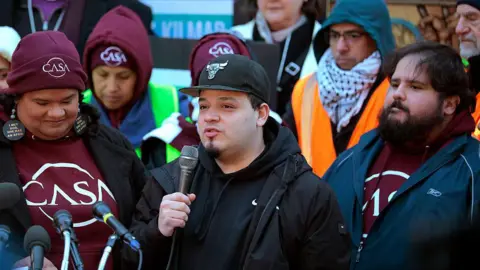
Outside a Baltimore immigration office Friday, Mr. Abrego spoke with reporters and supporters.
“I stand before you as a free man and I want you to remember me as such, with my head held high,” he said through an interpreter. “I will continue to fight and stand firm against all the injustices that the government has done to me.”
He added that he believes that “this is a country of laws, and I believe that this injustice will come to an end.”
 Getty Images
Late Thursday, Mr. Abrego Garcia was officially released from Immigration and Customs Enforcement (ICE) custody, his lawyer Simon Sandoval-Moshenberg told CBS News, the BBC's US partner.
“We remain hopeful that this will be a turning point for Mr. Abrego Garcia, who has been through more than anyone has ever had to,” Mr. Sandoval-Moshenberg said.
Mr. Abrego Garcia returned to his home in Maryland but was then told to report to the ICE field office in Baltimore at 0800 Eastern Time (1300 GMT) on Friday.
In her ruling on Thursday, Judge Xinis said Mr Abrego Garcia could not be deported from the country.
“Because Defendants do not have the legal authority to remove Abrego Garcia to a third country in the absence of a removal order, his removal cannot be considered reasonably foreseeable, inevitable, or consistent with due process of law,” Judge Zinis wrote.
A Department of Homeland Security spokeswoman criticized the decision, calling it “naked judicial activism by an Obama-appointed judge,” referring to former President Barack Obama.
“This order lacks any valid legal basis and we will continue to fight this tooth and nail in the courts,” Trisha McLaughlin wrote on X.
The case became a key moment in the Trump administration's crackdown on immigration after Abrego Garcia was deported to El Salvador in March despite a 2019 court order barring his deportation.
The administration claims that Mr. Abrego Garcia was a member of the MS-13 criminal organization, but he denies this.
In 2019, he was arrested along with three other men in Maryland and detained by federal immigration authorities.
A judge then granted him protection from deportation on the grounds that he might face gang persecution in his home country.
But the Trump administration deported him to El Salvador in March, prompting a U.S. Supreme Court ruling in April requiring the government to bring him back.
In June, he was returned to the United States, where he was arrested and taken to Tennessee, where he was charged with human smuggling. He pleaded not guilty.
Mr. Abrego Garcia was then released from prison in Tennessee, but was taken back into custody after being summoned to a mandatory immigration meeting in Baltimore.
At that point, Judge Xinis temporarily blocked the government from deporting him to a third country while she heard his complaint about his detention.
In her ruling on Thursday, Judge Xinis said the government had said it was considering deporting him to Uganda, Eswatini, Ghana and then Liberia.
Costa Rica offered to take Mr. Abrego Garcia, but the government did not accept its offer, the judge said.
In a 31-page ruling, the judge wrote that immigration detention cannot be used as punishment or continue indefinitely.
She said the first three African countries were never “viable options” while Costa Rica “never wavered in its commitment to accept Abrego Garcia, just as Abrego Garcia never wavered in its commitment to resettle there.”
“Whatever the purpose behind his detention, it did not serve the ‘primary purpose’ of timely removal from a third country,” she wrote.