

Bernd Debusmann Jr.in Doral, Florida
 Getty Images
For years, Florida resident Rosana Mateos had a recurring dream about the fall of Nicolas Maduro in Venezuela.
“I always dreamed of finding out about this early in the morning,” said the Venezuelan expat, who has been in the United States since 2012. “We always figured that if something was going to happen, it would happen somewhere around this time.”
Before dawn on Saturday, US special forces entered Maduro's territory and took him and his wife away.
“My phone was off and I was asleep,” Ms. Mateos recalled. “But then my husband woke me up and said they had caught Maduro. I couldn't believe it.”
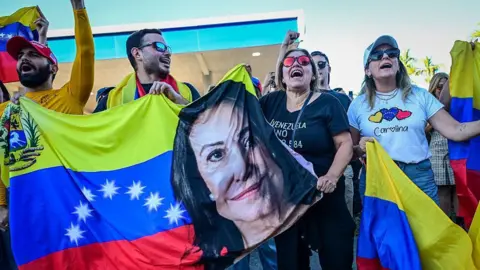
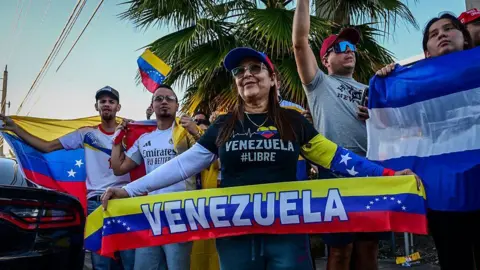
Hours later, she was one of hundreds of Venezuelan expats and Venezuelan-Americans who gathered in the Miami suburb of Doral – the center of South Florida's Venezuelan community – to celebrate.
More than 40% of Doral residents are of Venezuelan ancestry, the largest concentration in the United States. Many fled economic problems and insecurity in their country after Maduro took office in 2013, while others fled the rule of his predecessor Hugo Chavez.
A significant number are vehemently opposed to Maduro—and it showed on the streets of Doral.
Even before sunrise Saturday, many gathered at El Arepaso, a Venezuelan restaurant and community center in the area. By midday the crowd had swelled to hundreds of people, playing music and chanting as motorists honked and waved flags on nearby roads.
Many have expressed relief that Maduro, whom they blame for Venezuela's economic and political woes, is no longer in power.
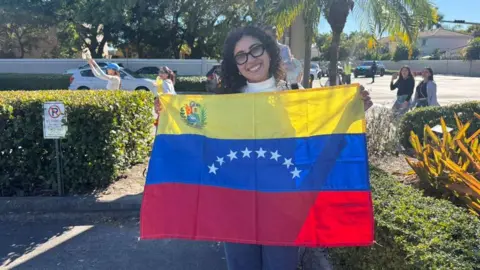
Among them was Brian Marquez, a native of the agriculturally rich Venezuelan state of Tachira, located on the country's western border with Colombia. Mr Marquez, who emigrated just two years ago, becomes emotional when he talks about his home.
“I don't even know how to put it into words,” he told the BBC, speaking Spanish in a lilting, rapid-fire Venezuelan accent. “We suffered under them [Maduro]. It was humiliating. That's why many of us left. The economic situation was bad and there was no security. We just wanted a better life.”
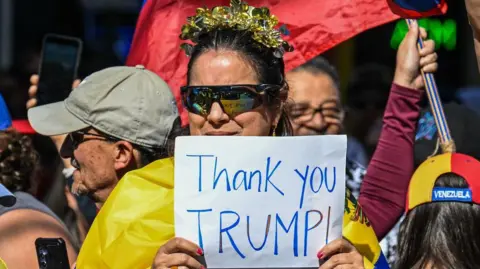
Like many at the Doral celebrations, Mr. Marquez believes one man is responsible for many Venezuelan exiles getting what they wanted: US President Donald Trump.
“It’s an indescribable feeling,” he added, the emotion clear in his voice. “He helped us a lot… I don’t know what to say except thank you.”

 Bernd Debusmann Jr/BBC News
Others see Maduro's sudden and violent exit from Venezuelan politics as an opportunity.
“Trump really did this for the Venezuelan people,” said Luis Atristain, 21, who despite being born in Miami spent part of his youth in Venezuela.
Mr. Atristain, wearing a red “Make America Great Again” hat, said he expected Maduro's fall to bring economic relief to millions of Venezuelans after years of hyperinflation and deficits.
“Venezuela is one of the most resource-rich countries in the world,” he explained. “They [the US] are going to enter and restart the industry. Oil alone is worth billions or trillions of dollars. This will help the country recover again.”
According to his forecasts, many Venezuelans will return to the United States.
“The money will keep coming,” he said. “There will be a lot of opportunities there.”
 Getty Images
While some Venezuelans in Doral are largely encouraged by Maduro's fall, they also expressed uncertainty about what will happen next.
The confusion grew during Trump's press conference on Saturday. He said the US is “going to govern” Venezuela through “a team that works with the people of Venezuela to make sure we get Venezuela right.”
“I don’t know what that means or what the level of participation is,” said Ana Maria, a Doral resident. “Let's see. But now we're just glad Maduro is gone.”
Even more puzzling to some was Trump's remark that Venezuelan opposition leader Maria Corina Machado “has neither the domestic support nor the domestic respect” to govern the country.
Ms Mateos, for example, was outraged by the suggestion that Venezuelan Vice President Delcy Rodriguez or any member of the Maduro regime would play a role in Venezuela's future.
 Getty Images
In a televised address on Saturday, Rodriguez said she was willing to cooperate with the United States in the future.
“I hope it's very clear [to the Trump administration]. We do not recognize the government of Delcy Rodriguez or anyone who was part of the Maduro regime,” Ms. Mateos said.
“They are dirty and corrupt. We support Maria Corina Machado as well as [former opposition candidate] Edmundo Gonzalez. This is what the Venezuelan people want, what we have already said at the ballot box.”
Mr. Marquez, for his part, said he and his friends remained suspicious of Rodriguez.
“Members of the Venezuelan government also have relatives outside the country,” he said of Rodriguez. “But for them it’s different. They have power. They didn't fight like we did.”
As the sun began to set on the Doral celebrations, some expressed doubt that any of Venezuela's key players – Machado, Rodriguez or Gonzalez – could effectively govern the country in the short term.
“None of them can take over,” said a local marketer named Elkin, who declined to give his last name.
“At this point, it will be up to Donald Trump … he will be the one moving Venezuela toward a more inclusive transition.”



