This year, generative AI seeped into mainstream gaming. Though it didn't so much shimmer, as smear. It mispronounced lines in Arc Raiders, “drew” a smudgy loading screen in Anno 117, voiced a sweary Darth Vader in Fortnite – perhaps its least subtle appearance was in Where Winds Meet, the wuxia-themed open-world RPG that plugged some of its minor NPCs into AI chatbots. The results were predictably beige and sometimes absurd.
I was heartened, as I sometimes am, by RPS' comments section, which largely dismissed the concept of an “in-game Siri”. The most-liked response summed it up: “I think that using a game to interact with chatbots instead of experiencing a hand-crafted story written by a living person is idiotic.”
But a segment of players and of RPS readers did like the idea. One commenter on Reddit said it creates NPCs that “you can truly interact with, you can't achieve this without AI”. Where Winds Meet continues to peak at more than 100,000 daily players.
I can't imagine a 2026 where we don't see more in-game chatbots. GenAI's dribbling into every crevice of our lives, including the art we enjoy, appears uninterruptible – or at least, uninterrupted. More is coming. Indeed, as 2025 draws to a close, Larian founder Swen Vinke revealed the studio is using generative AI in pre-production of Divinity, its first new game since Baldur's Gate 3. The news caused such a stink that he's committed to an open Q&A in the new year.
With that thought of the approaching wave of AI use in game narrative in mind, I contacted five experts to get their perspective: two AI researchers and three narrative designers. I wanted to know if there's something I'm missing. Could future AI chatbots, more carefully prompted and constrained, enhance a game's world? Does this technology open any doors? How will it evolve? And how should story-driven studios respond?
For Meghna Jayanth, writer and narrative designer known for 80 Days, Thirsty Suitors and Sable, the chatbot in Where Winds Meet sounds “both horrible and boring” and LLM chatbots are “the least interesting, most resource-hungry, most corporately controlled version” of procedurality and generation, a field games narrative has pioneered.
“I made something for you, without even knowing you. You, in playing, reading, listening, experiencing, know a part of my humanity without knowing me.”
– Meghna Jayanth
Chatbots are toys with “novelty value” for some players – but the fact they can answer anything is “more of a disadvantage than an advantage”, Jayanth says. Games are not about giving players as much agency as possible, they're “about designing agency in pleasurable or thematically interesting ways”, she explains.
“What the player cannot do, what the player cannot say, what the game says and leaves unsaid, these limitations convey what the story and the world mean to the player. What the chatbot says or doesn't say is not intentional,” she says. And for Jayanth, human connection is intrinsic to art: “I made something for you, without even knowing you. You, in playing, reading, listening, experiencing, know a part of my humanity without knowing me.”
For those reasons, “I don't see a genuine place for the LLM chatbot in fiction, apart from some specific cases where the affordances and failures of the technology are part of the narrative or thematic conceit,” she says.
And this is all before you consider the myriad ethical problems she describes with AI and LLMs: the climate impact of data centres; the privacy dangers of “sharing intimate details of your life with a corporately-controlled chatbot”; creators having LLMs trained on their writing without being paid and then watching LLMs replace their work; and chatbots hallucinating reality, “driving us further away from truth at a time where the information landscape is hopelessly fragmented, polluted, politicised and delusional”.
“I think the question is as simple as: do we want to live in an alive world, or a dead one?” she asks.
“We are all desperate for more connection, with nature, with each other, with life itself. We are increasingly atomised, overworked, underemployed, choked by toxic air, at risk of floods, earthquakes, heatwaves, while billionaires and elites consume the planet for profit and leave us to live in the wreckage. And their solution to all of this is for us to look deeper into the machine-vortex for friendship, validation and connection, rather than each other.”
Max Kreminski, an assistant professor of Design Tech at Cornell Tech university, questions the suitability of the technology itself, saying that LLM-based chatbots won't tend to make good NPCs. They're too unoriginal to come up with novel ideas in a conversation, and too uncontrollable to do what a narrative designer might want. “As a result, they tend to wash out the strong authorial intent that characterises really good narrative design, while also not really giving the player much to ‘work with' if viewed as an open-ended improv partner,” they explain.
Kreminski – who until recently led the Storytelling Lab at Midjourney, which makes AI models and is known best for its image generator – believes developers are “awkwardly wedging [genAI] into contexts where it doesn't really fit”, particularly in popular, proven genres. “On top of that, present-day executive-level interest seems to be mostly driven by a desire to cut production costs… even though pursuing this strategy pretty much always makes the resulting games weaker.”
“Present-day executive-level interest seems to be mostly driven by a desire to cut production costs… even though pursuing this strategy pretty much always makes the resulting games weaker.”
– Max Kreminski
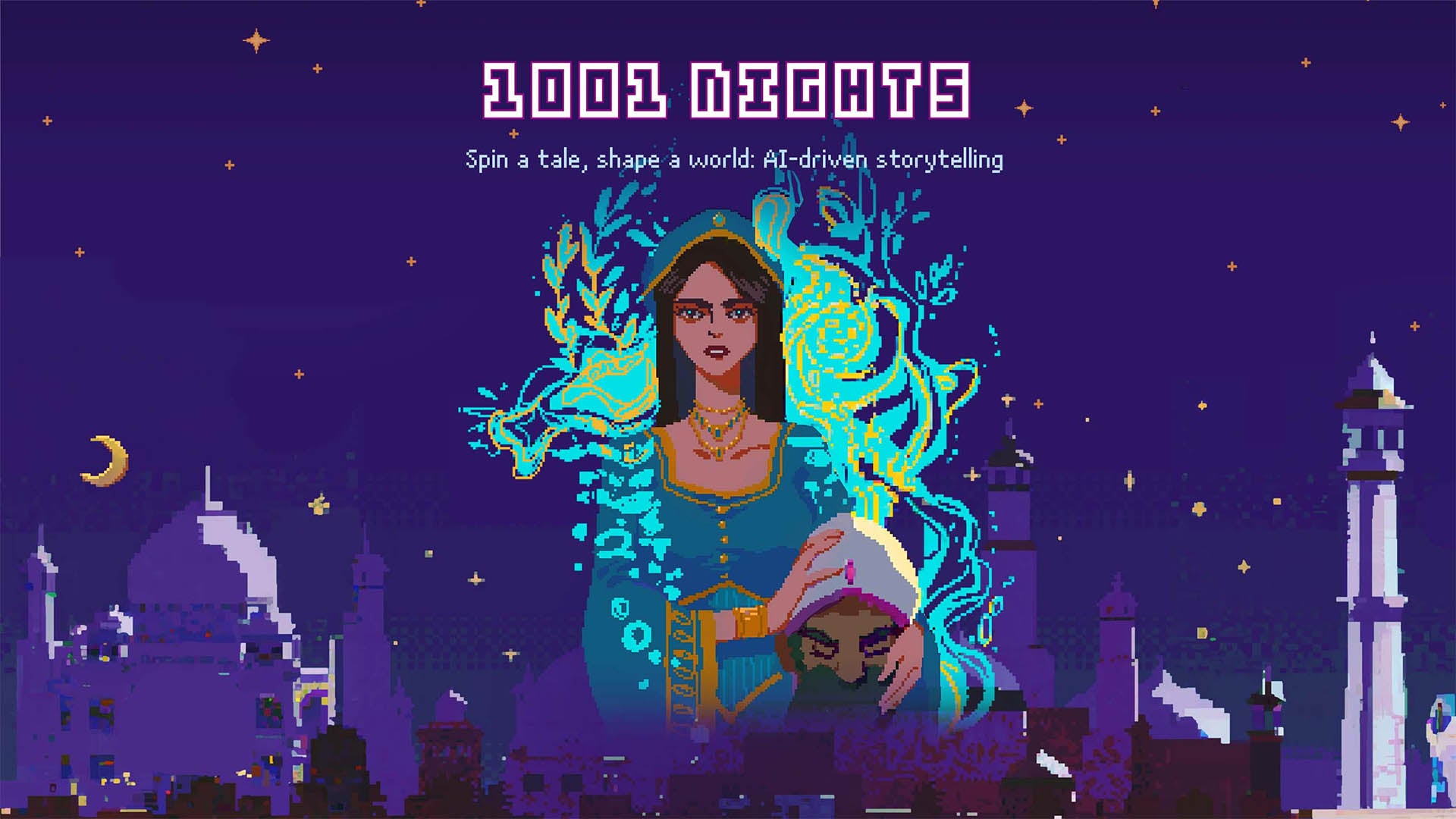
But they also believe LLMs could help create new, interesting experiences. They point to examples away from mainstream development: 1001 Nights is “designed around tricking the LLM-simulated character” into saying certain words.
“The designer didn't just drop LLM-based NPCs into an established game genre, she put a ton of design thought into coming up with new handcrafted interactions around the LLM-based core gameplay loop.” They also point to Infinite Craft, praised by RPS' former reviews editor Ed Thorn, a crafting game that uses an LLM to let players combine seemingly unrelated ideas.
Kreminski thinks there's “a whole new category” of games that could be designed using LLMs not as chatbots but as “interpreters of open-ended player input”.
In Façade, the 2005 interactive story created by Michael Mateas and Andrew Stern, players walk around an apartment, type whatever they want, and watch the game respond. LLMs weren't around then, “so Michael and Andrew had to handcraft a super elaborate rules-based parser to make sense of these open-ended player utterances”. It broke often, but Kreminski still found the mix of scripted and improvised play compelling.
They can imagine LLMs sitting as one of many components in a designer-led system that supports this Façade-style play. Success would look a lot more like “inventing a new game genre” than “augmenting an existing one”, they say, before ending like a consummate academic: “more research is needed”.
Dan Griliopoulos, writer and narrative designer, formerly of Inflexion Games, Improbable, and Proxy Studios, shares the same ethical concerns around AI as his peers – including energy usage, copyright and ownership, the risks of structural unemployment, and the difference in values between CEOs and workers – but from a purely practical perspective, he believes chatbots will become more common and better over the next decade.
Where Winds Meet's chatbots are “in a bad state”, he says: they're too general, and break the fiction too often. But he envisages narrative designers “curating” similar chatbots and writing backstories, world histories, and personalities that feed into these NPCs, shaping their responses. These texts, he points out, could be written by AI, but “I wouldn't necessarily want a chatbot to do that because of its tendency towards the average. I want to curate my world, I want to make something original and new.”
He acknowledges this would be a “cultural shift” from writing to curating, and it also requires programmers who can better implement chatbots into games so that NPCs can react to player choices in the world.
Massaging a chatbot's voice to make it less generic would be similar to prompting an AI in your daily life, he says. “You can say to it, write this in the style of a noir detective from the 1930s, but stay within our world, or, use an out-of-copyright or character voice, like Dickens, a character from Bleak House. And then you might have something more interesting.”
While his ethical concerns are very real, and immediate, he is perhaps a lick more optimistic than others. “I'm anxious about the people whose careers can get wiped out, and I'm anxious about the structural unemployment that comes with technological shifts. I'm excited to live in the future, and I'm excited to play games where there are AIs who are smart enough to have learned from the world and to react properly to what I've done. It's been a dream for a long time.”
And he also believes that the industry needs to wake up to the inevitability of genAI. In other sectors it is being used to make junior staff redundant and “we can't just pretend it's not going to happen”.
“Instead of having these angry conversations about, how do we stop it, the conversations really could be more productive. How do we retain jobs? How do we retain creativity? How do we avoid this stuff being power-hungry and copyright-infringing? Can we make a version of this that we're happy with? Can we work towards that? That conversation isn't happening because the CEO class and everybody else is scared of engaging with AI.”
When asked, he says can't think of anybody doing these things right at the moment.
“If you hold yourself up as a flagship and go, we make all of this stuff ourselves, everything is handcrafted, there are people who are willing to pay the extra price for luxury goods”
– Dan Griliopoulos
One reason for optimism, he says, is that studios relying purely on human writers might more starkly stand out. Players may even be willing to pay more for those games, he says. “If you hold yourself up as a flagship and go, we make all of this stuff ourselves, everything is handcrafted, there are people who are willing to pay the extra price for luxury goods,” he says.
“Going out there and finding the strangeness and finding weird little edges that the AIs aren't going to dig into, those are the bits of storytelling we can do better still. They can't copy something if there's nothing to copy. So, find the new stories, go and do your own research, read weird old books, watch strange films from other countries, before it all becomes an average block.”
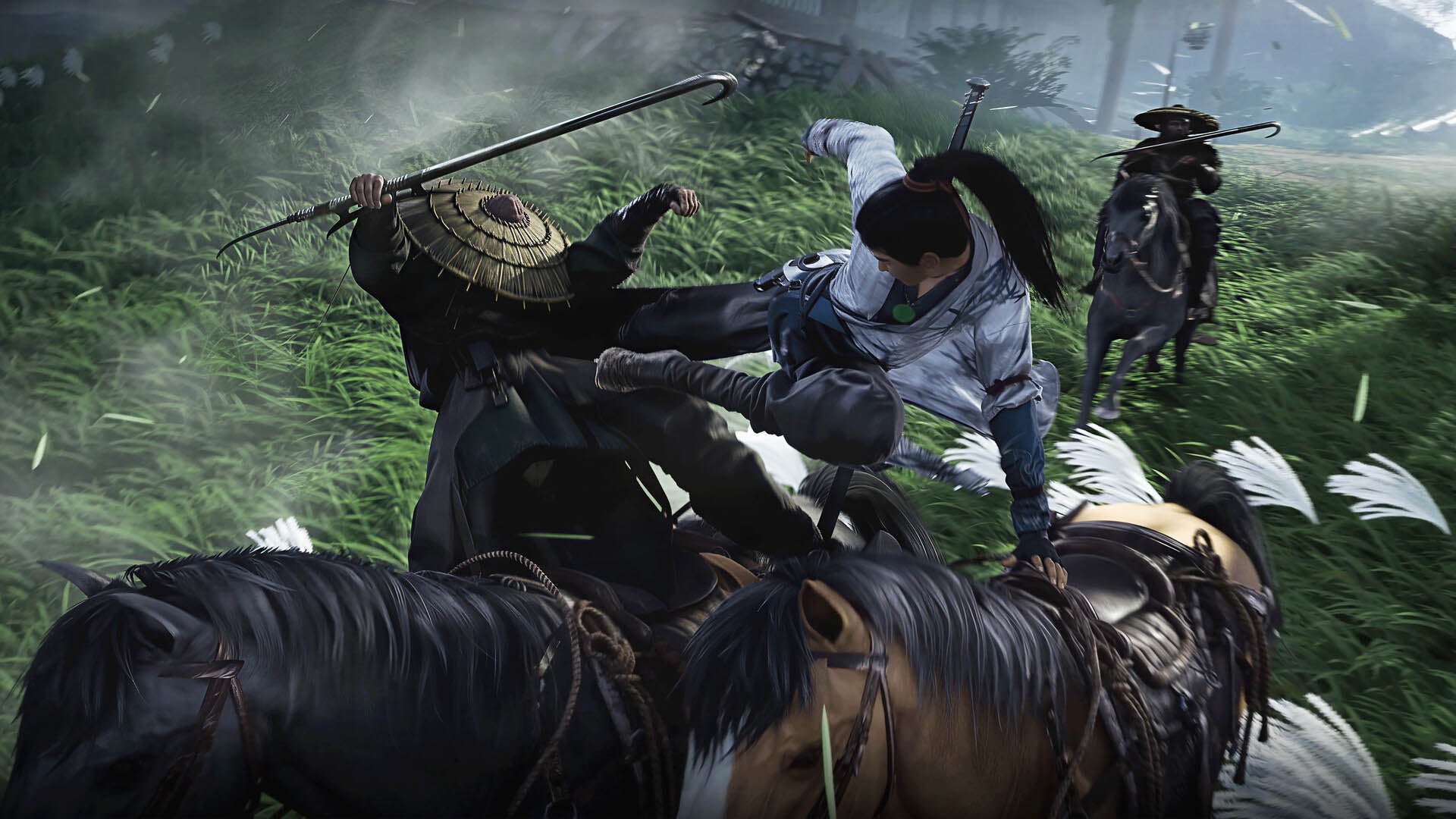
To Younès Rabii, an indie developer and AI researcher, currently studying for a PhD at Queen Mary University in London, the chatbot in Where Winds Meet feels like a “black box commercial industry grade model”: a “cheap gimmick” that was never going to feel coherent with the world. “It felt like, in a way, avoiding the work of writing dialogue for a game and instead externalising this work to a system that doesn't even seem adapted,” they say.
“There's a sort of wish fulfillment thing behind this technology.”
– Younès Rabii
LLMs have the advantages of generality and a giant knowledge base, but one of their disadvantages, as seen in Where Winds Meet, is specificity. “There's a sort of wish fulfillment thing behind this technology: I can say whatever and I will get an answer. But honestly, you can do that with a dice. It doesn't mean that the answer is relevant to you. That's relevancy, that's precision. That's work that has been put in there by humans.”
Rabii believes it is theoretically possible to make a chatbot that is relevant and adapted to a specific game world, but it would take lots of work – human work. And at that point, you're going beyond an LLM chatbot to what is effectively a procedural generation system, they say.
“Say we have a game set in a specific era in China or evoking specific folktales and stories. We want a genAI but we want to train it on sources that are from this era. Either historical sources that you have found and have translated, or texts that you have curated, cleaned and reformatted. Or, you're hiring writers who write new stories and scenarios that you want to feed in. And all of this, it takes work and specificity. And this specificity is something that you do have to pay for,” Rabii says.
“It's the cost of research. It's the cost of writing and everything that is behind writing a good novel or a good story. If you avoid paying these costs, why would you have in any way the advantages of them?”
The industry, they say, needs to slow down. We must first understand the technology, its limitations, its costs – including a “catastrophic amount of energy” and creators not being paid for the work LLMs are trained on – and then “domesticate it”.
“It's not impossible that one day AI systems will have a very interesting voice that is relevant and adapted, but behind it, humans will be putting in the work to make sure that this voice is interesting and relevant. And in a way it will be their voice too, because they'll make decisions in that system.”
Chris Gardiner, narrative director at Failbetter Games, says it's easy to see the appeal of LLM-powered chatbot NPCs. The “cynical appeal”, he says, is cost: squeezing the most words from the fewest writers, which could ultimately “manifest as layoffs and lost institutional knowledge”.
But he also sees an idealistic appeal. “The promise of the fully-immersive game, where you can do anything and the world responds appropriately. Being able to talk to any NPC about any topic sounds like a big step towards that, right?”
That ideal – and the notion that LLMs move us towards it – is misguided, he says, because the product of writing is not words but meaning. “And generative AI can’t understand meaning, or perspective. It can’t have insight or appreciation. It can only algorithmically guess at what you expect to hear, with varying levels of success.”
Human writers can make the kind of deliberate choices that AI chatbots can't, he says, inflecting incidental NPC lines “to imply something about the game’s society or recent events. They could add a joke, or tie it to the theme of the game, or foreshadow a future event, or contrast another piece of content elsewhere. All of which adds to the richness of the game.”
“[An LLM] doesn't understand what a player might want or need. It doesn't respect the player enough to give them what they didn't know they wanted.”
– Chris Gardiner
AI chatbots do give players agency of a sort: the freedom to say anything to an NPC and get a response. It lets players go “off the rails”. But writers already reward players who want to do this, he says. “Games like Baldur’s Gate 3 enable their players to go off the rails in the most wild, ambitious ways, and then give that meaning because a human writer hand-crafted a wicked or delightful consequence to it.
“An LLM couldn’t, because it doesn't have interiority, or motive, or a sense of the wider and deeper truths of the game's world. It doesn't understand what a player might want or need. It doesn't respect the player enough to give them what they didn't know they wanted.”
More widely, he says, “even if I could set aside the ethical issues with generative AI that was scraped without permission or payment from creators (I can’t) or the environmental consequences (I won't) or even the quality issues (I don’t want to) I still come back to the fundamental question of ‘why’? Why would we want less of those things I just talked about in our art and our games? Why have less ingenuity and craft in them? We deserve games that people worked on with passion.”