
CHICAGO — Barely half an hour had passed since the flight landed at O’Hare International Airport, and the Army combat veteran’s palms were already sweating.
Spencer Sullivan, 38, situated himself at the front of a crowd of people waiting near the exit for international arrivals. He knew it could be hours before his friend got through customs.
Still, he said, “I’ve been waiting so long for this moment. I don’t want to miss it.”
It had been just over 13 years since Sullivan, who now works in corporate development, first began helping his former interpreter in Afghanistan petition for a visa to live in the U.S.
The process had been full of big hopes and bigger letdowns. Then, after finally securing the visa in September, an Afghan immigrant was accused of shooting two National Guard members in Washington.
In the politicized aftermath, Sullivan wondered, would his friend get in?
Abdulhaq Sodais, left, and Spencer Sullivan right have breakfast at a hotel in Skokie, Ill., a day after Sodais’ arrival in the U.S.
After the U.S. invaded Afghanistan, a teenaged Abdulhaq Sodais enrolled in English classes with the goal of becoming an interpreter for coalition forces. Nearly a decade later in 2010, employment records show he was contracted by Mission Essential, one of the largest companies that supplied interpreters in Afghanistan to Western forces.
Sodais, 33, and Sullivan, then a platoon leader, met two years later at a military base in the remote Zabul Province.
Together they would go on intel-gathering missions, talking to village leaders, scouting unfamiliar terrain and observing the Taliban from hilltops, where Sodais interpreted their radio transmissions for Sullivan in real time.
In December 2012, Sullivan returned to the U.S., though he and Sodais stayed in touch. The following year, the blast of an improvised explosive device left Sodais with a concussion and a bulging spinal disk. He returned to his parents’ home in Herat to recover.
After his convalescence, he said, his supervisor told him to take a dangerous road back to the Zabul base — a day’s drive for a journey commonly traveled by air. Afraid it would be a suicide mission, he declined to take the land route and was fired for job abandonment.
The denial of his first Special Immigrant Visa application soon followed.
Those visas offer a pathway to citizenship for Afghans who were employed by the U.S. government or its private contractors. In establishing the program, federal officials acknowledged a moral obligation to protect allies who risked their lives to help the U.S. mission in Afghanistan.
More than 50,000 such visas have been approved since 2009, according to the State Department.
One requirement is “faithful and valuable service to the U.S. government.” Applicants denied visas are often deemed to have failed that provision, though interpreters and advocates have said the smallest inconsistency could trigger a denial. Over the next few years, Sodais said, three more visa applications would be denied.
In a Nov. 23, 2014, recommendation letter, Sullivan, by then an Army captain, wrote that granting Sodais a visa “is the least that can be done in order to express America’s gratitude for his services.”
“On multiple missions in enemy controlled villages, his life was threatened by local nationals in support of the Taliban for his assistance of [coalition] forces,” Sullivan wrote. “Abdulhaq did not cover his face while on mission, leaving him recognizable to Taliban informants, further endangering his life.”
He was rehired by Mission Essential in 2014, but fired again in 2016, with a civilian contractor writing in his file that he had an “incompatible skill set with [the] unit’s mission.” She accused him — falsely — Sodais says, of checking his personal Facebook at the office.
Mission Essential later told The Times that he was terminated by the military for poor performance but that it had no record of the incident he referred to.
Sodais said he was confronted by his local mullah, or Muslim clergy leader, in 2015 for working with Western armed forces. The mullah said he was labeled an infidel, and his death had been sanctioned by the Taliban. He went into hiding at his parents’ home.
Then, in July 2017, the Taliban killed Sayed Sadat, another interpreter who had worked with the platoon Sullivan had led. Devastated by the news, Sullivan reached out to Sodais, asking if he was OK.
Sodais had gotten a new phone and didn’t reply. Sullivan, who now wears a metal memorial band with Sadat’s name and date of death, feared Sodais also was dead.

Abdulhaq Sodais, left, and Spencer Sullivan walk through a park in Bremen, Germany, in 2021. Sodais fled Afghanistan for Germany, and Sullivan worked for years to get him a visa to travel to the U.S.
(Peter Dejong / Associated Press)
What Sullivan didn’t know was that Sodais had fled Afghanistan and arrived in Germany in 2018 after seven months of travel with smugglers by land.
After his first German asylum claim was rejected, a lawyer told Sodais he needed more evidence to back up his claims of working for the U.S. So, that Christmas Eve, he messaged Sullivan asking for photos from their missions together. He told Sullivan that if he couldn’t find safety and stability, he would take his own life before the Taliban could.
Sullivan had been wracked with guilt since Sadat’s death and vowed to help. He sent the photos Sodais requested, wrote a letter of support and helped him navigate German bureaucracy. He even flew to Germany from his home in Virginia in 2019 to offer encouragement.
But the asylum process moved slowly. By March 2021, Sodais, overwhelmed by fear of deportation, became deeply depressed and attempted suicide. At a psychiatric hospital, medical records show, he was diagnosed with post-traumatic stress disorder.
That August, as the Taliban regained control of Afghanistan, Sullivan returned to Germany to help Sodais prepare for his final asylum appeal hearing.
The verdict arrived a month later. He’d won.
Sodais found succeeding in German society difficult. He felt a palpable sense of discrimination and was laid off from various contract jobs, including as a forklift operator and an aid helping special needs children on and off school buses.
While Sullivan was happy his friend had found safety, he was disappointed that the country he had served continued to reject his requests for a visa.
“He should be in America,” he said at the time. “We failed him.”
In the meantime, life continued. Sodais married another Afghan refugee, Weeda Faqiri, in 2022. Sodais’ and Sullivan’s families met for the first time in 2022 when Sullivan, his wife and son visited Germany.
Also that year, Sodais said, he won a $15,000 legal judgment against Mission Essential over lack of medical care after the explosive device blast more than a decade earlier.
He and Sullivan decided to write a book about Sodais’ life and their friendship. “Not Our Problem: The True Story of an Afghan Refugee, an American Promise, and the World Between Them” is scheduled to publish in April.
Last year, Sodais decided to make a final pitch to the U.S. government. On Feb. 4 came a reply unlike the others: “Approval of Appeal for the Afghan Special Immigrant Visa Program.”

Abdulhaq Sodais and his wife, Weeda Faqiri, share their first meal in the United States at a restaurant Chicago on Dec. 17.
On Sept. 25, Sodais was issued a visa valid for just over five months, until March 3. Overjoyed, he and Faqiri, 26, began planning their move.
Two months later, Rahmanullah Lakanwal, 29, was charged in the shooting that killed Army Spc. Sarah Beckstrom, 20, and critically wounded Air Force Staff Sgt. Andrew Wolfe, 24.
Lakanwal, who pleaded not guilty, entered the U.S. in 2021 through a Biden administration program for Afghans in the wake of the military withdrawal, and his asylum application was approved in April. In Afghanistan, he served in a counterterrorism unit operated by the CIA.
After the shooting, the Trump administration enacted sweeping restrictions to legal immigration programs, including halting visa applications for Afghans and others.
Worried that further restrictions could follow, Sullian called Sodais and told him there were likely two options: stay permanently in Germany, or attempt to move immediately to the U.S.
Sodais chose the move.
Sullivan learned that RefugeeOne, a Chicago-based group that aids refugees, could help. Using money from their book advance, Sullivan booked Sodais and Faqiri flights from Munich to Chicago, arriving Dec. 17.
The night before their trip, the Trump administration announced a new proclamation titled “Restricting and Limiting the Entry of Foreign Nationals to Protect the Security of the United States.” Under that order, even Afghans who had secured Special Immigrant Visas — people like Sodais — could be denied entry into the U.S.
Sullivan panicked.
“Well, this confirms our decision to get them here as fast as possible,” he said that night. “This is a deliberate dismantling of the SIV program, one brick at a time.”
Then he learned the proclamation wouldn’t take effect until Jan. 1. The panic subsided a little.

A woman is taken into custody by Border Patrol agents after she was accused of using her vehicle to block their vehicles while they were patrolling in a shopping center in Niles, Ill., on Dec. 17.
(Scott Olson / Getty Images)
On the day of Sodais’ arrival, Border Patrol leaders returned to Chicago for a fresh round of immigration raids and patrolled a neighborhood near the hotel where he and Faqiri would be staying.
Sullivan said he would put himself physically between Sodais and immigration agents. He was half joking, but it underscored the political moment.
After Sodais’ plane landed, Sullivan knew he had seen one of his WhatsApp messages because of the two blue checkmarks next to it. But others were unread. Had he been denied entry?
“After so many disappointments over the years, it’s hard to believe that anything’s going to go right,” Sullivan said, later admitting that “I was convinced they were cuffed face-down on the linoleum somewhere.”

Spencer Sullivan, left, guides Abdulhaq Sodais to a parking garage at O’Hare International Airport in Chicago on Dec. 17.
The arrival of three giddy RefugeeOne employees lifted the mood. After years of serving mostly Afghans, Syrians and Ukrainians, they hadn’t picked up an arriving refugee since January, said Emily Parker, who oversees contract compliance.
Parker said a private donor had paid for Sodais and Faqiri to stay a week in a hotel. They qualified for food stamps, three months of rental assistance, cash assistance and four months of Medicaid, a welcome provision because Sodais still suffers back pain from the explosion.
On the other side of the arrivals door, Sodais and Faqiri were stuck in a winding line with hundreds of other foreigners. Sodais later said they were nervous — they had been questioned for an hour in Munich and nearly just as long on their layover in Lisbon.
When they finally got to the front, the customs officer asked what Sodais did for work in Afghanistan. Sodais said he had been an interpreter for U.S. forces. Great, he recalled the agent replying, before welcoming them through.
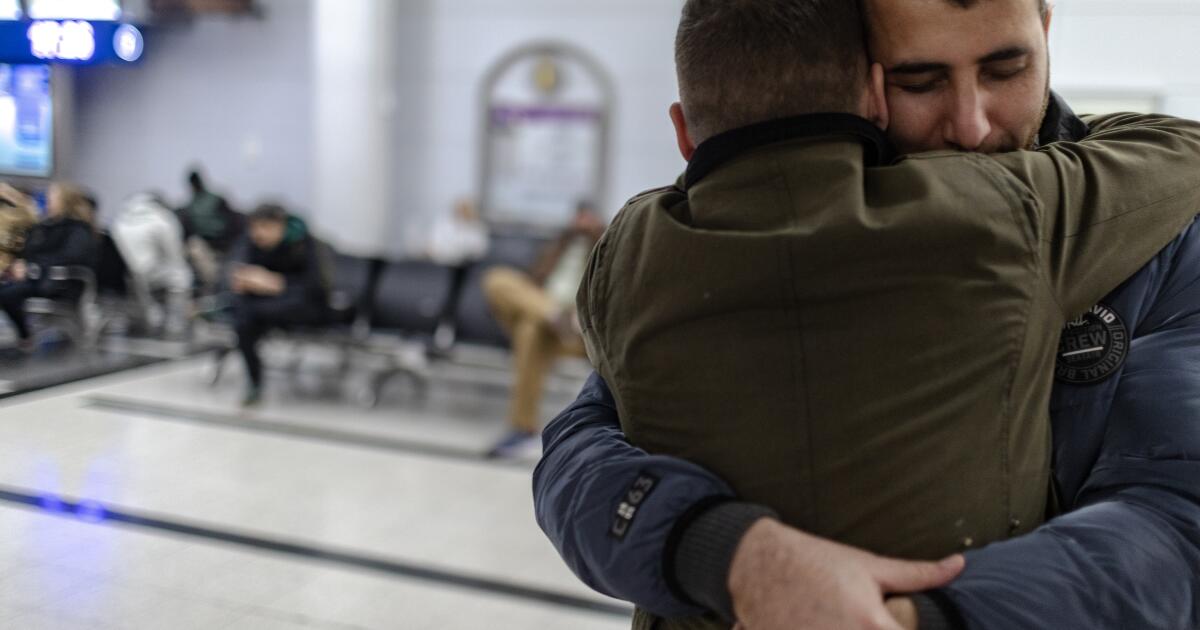
At 5:24 p.m., Sullivan’s phone rang. Sodais had exited through a different door, so Sullivan rushed to another part of the airport and pointed excitedly when their eyes locked.
“You made it!” Sullivan said, pulling his friend in for a bear hug as they both sobbed.
Without Sullivan, Sodais told the RefugeeOne workers, he would never have made it to the U.S.
“He saved my life.”

Abdulhaq Sodais, right, listens to Adriano Gasparini, a housing manager with RefugeeOne, after viewing potential apartments in Chicago.
The next morning, Parker conducted an intake interview with Sodais to determine potential job placements and explain the services her organization would provide. She said Sodais had technically entered the U.S. as a lawful permanent resident, and his green card should arrive in the mail within a few months.
“That’s how it works with SIVs,” she said. “They’re already 100 steps ahead of any asylee or other refugee.”
Sullivan let out a deep breath. “In my mind, we were playing a long gamble on the courts challenging the executive orders, so that’s good news,” he said.
Sodais, who had applied for the visa with only Sullivan’s help and no lawyer, was also pleasantly surprised.
“This is very exciting for me, because I heard Donald Trump say he stopped everything about refugees,” he said.

Spencer Sullivan looks out of a living room window of a potential apartment for Abdulhaq Sodais and his wife in Chicago on Dec. 18.
After dinner — the couple’s first Chicago tavern-style pizza — Sullivan offered Faqiri a box to save her last slice, and she hesitated. Sodais gently explained that in Afghanistan, it’s not cultural norm to take food home from restaurants.
“I just realized something,” Sullivan said. “You’re going to be my interpreter for the rest of our lives.”
Sodais shot back a knowing smile.



