

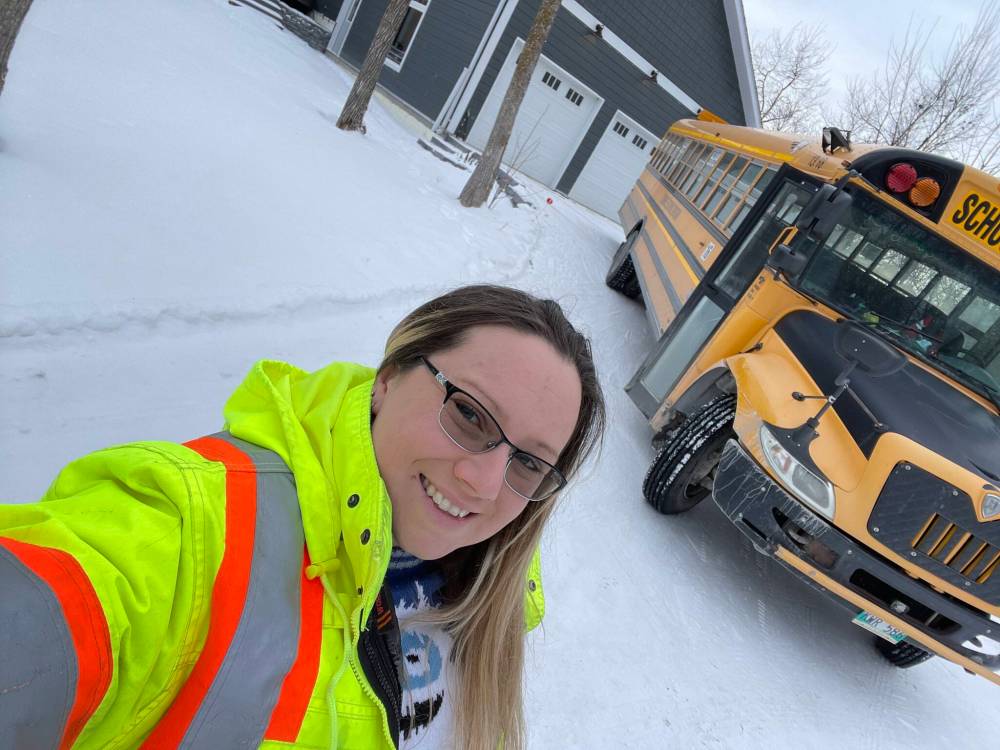
Jodi Ruta is a Manitoba school bus driver by day, an independent traffic-safety researcher by night and a social media influencer 24-7.
Better known as “Jodi The Bus Driver” on TikTok, the 39-year-old has amassed a following of more than 150,000 users, many of whom earn a living transporting people and goods across North America.
She began recording herself — often inside her mobile office on break or with a parked yellow bus in the backdrop — during the COVID-19 pandemic.
SUPPLIED Jodi Ruta is a rural school bus driver and is known as “Jodi The Bus Driver” on TikTok.
Whether she’s sharing tips for winter driving or recalling student escapades, Ruta’s trademark is her bluntness both about how much she loves her job and its challenges.
Two years ago, at her therapist’s urging, the rural bus driver took to TikTok to process a traumatic collision that happened when she was transporting students home at the start of the 2023-24 school year.
“I was hit by a drunk driver 63 days ago,” Ruta said in a video posted Nov. 11, 2023. “I’m still trying to claw my life back into some semblance of normal.”
She has spoken candidly about post-traumatic stress disorder and her frustrations that similar incidents are deemed unserious if there are no broken bones or on-scene fatalities.
The crash and constant reminders of it — the site where she was rear-ended is part of her route when classes are in session — have furthered her resolve to do everything in her power to protect her young passengers.
That’s why Ruta dedicated much of 2025 to researching collisions and compiling 10 evidence-based recommendations to improve safety for student commuters.
Her top priority? Mandatory three-point seatbelts — a basic safety feature that she believes would have prevented her students from being “thrown forward like rag dolls” on an autumn day in 2023.
Over the last 40 years, Manitoba has held parent chauffeurs responsible for buckling up students to get them to school safely via minivans and other personal vehicles.
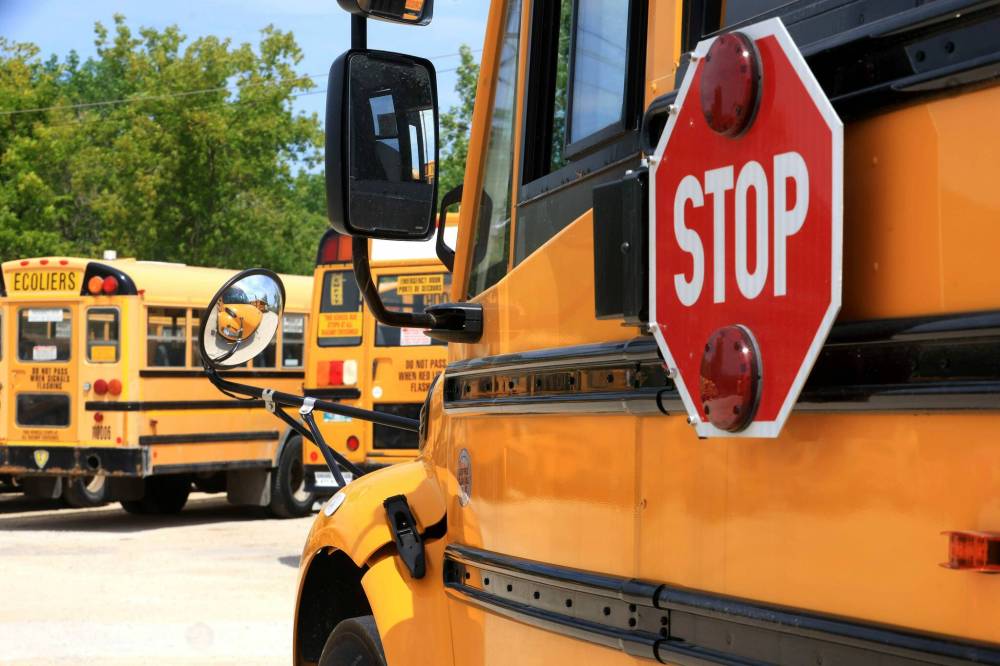
Between Jan. 1 and Dec. 19, the last day of classes before the holidays, Manitoba Public Insurance recorded 108 school bus-involved collisions.
In Ruta’s experience, children are confused upon learning the same rules don’t apply aboard her bus.
Combined, school divisions rely on about 2,000 yellow buses to get students to and from class between September and June. Most of them are made by Blue Bird, International or Thomas Built Buses.
Transport Canada endorses the use of seat belts on these vehicles if they are used properly, but it stops short of recommending they be standard protection.
School bus operators and the provinces that employ them have been left to weigh the pros and cons, review incidents on their roadways and make sense of industry changes.
Blue Bird, one of the preferred manufacturers of Manitoba school divisions, made belts a standard feature on new models ahead of the 2024-25 school year.
“I’m still trying to claw my life back into some semblance of normal.”
More than a year later, the Legislative Assembly of Manitoba is reviewing baseline protections on local school buses.
Two new bus-related bills — both of which are tied to Ruta’s advocacy on the file — received first reading shortly before MLAs rose for the winter break.
As far as PC education critic Wayne Ewasko is concerned, Manitoba has a unique opportunity to become a national leader on this file.
Ewasko, a certified teacher who rode the school bus daily when he was a child, has proposed two pieces of legislation to make that happen.
Bill 220 prescribes a foundational shift that would phase in mandatory belts on school buses in Manitoba, beginning in 2026.
The legislation, which was drafted after multiple meetings with Ruta, who lives and works in his consituency of Lac du Bonnet, aims to raise minimum safety standards for new vehicles purchased by public and private schools.
In order to police use and misuse, school leaders would be required to establish policies that spell out progressive disciplinary measures.
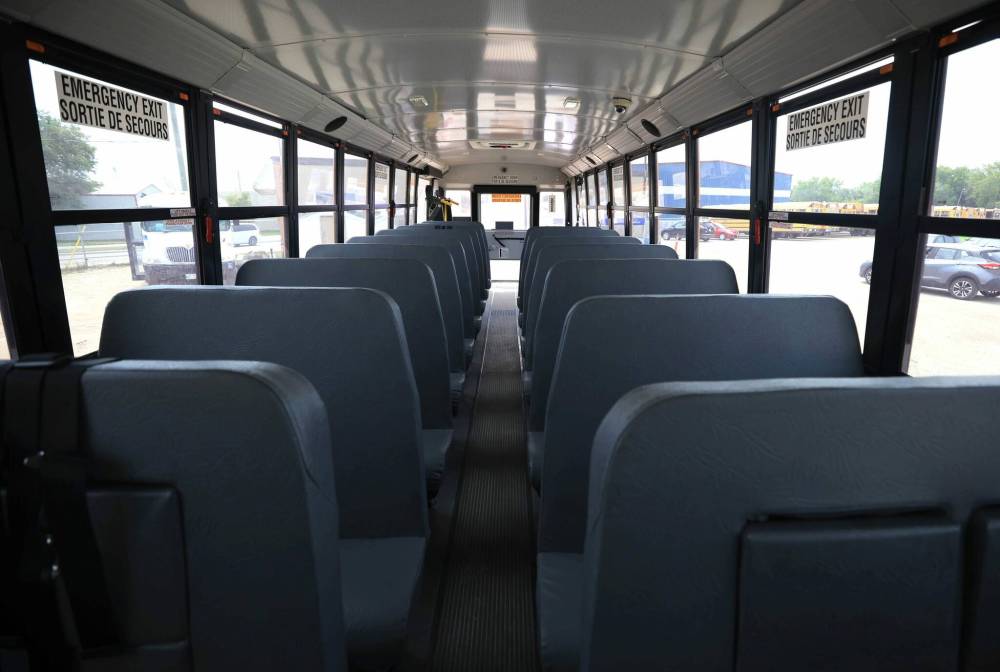
Transport Canada endorses the use of seat belts on school buses if they are used properly, but it stops short of recommending they be standard protection.
A complementary bill aims to increase penalties for motorists who fail to stop when a bus is loading or offloading students.
Ewasko wants motorists who ignore a school-bus stop arm and flashing lights to be fined up to $2,500, compared to the existing penalty of $673.63 and demerit points.
“Seat belts save lives… It’s a safety mechanism that is out there. Why wouldn’t we be using them?” he said, adding that he’s confused as to whether Manitoba is paying for belts that are not in use, given Blue Bird’s recent changes. (Blue Bird did not provide comment.)
The simple answer from supporters of the status-quo, including the federal regulator and the Canada Safety Council, is the effectiveness of “compartmentalization.”
The trademark grey booths on buses are a passive design feature that traps young passengers and absorbs impact. The high-backed cushions are key in creating protective compartments.
Other arguments — many of which can be found in the comments on Ruta’s TikTok videos — question how belting children would affect transportation costs, driver workloads and emergency evacuations.
“Making sure all children are properly secured in seat belts is a lot more challenging in a 70-passenger school bus than in a five-passenger or seven-passenger minivan.”
“Making sure all children are properly secured in seat belts is a lot more challenging in a 70-passenger school bus than in a five-passenger or seven-passenger minivan,” according to Transport Canada’s website.
The federal agency came out with seat belt installation regulations for the kindergarten-to-Grade 12 sector in 2018.
They were published several months after 16 members of the Humboldt Broncos were killed in one of the worst highway crashes in Canadian history.
The tragedy, which involved a coach bus carrying a junior hockey team and semi-truck that blew through a stop sign, has resulted in all new highway buses being equipped with seatbelts.
“It took an enormous tragedy to force meaningful change in that context. We must not wait for the same to happen with school buses,” Ruta wrote in a 70-page report, a self-assigned passion project, outlining her case with lived experience and an 111-item reference list.
SUPPLIED Jodi Ruta became an outspoken advocate for installing standard seatbelts on school buses and other safety measures after she was involved in a collision on the job on Sept. 28, 2023.
Her findings acknowledge that compartmentalization provides “excellent protection” in certain types of crashes, especially ones that occur at low speeds.
“But it cannot prevent the violent forward and sideways forces that occur in real-world collisions,” she wrote, reflecting on what happened to her on Sept. 28, 2023.
Ruta was stopped at a railroad crossing on Provincial Highway 302, doing her usual checks, when her packed bus was rear-ended by a truck driver who was going approximately 80 km/h.
She considers herself and her students “lucky,” given the angle at which they were hit and all passengers were seated properly so they only sustained sprains, whiplash and other injuries that did not require serious medical intervention.
The video footage of her students, many of whom cried out for their parents, profoundly affected her, she said.
There are vulnerabilities that cannot and should not be ignored, especially given rural drivers frequent 100 km/h zones and share the road with large vehicles, Ruta said, noting that rollovers may be infrequent but they have the potential to be devastating.
Between Jan. 1 and Dec. 19, the last day of classes before the holidays, Manitoba Public Insurance recorded 108 school bus-involved collisions.
A Manitoba school bus driver’s calls to action
1. Update traffic laws to remove driver liability if proper checks are completed when students board the bus and there are no clear signs of non-use or misuse of seat belts.
2. Require all new school buses to be equipped with three-point seat belts, while maintaining compartmentalization standards.
1. Update traffic laws to remove driver liability if proper checks are completed when students board the bus and there are no clear signs of non-use or misuse of seat belts.
2. Require all new school buses to be equipped with three-point seat belts, while maintaining compartmentalization standards.
3. Authorize local law enforcement to conduct seat-belt spot checks, with fines issued.
4. Require fire-suppression systems in the engines of all new school buses.
5. Require more than one seat-belt cutter on each bus with seat belts, placed in readily accessible but tamper-resistant locations.
6. Mandate monthly evacuation drills for buses with seat belts, conducted by the regular driver, in addition to the twice-yearly safety lessons.
7. Require cameras in the passenger compartments of all new school buses.
8. Implement a progressive discipline system for students who fail to comply with seat belt rules.
9. Require seat belt latch push forces to be what is in CMVSS 213 (71 N) to ensure accessibility for young children.
10. Develop policies that hold students and their families financially responsible for damage caused by tampering with or vandalizing seat belts.
The breakdown of 2025 collisions was prepared for the Free Press for an ongoing series on school zone safety and related transportation challenges.
The MPI data show more than three-quarters of these incidents were multi-vehicle crashes.
Public school students, one of whom suffered multiple spine fractures, were taken to the hospital on Feb. 12 when a motorist crashed into their bus near Swan Lake. The vehicle, which was carrying 14 students, ended up on its passenger side in a ditch.
Transportation Minister Lisa Naylor said risky driving behaviours in and around stopped buses — despite prominent red signage and flashing lights — currently pose the greatest risk to schoolchildren.
Her office is undertaking a comprehensive review of the Highway Traffic Act to determine whether any fines should be adjusted, she said. Naylor suggested there’s no need for Ewasko’s private member’s bill as this matter can be dealt with via regulation updates.
On the subject of seat belts, the minister said her office plans to continue following the lead of Transport Canada.
Naylor and her ministerial colleagues in other jurisdictions were briefed on the inconclusive results of seat belt pilot projects in Ontario and B.C. earlier this year.
“There’s some challenges in terms of using seat belts because you’ve got children of all ages and all abilities, children with different levels of dexterity,” she said.
“There’s some challenges in terms of using seat belts because you’ve got children of all ages and all abilities, children with different levels of dexterity.”
The minister identified winter clothing and the inability for all students to unbuckle themselves as other reasons why Canada and Manitoba are reluctant to issue blanket mandates.
“For those reasons and because there are already 40 different regulations that school buses follow in order to be safe… it is not the recommendation at this time,” she said.
Ruta’s research suggests an absence of adequate emergency exits and evacuation training protocols have proven to be safety issues in historic incidents rather than seat belts in and of themselves.
For the rural bus driver, the topic is a deeply emotional one that often brings her back to the collision she experienced more than two years ago.
“There are 40,000 different choices that a school has to make when they order a school bus. Most of those are safety-related choices — so the fact that we’re celebrating 40, is kind of actually sickening,” she said.
Ruta’s request to meet with Naylor was turned down this month. The minister’s office cited her busy schedule.
What’s especially frustrating to Ruta is she feels her lived expertise is being dismissed. She added she’s in the process of getting her 70-page report peer reviewed.
Meantime, she has turned her attention to debunking misinformation in her comment section and greeting skeptics with facts about collisions, including the one that happened on a fall 2023 day in Beausejour.

Maggie Macintosh
Education reporter
Maggie Macintosh reports on education for the Free Press. Originally from Hamilton, Ont., she first reported for the Free Press in 2017. Read more about Maggie.
Funding for the Free Press education reporter comes from the Government of Canada through the Local Journalism Initiative.
Every piece of reporting Maggie produces is reviewed by an editing team before it is posted online or published in print — part of the Free Press‘s tradition, since 1872, of producing reliable independent journalism. Read more about Free Press’s history and mandate, and learn how our newsroom operates.
Our newsroom depends on a growing audience of readers to power our journalism. If you are not a paid reader, please consider becoming a subscriber.
Our newsroom depends on its audience of readers to power our journalism. Thank you for your support.



