

Reviews and recommendations are unbiased and products are independently selected. Postmedia may earn an affiliate commission from purchases made through links on this page.
Our cookbook of the week is
Ferment: Everyday ferments and pickles, and how to eat them
by Kenji Morimoto.
Jump to the recipes:
miso pesto
with chili crisp balsamic roasted tomatoes, chili, orange and coriander
, and
.
At nine or 10, author
saved up to buy a plastic pickle press from Japan. “Pickling was something that I was so enamoured with as a child. I was probably quite a weirdo,” he says, laughing. “But I also grew up with Harry Potter, so for me, it was magical. The ability to put random bits in a jar, and trust the process, trust the microbes, and then, magically, things happen.”
The London, England-based content creator and food writer’s cookbook debut, Ferment, is a guide to lactofermentation, kimchi, miso, pickling, kombucha and cheong (a Korean fruit preserve). “A book of two halves,” it concludes with 50 of Morimoto’s favourite recipes to build on homemade or store-bought pickles and ferments, such as a weeknight
miso pesto pasta salad with chili crisp balsamic roasted tomatoes
and “
” (focaccia topped with a ruby-red chili, orange and coriander sauerkraut).
Morimoto grew up in a Japanese American community in Chicago. A career in finance took him around the world, living and working in cities such as Mumbai and Hong Kong. His experiences in India, where he moved in 2011 after graduation, were especially formative, laying the groundwork for his culinary work, which began with his Instagram,
, in 2020.
“I cooked. I ate a lot. I made friends via food,” he says. “That’s informed how I perceive and create food at the moment in my London home as a ‘third-culture’ adult.”
Though he loved making pickles as a child — “it’s always been a part of me” — India was where he really started fermenting. The kimchi he had easy access to in the United States was harder to come by, as were many other ingredients, such as gochugaru (Korean chili flakes). So, Morimoto adapted, using Kashmiri chili powder instead. “That was an inflection point in which I really thought about, ‘What is a tradition? What is authenticity?’ Traditions and authenticity evolve based on people, place, accessibility. And why not delve into a very traditional Korean ferment in a brand-new environment of India, whilst respecting that?”

Recipes such as Morimoto’s cornershop kimchi reflect how he tweaks ferments based on what’s available, swapping napa cabbage and daikon radish for sweetheart cabbage and red radishes. Versatile ferments such as his zero-waste green paste can be made with “almost any combination of herbs and aromatics,” depending on what you have in the fridge that needs saving.
Morimoto acknowledges that intimidation is often a barrier to people fermenting at home. He shares the principles of food preservation and his “mantras” in the book, aiming to make the process more accessible. “What I always tell people is that, No. 1, all of our ancestors, regardless of where we’re from in this crazy world, we all fermented. That’s how we survived and thrived and now create a cool culinary legacy.”
Beyond a kitchen scale (to calculate the salt as a percentage of the weight of what you’re fermenting) and containers, you don’t need any special equipment. “It should be a point of reassurance that before they immigrated from Japan to America, my great-grandparents didn’t have any of this stuff. They were looking for the right things. They were smelling. They were listening. They were also believing in the process. And I think, oftentimes, that belief that you can actually create something is one of the biggest obstacles.”
Even if you experience a fermentation failure, you’ll have learned something, adds Morimoto. “That’s one of the biggest things you can get from this book, is not being so scared to fail, but trying and learning what works at home.”
MISO PESTO PASTA SALAD WITH CHILI CRISP BALSAMIC ROASTED TOMATOES
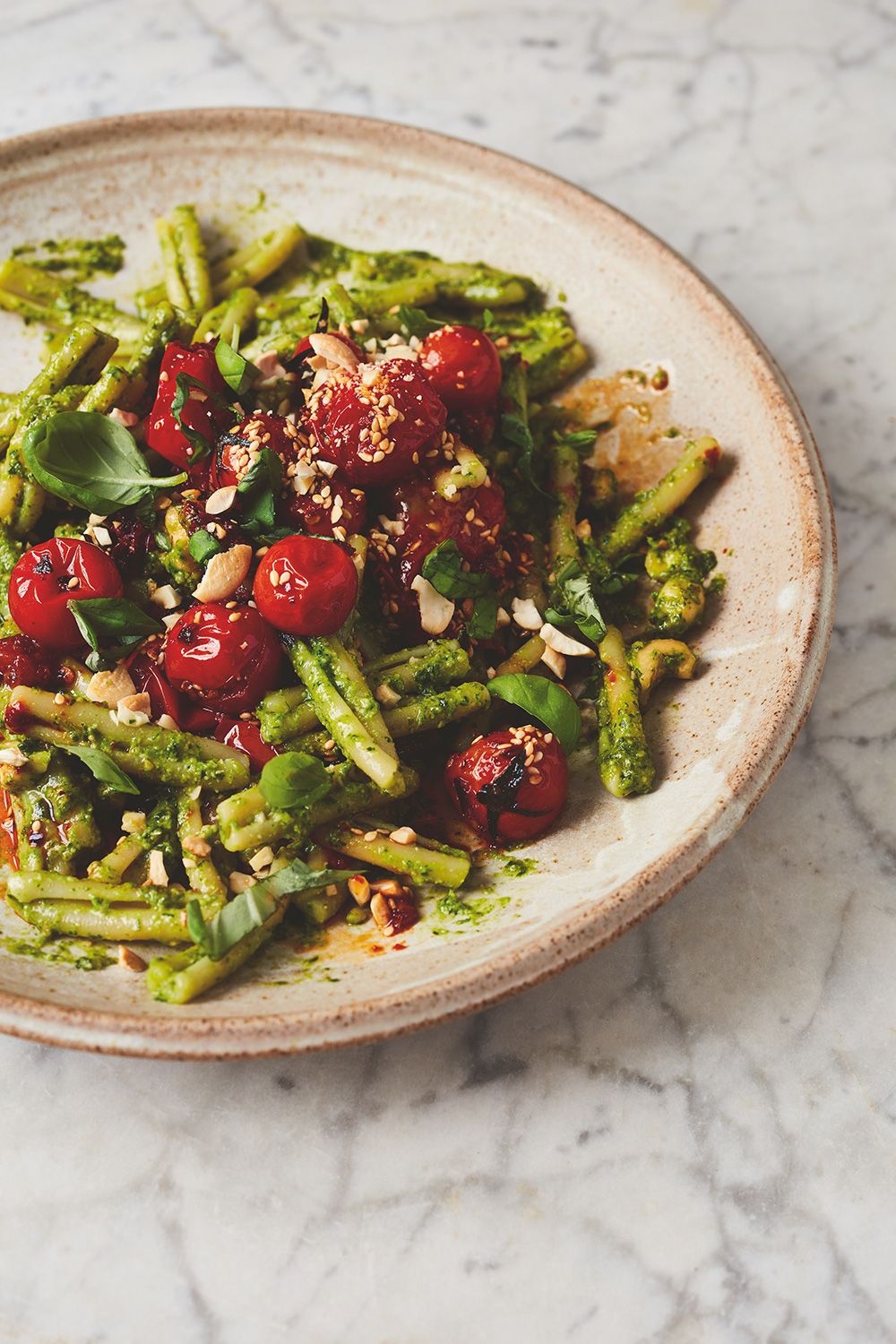
Serves:
4
10 g unsalted cashews (roughly 1 tbsp)
300-350 g pasta (my favourites are casarecce, penne or fusilli)
Salt and pepper
Handful of fresh basil leaves, thinly sliced, to garnish
Lemon wedges, to serve
For the pesto:
40 g (roughly 1/3 cup) unsalted cashews
70 g basil
1 large garlic clove, peeled
1 tbsp red miso
60 mL (1/4 cup) extra virgin olive oil
For the chili crisp balsamic roasted tomatoes:
500 g cherry tomatoes
1 tbsp olive oil
2 tbsp chili crisp or chili oil (Laoganma is my favourite brand)
2 tbsp white sesame seeds
1 tbsp balsamic vinegar
Step 1
To make the pesto, put all the ingredients into a food processor and blitz to your desired consistency. I prefer a rough-textured pesto that is not too pureed. Adjust the seasoning with salt to taste — but additional seasoning will come from the tomatoes.
Step 2
To make the chili crisp balsamic roasted tomatoes, preheat the oven to 230C (450F/fan 220C) and line a baking tray with parchment paper. Put all of the ingredients for the tomatoes on the lined baking tray and roast for 15 minutes. Give the tray an occasional shake and, after 7-8 minutes, use a wooden spoon to smash some of the tomatoes — the beginning of a jammy sauce. Once the tomatoes are done, use a metal spatula to scrape off all of the residual bits from the paper and mix them back into the sauce.
Step 3
While the tomatoes are roasting, toast the cashews in a dry pan over a low heat until lightly browned, around 3 minutes. Roughly crush the cashews — rugged is best. If you do not have a pestle and mortar, crush them on a cutting board, using the bottom of a pan.
Step 4
Cook the pasta in a pan of boiling salted water according to the packet instructions. Drain, reserving 120 mL (1/2 cup) of the pasta cooking water.
Step 5
Return the drained pasta to the pan, add the pesto and mix until fully combined. You may need to add some of the reserved pasta cooking water to loosen it. Dollop the roasted tomatoes on top of the pasta, followed by the crushed cashews, sliced basil and a lemon wedge.
CHILI, ORANGE AND CORIANDER SAUERKRAUT
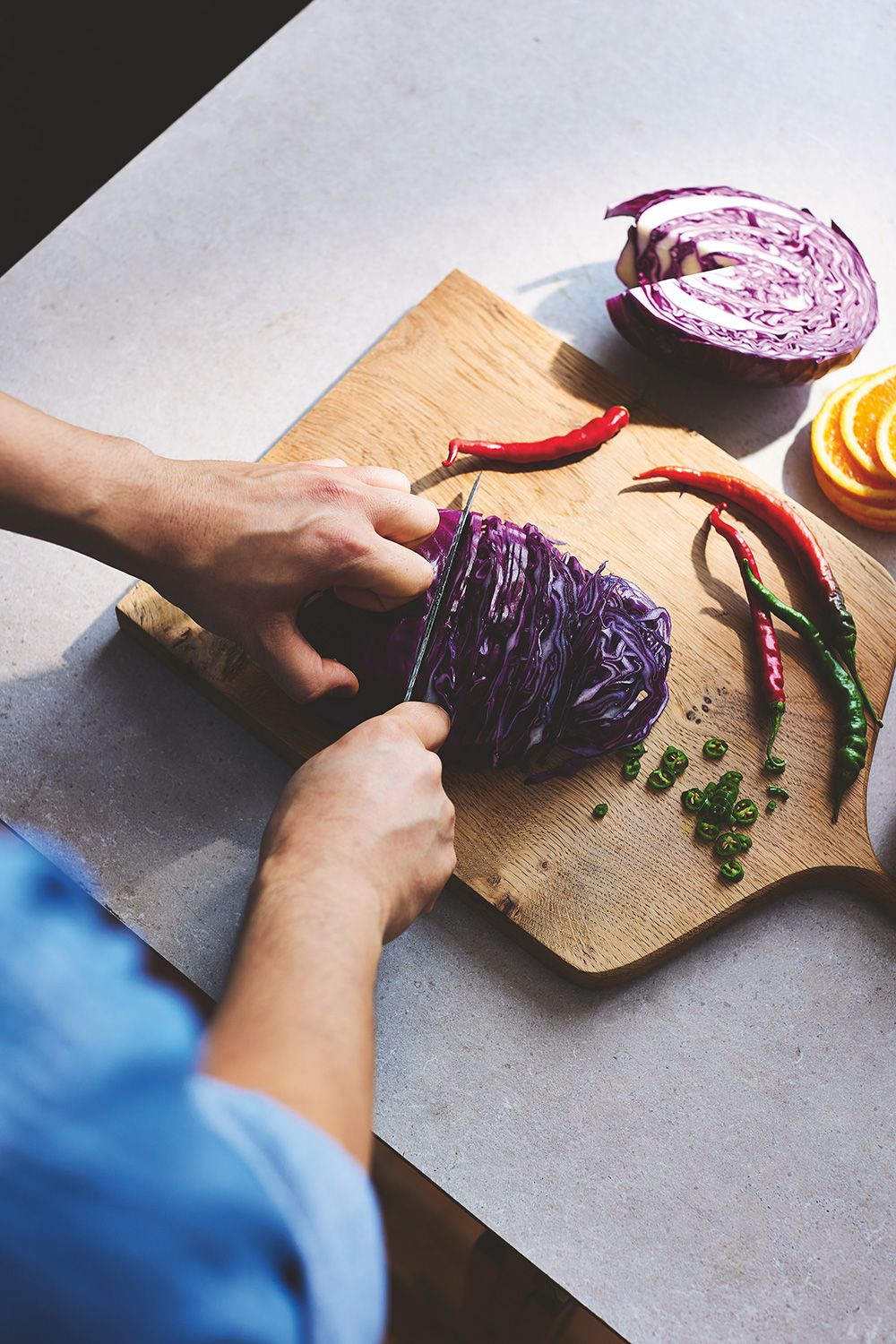
Makes:
a 1 litre jar
1 kg red cabbage
1 orange (peel included), thinly sliced
2 mild red chilies, thinly sliced (deseeded if you want to reduce heat level)
Measured salt: 2 per cent of the total weight of above ingredients
1 tbsp coriander seeds
Step 1
Halve the cabbage. Shred it finely using a sharp knife or a mandolin — I like to use as much of the cabbage as possible. Place the shredded cabbage in a bowl with the orange and chilies and calculate 2 per cent of that total weight. This is the amount of salt you will need.
Step 2
Remove the oranges and set aside. Add the salt to the sliced cabbage and chilies and massage for 5-10 minutes, using a fair amount of pressure to optimize the creation of brine. If you do not see much brine, continue massaging the cabbage and a pool of brine should appear. Add the sliced oranges and coriander seeds and mix it all together.
Step 3
Decant into your jar and pack it down to ensure there are no air pockets in your sauerkraut, allowing the brine to gather on top of the mixture. Use a food-safe fermentation weight to ensure everything is below the brine.
Step 4
Cover the jar and leave it at room temperature and out of direct sunlight to ferment for 2-5 weeks. After 2 weeks, start tasting the fermented cabbage. When you’re pleased with the flavour, move it to the fridge where it will keep indefinitely.
SAUERCACCIA

Makes:
12 squares
7 g (2 1/4 tsp) instant yeast
1 tsp sugar
350 mL (1 1/2 cups) lukewarm water (from the tap)
500 g white bread flour
3 tsp salt
1 tsp extra virgin olive oil, plus 2 tbsp for oiling the tray, plus extra to drizzle
1 tbsp semolina
250 g sauerkraut, gently squeezed
Flaky sea salt and pepper
Step 1
Put the yeast in a small bowl with the sugar and water and whisk together; leave aside for 5 minutes until frothy, which shows that the yeast is ready to be used.
Step 2
In a large bowl (or an electric mixer with a dough hook), mix the flour and salt with the yeasty liquid until fully combined. If using an electric mixer at medium-high speed, this should take 5-7 minutes. It’ll be a fairly sticky dough and should become stretchy. Scrape down the sides of the bowl and form the dough into a rough ball. Cover it with a teaspoon of extra virgin olive oil, using your hands to ensure there’s a layer of oil all over the dough. Then cover the bowl with a damp tea towel or plastic wrap, move it to a warm area of your kitchen and leave the dough to rise for an hour, until doubled in size.
Step 3
Pour 2 tablespoons of extra virgin olive oil into a 33 x 23 cm (13 x 9 inch) baking tray, ensuring it’s equally distributed, followed by a scattering of semolina: this will ensure the bread does not stick to the tray.
Step 4
Deflate the dough with a swift punch and scrape it onto the baking tray. Using your fingers (and a bit of force), spread the dough out so it completely covers the tray, pushing it into the corners. Cover with a damp clean tea towel or plastic wrap and leave to prove for a further hour.
Step 5
Preheat the oven to 230C (450F/fan 220C).
Step 6
Sprinkle the sauerkraut over the dough. Use your fingers to press the sauerkraut into the dough while continuing to spread the dough out over the baking tray. It may seem like a lot of sauerkraut, so take the time to ensure it’s evenly distributed both on top and throughout the dough. Drizzle with a little extra virgin olive and season generously with sea salt and pepper.
Step 7
Bake for 30-40 minutes or until the sides of the bread have released from the tray, the bread is golden, and the sauerkraut slightly charred and crispy. Leave to cool to room temperature before serving. This can easily be reheated in the oven.
Recipes and images excerpted from
Ferment: Everyday ferments and pickles, and how to eat them
by Kenji Morimoto, copyright ©2025. Published by One Boat.
Our website is the place for the latest breaking news, exclusive scoops, longreads and provocative commentary. Please bookmark nationalpost.com and sign up for our cookbook and recipe newsletter, Cook This, here.



