In the 4th century BC, at least four wooden plank boats arrived on the island of Als off the coast of Denmark. The unknown attackers were defeated and the defenders loaded their enemies' weapons into the swamp on one of these boats, known as the Hjortspring boat, most likely to give thanks for their victory. Archaeologists have now radiocarbon dated and analyzed the caulking and cord materials found on the boat, and have also discovered a partial human fingerprint found on a piece of caulking material. This remarkable fingerprint provides a direct link to the ancient sailors who used the Hjortsprings boat.
Photograph of a caulking fragment showing a fingerprint on the left and a high-resolution X-ray tomography of the fingerprint area on the right. Image credit: Erik Johansson/Sahel Ganji.
The Hjortspring boat was discovered in the 1880s during peat excavations in the Hjortspring bog on the island of Als off southeastern Jutland, Denmark.
Official exploration of the swamp and the discovery of the boat began in 1920 after the reunification of southern Jutland with Denmark.
The boat was excavated by Gustav Rosenberg between 1921 and 1922, and about 40% of the original boat was recovered from the swamp, allowing the boat's shape to be completely reconstructed.
The boat carried enough iron spearheads and shields to equip a war party of about 80 warriors—many more men than could fit inside the boat itself.
Based on these findings, it has been suggested that a party from an unknown location, traveling in four Hjortspring style boats, attacked the island of Als and were defeated, with the victors laying down the weapons of their defeated enemies along with one of their boats in the swamp to give thanks for the victory.
After excavations, the boat was preserved and has been on display at the National Museum of Denmark since 1937.
In a new study, Lund University archaeologist Mikael Vovel and his colleagues radiocarbon dated and analyzed some previously unstudied seal and cord materials found on the boat.
Using gas chromatography-mass spectrometry, they determined that the sealant most likely consisted of animal fat and pine resin.
At this point in history there were few pine forests in Denmark itself.
“It is possible that pine resin somehow found its way into Denmark through trade,” the researchers say.
“However, other coastal areas of the Baltic Sea, east of Denmark, did have pine forests, which leads us to believe that the boat may have been built in these regions, and that she and her warriors may have come from this direction.”
“If true, the boat would likely have traveled a long distance across the open ocean to reach Als, potentially indicating a particularly organized and deliberate attack.”
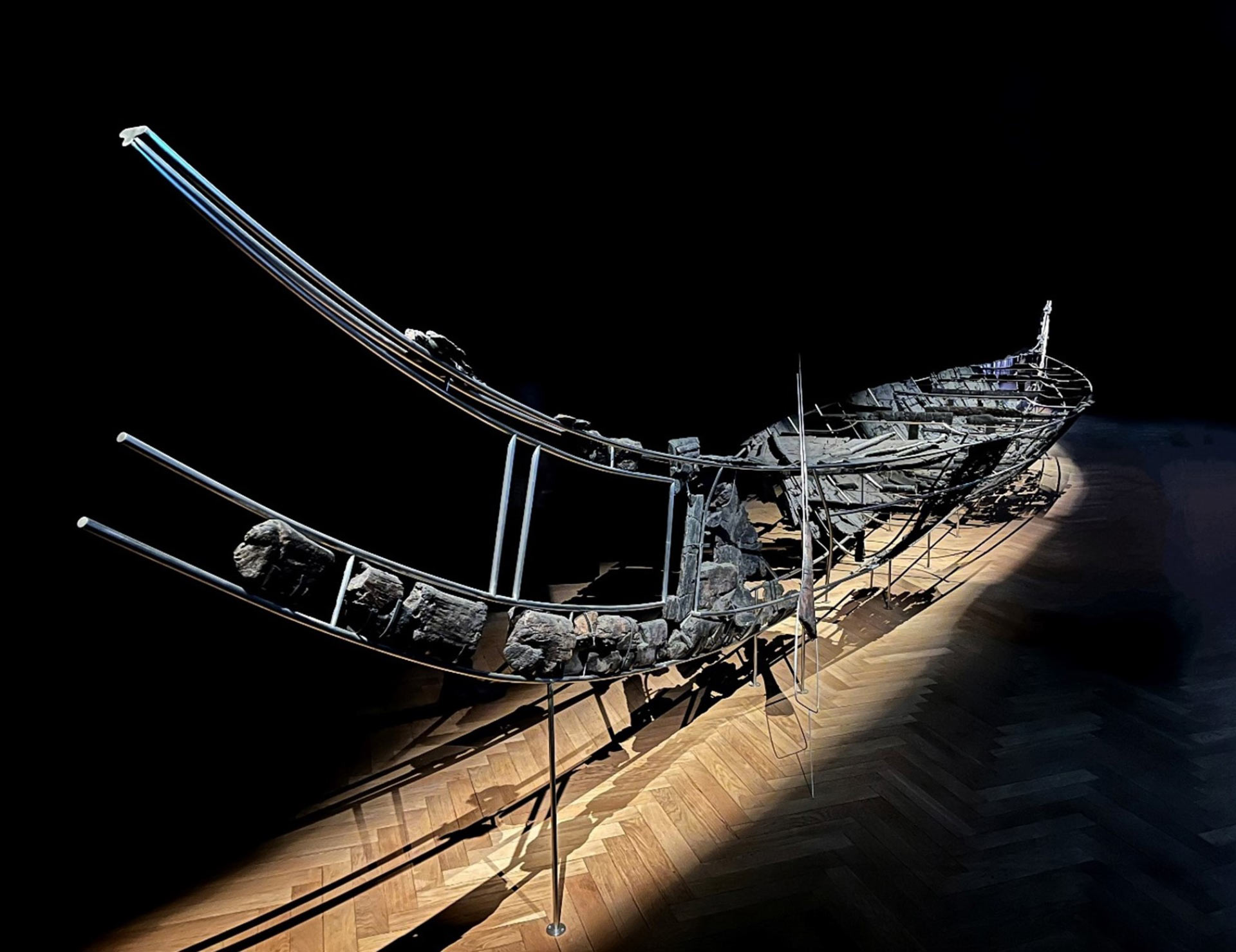
The Hjortspring boat is currently on display at the National Museum of Denmark. Image credit: Boel Bengtsson.
Radiocarbon dating of the cords and caulking showed that the boat was likely built sometime in the 4th or 3rd century BC, matching previous datings of wood from Hjortspring.
In addition, during the study, scientists discovered a partial human fingerprint on a piece of caulking material.
While they were unable to pinpoint where the fingerprint might have come from, it could have been left by one of the crew members while the boat was being repaired, providing a direct link to the ancient vessel's sailors.
“New analysis of Scandinavia's oldest plank boat takes us one step closer to solving the 100-year-old mystery of the ancient boat's origins,” they said.
“Using cutting-edge scientific techniques, we zeroed in on the Baltic Sea region as the most likely source of the approximately 2,400-year-old boat, and also discovered a fingerprint left by an ancient navigator in the resin used to waterproof the vessel.”
“The discovery of fingerprints on the resin fragments from the boat was a big surprise for us.”
“Fingerprints like this are extremely unusual for this time period.”
“It's nice to find a direct link to one of the people who used this ancient boat.”
“The boat was used by a small army of invaders who attacked the island of Als in southern Denmark more than 2,000 years ago.”
“The invaders were defeated and the local defenders sank the boat in the swamp as a sign of gratitude for the victory.”
“Ever since the boat was dug out of the swamp in the early 1920s, the question of where the invaders came from has remained a mystery.”
“The weapons they used, which were found in the boat, were quite common for the time and were used throughout northern Europe, giving us little indication as to their origin.”
“Over the last 100 years, several different theories of the boat's origins have been proposed, with some scholars suggesting that the boat's crew came from somewhere in northern Germany or perhaps another part of modern-day Denmark.”
“Now our scientific analysis of the boat's sealing material gives us our first important new clue in more than a century.”
“The boat was waterproofed with pine resin, which was rare in both Denmark and northern Germany in the first millennium BC.”
“We argue that this means the boat and its crew most likely came from the east, along the shores of the Baltic Sea, where pine forests were more abundant.”
“The boat was excavated before modern dating techniques were available, and much of the material from the boat was immediately preserved using chemicals that make radiocarbon dating impossible.”
“However, by looking through the archives, we were able to find some original ropes that had not survived.”
“We obtained a radiocarbon date from the rope, which showed a date range between 381 and 161 BC, which confirms the date of the boat as pre-Roman Iron Age.”
study was published online in a magazine PLOS ONE.
_____
Mr. Fauvel etc.. 2025. New research on the Hjortspring boat: dating and analysis of ropes and sealing materials used in a pre-Roman Iron Age boat. PLOS One 20 (12): e0336965; doi: 10.1371/journal.pone.0336965