
What comes next remains a mystery, but I would like to express my gratitude as 2025 fades into history.
If you are coming to Greater Los Angeles from Mexico via Calexico, Feliz Navidad.
If you once lived in Syria and settled in Hesperia, welcome.
If you were born in what used to be Bombay but raised your family in Los Angeles, Happy New Year.
I'm spreading some holiday cheer because it's been a terrible year for immigrants in general.
Under federal orders in 2025, Los Angeles and other cities were invaded and workplaces raided.
Immigrants were persecuted and protesters were beaten.
Their livelihoods were deprived and their loved ones were deported.
Despite all the insults and name-calling from the man upstairs, you would never guess that his mother was an immigrant, and his three wives included two immigrants.
President Trump mentioned Somalis like trash and he wondered why the US couldn't invite more people from Scandinavia and fewer from “dirty, dirty and disgusting” countries.
Not to be outdone, Homeland Security Chief Kristi Noem has proposed a travel ban to countries that “flooding our nation with murderers and leeches and privilege addicts.”
The president's schtick is that he mainly criticizes those who are in the country without legal status, and especially those who have a criminal record. But his tone and language do not always make such distinctions.
The goal is to divide, assign blame and create suspicion, so legal residents, including Pasadena Mayor Victor Gordo — told me that they always carry passports with them.
In fact, thousands of people with legal status have been forced out of the country, and millions more are at risk of suffering the same fate.
In a more advanced political culture, it would be easier to stipulate that immigration has costs and benefits, that it is human nature to flee from difficulties in search of better opportunities wherever they may be, and that laws can be passed that meet the needs of immigrants and the industries that depend on them.
But 2025 was the year the nation was taken in a different direction, and it was the year it became even more comforting, even liberating, to call California home.
The state is a deeply flawed enterprise, with its staggering wealth and income gaps, homelessness disaster, housing affordability crisis, and racial divisions. And California is not politically monolithic, no matter how blue it may be. He has millions of Trump supporters, many of whom applauded the news reports.
But there is an understanding, even in largely conservative regions, that immigrants, documented and undocumented, are an important part of the muscle and brains that help run the world's fourth-largest economy.
This is why some states Republican lawmakers ask Trump to back down when he first sent masked squads on raids, stifling the construction, farming and hotel sectors of the economy.
When the raids started, I called gardener I wrote about many years ago after he was shot in the chest during an attempted robbery. He insisted on leaving the hospital emergency room and returning to work immediately because the bullet was still in his chest. He had been hired by a client to complete landscaping work for Christmas as a gift for his wife, and the gardener was determined to get the job done.
When I contacted the gardener in June, he told me he was laying low because although he had a work permit, he didn't feel safe because Trump had promised to end Temporary Protected Status for some immigrants.
“People look Hispanic and they get arrested,” he told me.
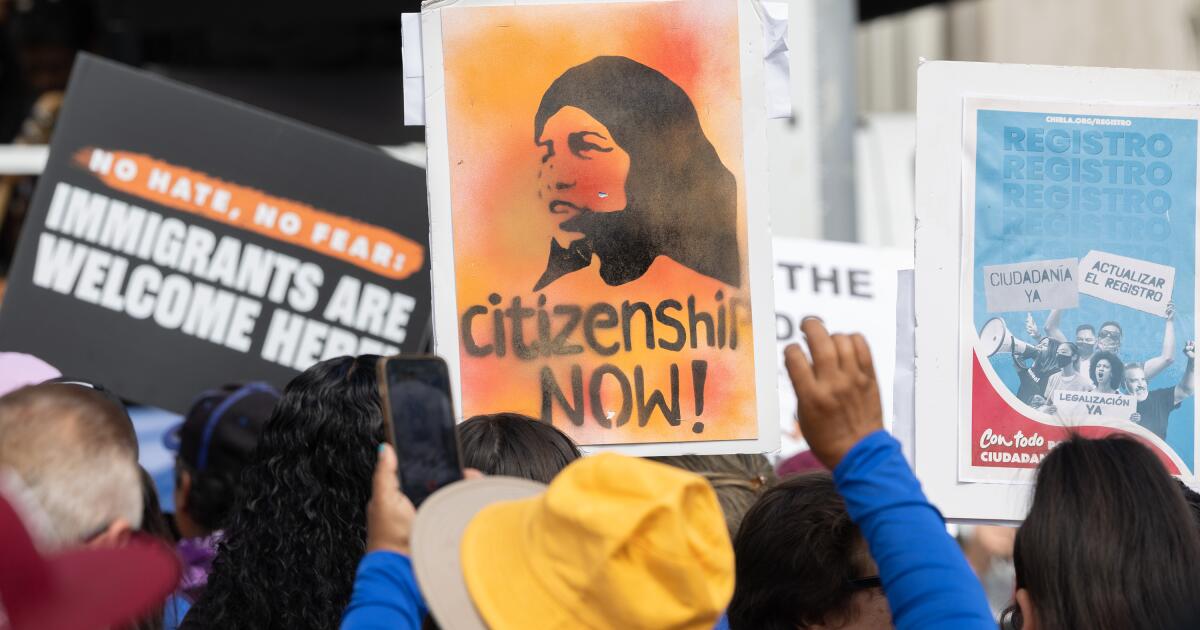
He said his daughter, whom I met two decades ago when I gave $2,000 to a family of readers, was planning a demonstration on his behalf. I met her at the No Kings rally in El Segundo, where she told me why she wanted to protest:
“To show your face to those who cannot speak and say that we are not all criminals, we all stick together, we support each other,” she said.
Mass deportations will tear apart $275 million hole in state economywhich critically impacts agriculture and health care among other industries, according to a report from the University of California, Merced and the Bay Area Council Economic Institute.
“Deportations tend to increase unemployment among U.S.-born and documented workers by reducing consumption and disrupting complementary occupations,” the expert says. UCLA Anderson report.
Californians understand these realities because they are not hypothetical or theoretical—they are part of everyday life and commerce. Near three-quarters of state residents believe immigrants are good for California “Because of their hard work and professional skills,” says the Public Policy Institute of California.
I'm a California native whose grandparents were from Spain and Italy, but the state has changed a lot in my lifetime and I don't think I ever really saw it clearly or understood it until I was asked to speak at Cal State Northridge's freshman reunion in 2009. The demographics were similar to today – more than half Hispanic, one in five white, 10% Asian and 5% black. And about two-thirds were first-generation college students.
I watched thousands of young people set out to find their path and make their mark, and among the students were a handful of proud parents and grandparents, many of whose stories of sacrifice and aspiration began in other countries.
It is part of the lifeblood of the state's culture, cuisine, commerce and sense of possibility, and these students are now our teachers, nurses, doctors, engineers, entrepreneurs and technical geniuses.
If you left Taipei for Monterey, said goodbye to Dubai and packed up for Ojai, traded Havana for Fontana or Morelia for Visalia, thank you.
And Happy New Year.



