Ruth CleggHealth and Wellness Reporter
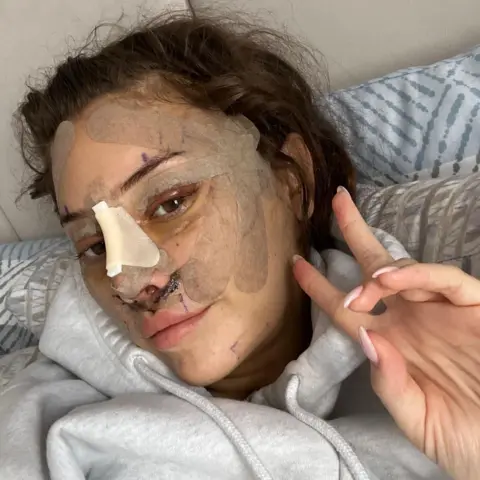 @hotgirlenhancements
The facelift is entering new territory.
A quick search on social media and my feed is flooded with posts from people in their 20s and 30s discussing different types of facelifts – mini, ponytail, deep plane.
Gone are the days when facelifts were the preserve of aging rich people – now more and more young people are choosing to go under the knife.
Some are happy to share photos of their faces before, after and with bruises in between – an often very painful recovery.
It's no longer a procedure that's talked about in secret, with celebrities like Kris Jenner, Catt Sadler and Marc Jacobs talking openly about their treatments. Rumor has it that many others had it.
A facelift is often considered a last resort, the most serious of cosmetic surgeries.
Will people become so insecure in the often fake online world that they will have to pay thousands of pounds for this operation?
Or have we had so many non-surgical treatments like Botox and fillers that removing skin from the cheekbones and redistributing facial tissue and fat seems like a logical and longer lasting next step?

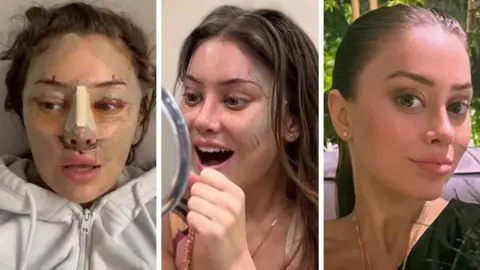 @hotgirlenhancements
For Emily, who had a facelift at 28, it was about getting the “cut out look” – a sculpted, sharp jaw, high cheekbones and fox-like eyes. She says the surgery in Turkey “changed her life” and she doesn't regret it.
“I had a total of six surgeries in one,” she explains. “Among them, I had a midface lift, a lip lift and a rhinoplasty. [nose job]”
Describing the process, the Toronto, Canada, businesswoman says the surgeon played her favorite song while she was under general anesthesia, and then, “I fell asleep, woke up, threw up, and had a new face and a new nose.”
The recovery process was long – the pain and bruising began to subside within the first few weeks, but it took Emily six months to regain feeling in parts of her cheeks.
Would she do it again? She hesitates.
“After the operation I changed my life. I have become healthier, I drink much less, I take care of my skin, and I sleep. I think if I had known what I know now, I might not have gone through this.
“My mom didn’t even know until I told her a couple days after the surgery.”
But then she stops and thinks.
“But I just wanted to be the best version of myself,” Emily says, “and now I think I am.”
Data from the British Association of Aesthetic Plastic Surgeons (BAAPS) shows an 8% rise in facelift surgeries over the past 12 months in the UK. They don't break down the numbers by age, but many members report that demographics are changing.
This is reflected in other parts of the world, with the American Society of Plastic Surgeons seeing a rise in the number of Gen Xers (ages 45 to 60) opting for a facelift.
Nora Nugent, president of BAAPS, says there are many reasons for the changes, including the rise in popularity of weight-loss drugs.
“Rapid weight loss with these drugs can leave you with a lot of excess skin. A facelift can help with this,” she says. “Technology has evolved significantly: a facelift no longer means taking risks with that wind tunnel.” [an overly stretched face as a result of the skin being pulled back] effect on the face we saw many years ago.”
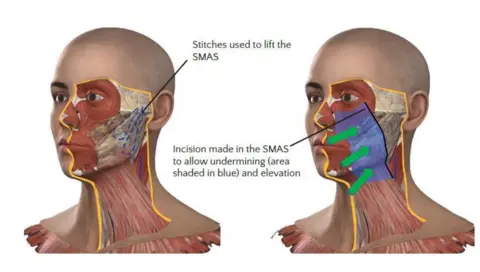 BAAPS
BAAPSHowever, a facelift is still an important procedure that should only be performed by a board-certified plastic surgeon in a registered facility with the appropriate equipment, she says.
At his Bristol clinic, consultant plastic surgeon Simon Lee has performed hundreds of facelifts and shows me a video of one.
The client remains conscious during the procedure as a small amount of local anesthetic is injected into the skin and deeper tissue underneath.
He makes a series of small incisions on her face before penetrating the skin, fat and superficial fascia (SMAS) – the part of the face that controls our facial expressions – and then reaching the deep plane where he repositions tissue and muscle to reshape the face.
When he finishes, the client, who has been under the knife for four hours, smiles with relief.
According to Mr Lee, one of the reasons the procedure has become more attractive is the ease with which face and neck lifts can now be performed. Once used in a hospital room and requiring general anesthesia, he now performs face and neck lifts without sedation in his clinic.
He said it's an “exciting time” in the industry and things are happening at a rapid pace. While the classic facelift, which focuses on the lower jaw and neck, is still popular, there are new treatments that target the upper two-thirds of the face, where he says the aging process begins and is noticeable at a younger age.
The surgeon cautions that a facelift is suitable for people over 40, but it would be very unusual to perform such a complex procedure on someone in their 20s or 30s.
Eat risks and complications associated with this type of procedurefor example, the formation of a hematoma, a collection of blood under the skin that, if left untreated, can lead to necrosis (death of surrounding tissue), infection, nerve damage, and alopecia.
In the UK, a facelift costs on average £15,000–45,000, but there are clinics offering these procedures for as little as £5,000.
Experts say it's important to do your research and choose a plastic surgeon who specializes in facelifts.
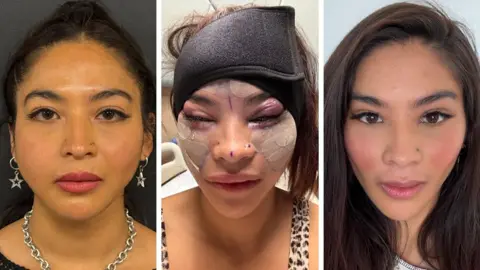 Julia Guilando
Julia Gilando, 34, decided she needed a facelift to correct facial asymmetry after having trouble aligning her jaw earlier in life.
Although many of her friends said they didn't see a problem with her face, she sensed it, “trusted her gut” and flew to Turkey for the procedure, which cost $8,000 (£6,000).
Despite warnings about risks associated with cosmetic surgery in Turkey it is becoming increasingly popular, mainly due to lower prices.
“At first I thought the whole idea was crazy, but I did my research and decided to go for it,” says Ms. Guilando, a health professional. “I was scared, I was in a foreign country, I was alone and I didn’t speak the language.
“After the operation I spent two days in the hospital and then I had to fend for myself. I was so swollen that I couldn’t see anything.
“There were some dark times, it was a whole mental rollercoaster of emotions, you go through ups and downs.”
Researchers are concerned about whether such cosmetic surgery procedures provide the self-esteem and confidence that the industry touts.
“I think there is unprecedented pressure,” explains Dr Kirsty Garbett, a body image expert at the Center for Appearance Research at the University of the West of England. “Especially when it comes to the face – we see ourselves on video calls, on social media, it’s so easy for us to compare ourselves to others.”
And she says that what we see is not necessarily a true reflection of reality.
“AI, filters, everything plays a role in creating a fake online world. And at the same time, we are seeing an increase in the normalization of cosmetic procedures.”
She said celebrities being more open about such surgeries is good in some ways, but it also normalizes them, making them “just part of life, and that's really concerning.”
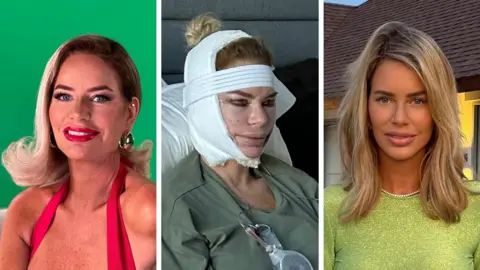 Caroline Stanbury
Caroline Stanbury, TV presenter and one of the Real Housewives of Dubai, had a facelift two years ago at the age of 47, despite everyone telling her not to because she was too young.
“It was the best thing I've ever done,” Caroline says. “Why do I want to wait until I'm 60, I'm desperate and I need it? I want to look and feel amazing now.”
After spending 20 years on regular Botox and fillers, she felt she was “starting to look weird.” She paid $45,000 (£34,000) for a deep facelift in the US.
“I still look like me, and this procedure has given me another 20 years of feeling great,” she says.
Alexis Verpaele, a plastic surgeon from Belgium who has clients from all over the world, including the UK, says he is concerned about the growing number of young people coming for treatment.
He often talks in detail to these clients about how they can achieve a certain look without something as major as surgery.
“If they get a facelift at age 20, and we know it can last 10-15 years, let’s say.
“So by the time they're 60, they'll probably have had three facelifts,” says De Verpaele.
“It's a lot of trauma for one person – and it's a best-case scenario without any complications.”