

Donovan Slack,
Grace Eliza GoodwinAnd
Kayla Epstein
 Reuters
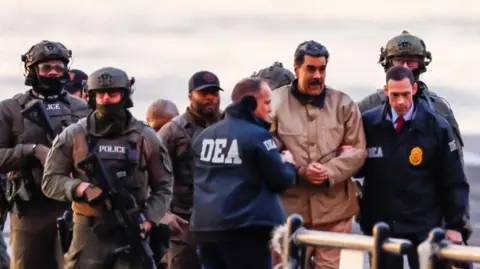
Just 48 hours after U.S. troops took Nicolás Maduro and his wife from a compound in Caracas, the Venezuelan leader appeared in a New York court and pleaded not guilty to conspiracy charges brought by the U.S. government.
As the world grapples with the United States' highly unusual military takeover of another world leader, the criminal case against Maduro will be processed through the justice system like any other brought in New York, based on evidence and U.S. law.
Prosecutors alleged in their charging document that Maduro, his wife and son, and their associates participated in a cocaine trafficking conspiracy and collaborated with cartels designated as terrorist groups.
They said the defendants “abused their position of public trust and corrupted once legitimate institutions to import tons of cocaine into the United States.”
Previously, Maduro called such accusations a tool for the implementation of “imperial” plans to gain access to Venezuela’s rich oil reserves.
In court Monday, his lawyer suggested that he should be protected from prosecution as the leader of a sovereign country and that his capture by force by the United States was unlawful.
As he left the court, Maduro said in Spanish that he was a “kidnapped president” and a “prisoner of war.”
His wife, Celia Flores, was in good spirits, according to a statement from her lawyer, Mark Donnelly, who added that “we look forward to reviewing and challenging the evidence the government has.” She also pleaded not guilty.
In a 25-page indictment, U.S. prosecutors laid out a case that allegedly began in 1999, when Maduro was first elected to public office, saying he, Flores, his son Nicolas Ernesto Maduro Guerra and three others engaged in a “ruthless cocaine trafficking campaign.”
Divine (2.
The United States is offering a reward for information leading to the arrest of Cabello Rondon and Guerrero Flores, who were indicted in New York in December on charges of racketeering, drug trafficking and other crimes.
After the US raid, Cabello Rondon appeared on television in Venezuela, urging residents to “trust our leadership, trust our military and political leaders in the situation we face.”
A total of six people face four charges, including participation in a drug conspiracy with certain terrorist groups, conspiracy to transport cocaine into the United States, and possession and use of illegal weapons – primarily machine guns – in furtherance of the alleged conspiracy.
The indictment accuses them of collaborating with the FARC (Revolutionary Armed Forces of Colombia), the Sinaloa and Zetas cartels, and Tren de Aragua. In February 2025, the US government listed them as a terrorist group.
Prosecutors say the defendants provided “law enforcement cover and logistical support” for drug shipments through Venezuela, knowing they were headed to the United States.
Before becoming president, Maduro issued passports to drug traffickers and “facilitated diplomatic cover for planes used by money launderers to repatriate drug proceeds from Mexico to Venezuela,” according to the U.S. government.
After taking office in 2013, he allegedly allowed the drug trade “to flourish for his own benefit, for the benefit of members of his ruling regime and for the benefit of members of his family.”
Prosecutors say his wife, who was the leader of Venezuela's National Assembly, received hundreds of thousands of dollars in bribes, including kickbacks for the safe passage of drug shipments.
The pair allegedly ran state-sponsored gangs and “ordered kidnappings, beatings and murders of those who owed them drug money or otherwise undermined their drug trafficking activities.”
Meanwhile, prosecutors accuse Cabello Rondon of collaborating with Colombian drug traffickers to facilitate massive shipments of cocaine to Mexico and eventually the United States.
Rodríguez Chacín allegedly maintained an estate that housed a FARC camp and training school and is accused of accepting bribes from the group to protect it from arrest and prosecution.
Maduro's son, Maduro Guerra, is accused of regularly visiting Margarita Island off the coast of Venezuela on a plane carrying packages that military officials believe contained drugs.
Prosecutors also allege that in 2017, he worked to ship hundreds of kilograms of cocaine to Miami and “spoke with his drug trafficking associates about, among other things, shipping substandard cocaine to New York because it could not be sold in Miami, arranging for the unloading of a 500-kilogram load of cocaine from a shipping container near Miami, and using scrap metal containers to smuggle cocaine into New York ports.”
On Monday, Maduro Guerra criticized the US operation as a “direct threat to global political stability.”
“If we normalize the kidnapping of a head of state, no country will be safe,” the Venezuelan congressman said.
In the indictment, prosecutors also asked for the confiscation of the defendants' property and money.
U.S. District Court Judge Alvin Hellerstein has scheduled the next hearing in the case for March 17.
It is difficult to assess the legal strength of the case against Maduro because the indictment does not specify the evidence prosecutors have against him, said defense lawyer and former federal prosecutor Sarah Krissoff.
Typically, international drug trafficking charges or charging documents contain “a lot of inference and little specificity,” said Krissoff, who worked for more than a decade in the court where Maduro is being tried.
Technically, the document is not required to detail the evidence prosecutors have against a defendant, and in large-scale drug trafficking cases like this one, much of that evidence is confidential or classified, she said.
Krissoff expects parts of the trial will be closed to the press and public, and defense attorneys will have to obtain security clearance and review some material in highly secure areas the government uses for classified intelligence work.
Prosecutors have a “real advantage” in the case against Maduro because they have been building the case for more than a decade, she added.
Several legal experts interviewed by the BBC, including Milena Sterio of Cleveland State University College of Law, believe the US operation to bring Maduro to New York violated the UN Charter and other international law.
But now that Maduro is in the United States, under U.S. domestic law, he can almost certainly face trial, Sterio said.
“Our courts have long recognized that for a defendant, even if he is abducted, abducted or forcibly brought to the United States, this is not grounds for dismissal of the case,” she said.
The BBC has approached Maduro's lawyer for comment.



