 Getty Images
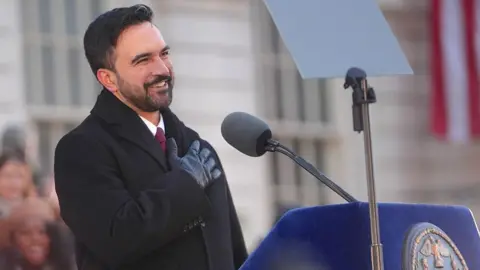
On the first crisp day of winter in 2026, surrounded by thousands of cheering New Yorkers and progressive Democratic allies, New York City Mayor Zohran Mamdani promised to tell “a new story for our city.”
“City Hall will deliver a program of safety, affordability and abundance—where government looks and lives like the people it represents,” he told the crowd in his inaugural address.
It was that message that propelled the 34-year-old Democratic Socialist to a surprise election victory in November. His bid to lead the most expensive city in the United States included big changes such as universal child care, free public buses and city grocery stores.
But the mayor will likely face a number of challenges in trying to deliver on those promises, and he'll have to keep other important political stakeholders in the loop—starting with his first full day in office.
“He will bring all his political and other power to bear to achieve these goals,” said Patrick Egan, a professor of politics and public policy at New York University. But, he said, New York is “a big and complex place, so you can't bet on whether these things can happen or not.”
1. Payment for political promises
Mamdani's high-profile policy platform focuses on cost-of-living issues, including freezing rent increases for subsidized housing and providing universal free child care.
Government experts say he will be able to achieve some of his policy goals on his own and without significant costs. For example, if he wants to freeze rents on subsidized housing, he could appoint people who agree with the policy to the city's rent control board.
But finding funding for other goals when the state and city face budget shortfalls will prove difficult, government experts say.
“If he wants to provide free bus service and free child care, those kinds of things are going to cost money,” said Robert Shapiro, a professor of international and public affairs at Columbia University. “The big obstacle to doing what he would like to do is New York State, the financial capacity of the state and the political will of the governor.”
Mamdani said some funding would come from new taxes. He believes taxes on the rich could rise by up to $9bn (£6.6bn), while he has pledged to raise the corporate tax rate from 7.25% to 11.5%.
But Mamdani needs the support of the state government to make tax changes.
More moderate Democratic Gov. Kathy Hochul supported his entry into the race last year, as well as some of his affordability goals. But Hochul, who is making her own political calculations as she runs for re-election this year, has already signaled she may not support Mamdani's broader tax plan.
2. How to avoid White House interference
In the weeks leading up to the New York mayoral election, President Donald Trump took to social media and in news briefings to attack Mamdani, a rising star in the Democratic Party, as a “communist” mayor who threatens the future of the United States' largest city.
Trump has threatened to withhold billions of federal dollars from the city if Mamdani is elected.
But the first meeting between the future mayor and the president last November turned out to be much more friendly than expected. The two men often smiled and praised each other, and Trump told Mamdani he was “confident that he can do a very good job.”
However, the two politicians' diametrically opposed policy positions could lead to conflict as Mamdani heads City Hall. Immigration can be a point of tension.
For now, New York has not been the target of Trump's efforts to send in National Guard troops, as he has done in Democratic-led US cities in response to anti-immigration protests.
But the Trump administration has stepped up immigration raids in New York as part of its efforts to enforce laws in several cities.
Meanwhile, in his victory speech, the mayor promised that New York “will remain a city of immigrants, a city built by immigrants, fueled by immigrants and…led by immigrants.”
3. Engage business leaders
Mamdani's shock victory in the New York City Democratic mayoral primary in June sent Wall Street leaders into a frenzy.
Some business leaders have threatened to leave the city, while others have spent millions behind the scenes trying to rally support behind other mayoral candidates.
But as Mamdani maintained his status as the leader of the race, some of these views began to change. The current mayor reached out to his opponents in the business world to hear their concerns.
Mamdani promised to meet with leaders, including JPMorgan Chase CEO Jamie Dimon, who later said he would offer to help if Mamdani was elected.
Mamdani also met with real estate developer Jeffrey Gural, who called him “personable” and “smart.”
Still, Gural and others in the business community continue to express concerns that the 34-year-old lacks the experience to lead the nation's largest city and that his plans to raise taxes on corporations and wealthy individuals will force some of them to leave New York.
Mr Egan said it remained to be seen whether the “spirit of collaboration” between business leaders and Mamdani would continue as he moved forward with an agenda that was ideologically at odds with some of their goals.
“Any mayor of New York needs cooperation from business leaders, particularly in finance and real estate, which play a big role here in New York,” he said.
4. Ensuring public safety
As mayor, Mamdani will face the perennial challenge for New York City leaders to fight crime and maintain a sense of security for New Yorkers.
Like many major cities, New York has seen a surge in crime during the Covid pandemic, although the city's homicide and shooting rates fell to near record lows in 2025.
This drop in crime gives Mamdani “a little wiggle room to think creatively” about public safety in New York, including improving social services and supports, Mr. Egan said.
Mamdani promised to create a Department of Public Safety that would invest in mental health programs and crisis response, as well as deploy outreach workers to subway stations throughout the city.
Outgoing Mayor Eric Adams' administration also deployed outreach workers to subway stations and established other housing and mental health programs. But some experts and community leaders say these efforts have failed to adequately address homelessness and mental health issues.
Democratic strategist Howard Wolfson, an adviser to former New York City Mayor Mike Bloomberg, said he and others will judge Mamdani primarily on how the city handles policing and how shoplifting and quality-of-life crimes are handled.
Mamdani convinced some business leaders and members of the public with his decision to ask Police Commissioner Jessica Tisch, who served in the Adams administration, to remain as police chief.
“Public safety is really a bit of a prerequisite for success or failure,” Mr Wolfson previously told the BBC. “I think if people feel safe here, they can withstand a lot of other problems. And if they don’t do that, there aren’t many other problems they’re willing to put up with.”