

 Peter Daisley/Getty Creative
From June 2025, companies are prohibited from selling or supplying disposable vapes in the UK.
The government said the ban would reduce environmental damage and help reduce the number of children and young people vaping.
How does the disposable vape ban work?
Ban on disposable vapes applies to both stores and online stores.
People caught breaking the law in England face a minimum fine of £200 and up to two years in prison for a repeat offence. Penalties are broadly similar in Scotland, Wales and Northern Ireland.
Trading Standards may confiscate any disposable e-cigarettes sold.
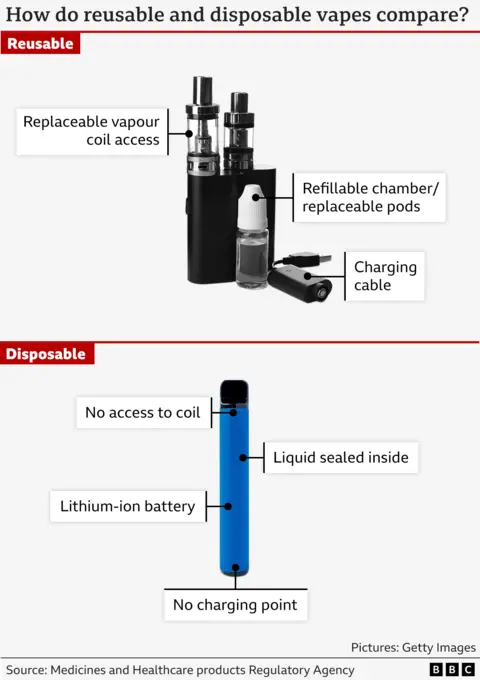
Only reusable devices can be legally sold. They must have a rechargeable battery, replaceable coil and be reusable.
Electronic cigarettes should be returned to stores or recycling centers for specialized treatment.

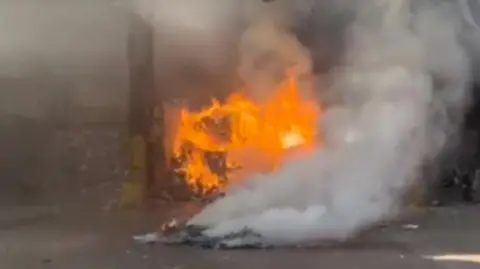
However, recycling company Biffa told the BBC it had noticed an increase in the number of vapes improperly mixed into general recycling since the ban. He said this led to an increase in the number of fires.
Vapes contain lithium-ion batteries, which can catch fire if crushed in garbage trucks or recycling centers. Biffa said it dealt with 60 fires caused by vapes and other small electrical devices in June alone.
Another of Britain's biggest recycling companies, Veolia, said vapes and other battery-powered devices were causing fires in its trucks and sites every day.
 BIFA
BIFAWhy are disposable vapes bad for the environment?
Almost five million disposable e-cigarettes were discarded every week in 2023, according to the Department for Environment, Food and Rural Affairs (Defra).
Vapes contain circuit boards that can release toxic compounds such as cobalt and copper if not properly disposed of, posing a risk to fish and marine mammals.
These minerals and lithium, if properly recovered, can be reused for clean technologies such as batteries for electric vehicles or in wind turbines.
However, recycling e-cigarettes is not an easy task due to their size and production method, which makes them difficult to disassemble.
How else are vaping regulations changing?
How many children and adults smoke cigarettes?
Although it is illegal to sell or supply vapes to anyone under 18, the number of children vaping has risen sharply in recent years.
Around 20% of children aged 11 to 17 (1.1 million) in the UK. tried vapingAccording to a 2025 survey by the charity ASH (Action on Smoking and Health).
About 7% (400,000 children) said they currently smoke e-cigarettes, and 3% (160,000) said they use e-cigarettes daily. Older children were more likely to vape.
ASH found that 2.8% of children ages 11 to 17 said they smoked cigarettes or vaped.
 Getty Images
According to the ASH study, 10% of people over 18 in the UK said they smoke e-cigarettesabout 5.5 million people. That's down slightly from 2024, suggesting vaping use may be leveling off.
About 13% of adults said they smoke, a figure that has remained the same since 2021.
The survey found that 55% of current vapers were former smokers, and 40% still smoke.
How harmful is vaping for children and adults?
Vaping is nowhere near as harmful as smoking cigarettes, which contain tobacco, tar and a range of other toxic chemicals that cause cancer, and is one of the biggest preventable causes of illness and death in the UK.
But because vaping itself can cause long-term damage to the lungs, heart and brain, it is only recommended for adult smokers trying to quit as part of the NHS swap to quit programme.
The inhaled vapor contains small amounts of chemicals, often including the addictive substance nicotine. which poses a greater risk to young people than adults.
“Vaping can be an effective way for adult smokers to quit smoking, but we have always been clear that children and non-smoking adults should never smoke,” the Department of Health and Social Care (DHSC) said.
More research is needed to fully understand the effects of vaping, but in December 2023 the World Health Organization (WHO) warned that “worrying evidence” of the harm it caused was growing.
In February 2025, the government said a £62 million research project would track 100,000 children aged 8 to 18 for a decade to better understand the risks.



