

IN new paper published this month in the magazine iScienceresearchers from the University of Tübingen and other organizations present an interdisciplinary analysis of the impact points of stones and bones associated with wise man in the Early Upper Paleolithic (40–35 thousand years ago). By combining experimental ballistics, detailed measurements and wear analysis, they concluded that some of these ancient artifacts corresponded to bow-propelled arrows, not just hand-thrown spears or spear darts.
In the Early Upper Paleolithic, people may have used bows and arrows as well as spear throwers. Image credit: sjs.org/CC BY-SA 3.0.
For decades, archaeologists assumed a linear progression of weapon technology, from hand-held spears to spear throwers and finally to the bow and arrow.
But University of Tübingen researcher Keiko Kitagawa and his colleagues argue that the development of technology was not a simple sequence.
“Direct evidence for the existence of hunting weapons is rare in the archaeological record,” they said.
“Prehistoric hunting weapons range from hand-held spears, which are effective for close-range hunting, to spear-throwers, and bow arrows, which are used for mid- to long-range hunting.”
“The earliest manifestations of such tools are wooden spears and throwing sticks, dating from 337,000 to 300,000 years ago in Europe.”
“Antler objects interpreted as spear-throwing hooks begin to be documented in the context of the Upper Solutrean (c. 24,500–21,000 years ago), and they become more prominent in the Magdalenian (21,000 years ago) from Southwestern France with almost a hundred specimens.”
“Meanwhile, bow and arrow technology is found only in exceptionally well-preserved contexts at the Late Paleolithic sites of Mannheim-Vogelstang and Stellmoor, Germany, dating to 12,000 years ago, and the Early Mesolithic site of Lilla Loshults Mosse, Sweden (about 8,500 years ago), making it much younger than other projectile technologies.”
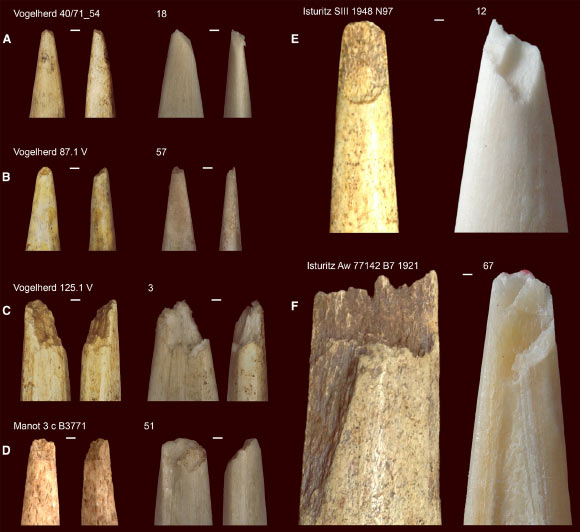
Archaeological examples from Aurignacian sites: Vogelherd in Germany, Isturitz in France and Manot in Israel compared with experimental samples. Image credit: Kitagawa etc.., document number: 10.1016/j.isci.2025.114270.
In their paper, the authors suggest that early modern humans likely experimented with multiple systems simultaneously or in overlapping phases, reflecting differential adaptations to different ecosystems and prey types.
The evidence comes from how these ancient projectile points break and wear out with use.
When stone and bone points were attached to shafts and fired in controlled experiments, the patterns of breakage and microdamage for some specimens were consistent with what would be expected from arrows fired from a bow, not just spears or darts.
“We focus on Upper Paleolithic bone projectiles, including split and massive horn and bone points, which were primarily found in Aurignacian contexts in Europe and the Levant between 40,000 and 33,000 years ago,” the scientists said.
“Our goal is to find out whether the type of weapon on which Aurignacian bone projectile points were collected can be determined from their wear patterns and their morphometry.”
The results are consistent with earlier archaeological research showing evidence of bow and arrow use in Africa as far back as about 54,000 years ago – older than once thought and earlier than some European archaeological evidence.
Importantly, the team does not claim that wise man the bow was invented everywhere at the same time and that bows were not exclusive weapons.
Instead, it suggests the presence of a diverse technological repertoire early in human expansion into new territories.
“Our study demonstrates in part the challenging nature of reconstructing projectile technology, which is often created from perishable materials,” the researchers concluded.
“While it is impossible to account for all the variables that influence the physical properties of reinforcement and the resulting damage, a series of experimental programs designed to explore the multifaceted nature of projectiles in the future can hopefully shed more light on one of the important pillars of the hunter-gatherer economy.”
_____
Keiko Kitagawa etc.. wise man could hunt with bows and arrows from the beginning of the Early Upper Paleolithic in Eurasia. iSciencepublished online December 18, 2025; doi: 10.1016/j.isci.2025.114270



