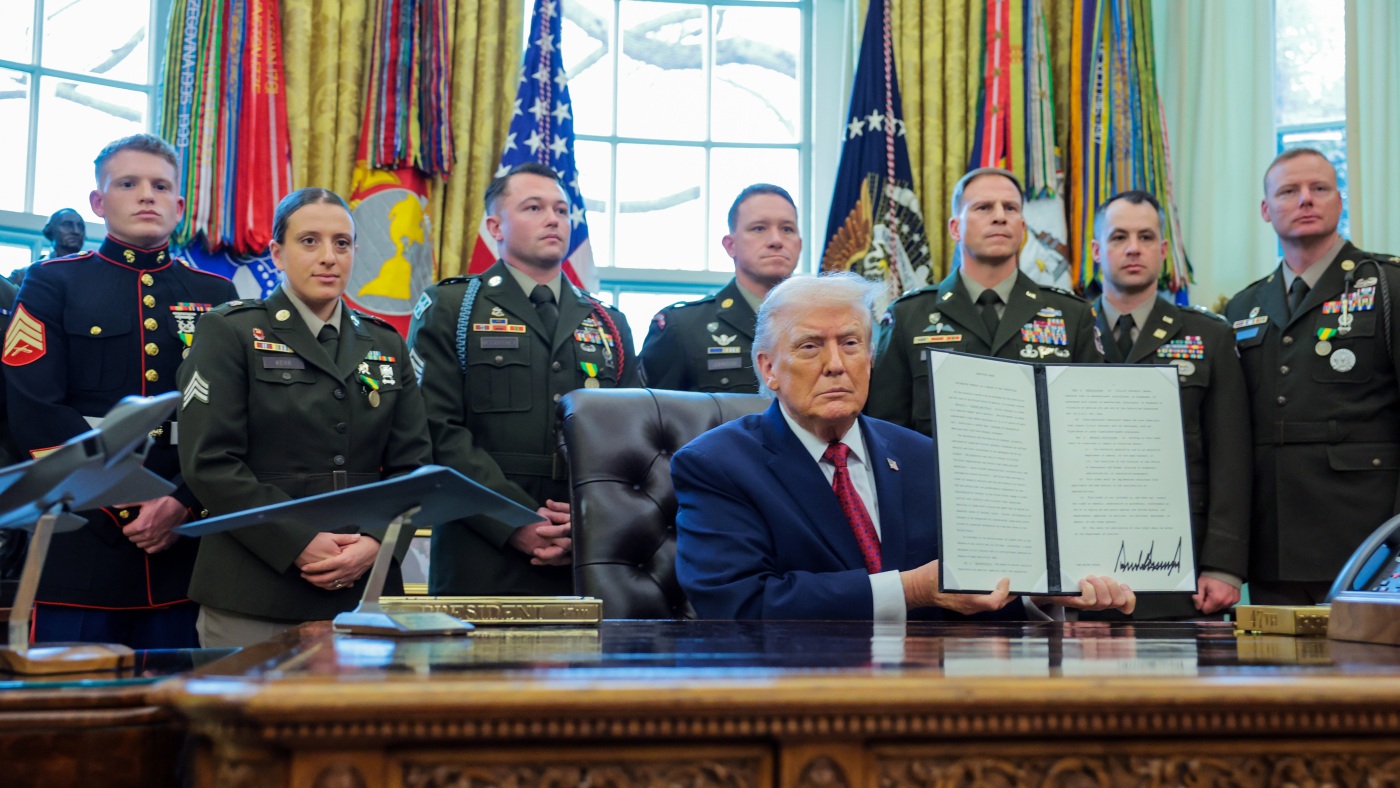
President Donald Trump poses with the newly signed executive order classifying fentanyl as a “weapon of mass destruction” during a ceremony in the Oval Office of the White House on December 15, 2025 in Washington, DC.
Anna Moneymaker/Getty Images North America
hide signature
switch signature
Anna Moneymaker/Getty Images North America
In his first year in office, President Trump overhauled U.S. drug policy and the response to fentanyl deaths in sweeping, often chaotic ways, quickly reversing efforts launched by the Biden administration to expand drug addiction treatment.
Many experts believe Biden-era public health policies have saved tens of thousands of lives. But with new laws, executive orders, budget cuts and military redeployments, Trump has turned the country away from those strategies and toward a militarized war on drugs.
“From the very first day of the Trump administration, we have declared all-out war on dealers, smugglers, traffickers and cartels,” Trump said in July during a ceremony to sign the Stop Fentanyl Act.
Trump targeted US Navy strikes on suspected drug ships; recognized drug cartels as terrorist organizations; classified fentanyl as a weapon of mass destruction; and stationed National Guard troops in American cities and along the U.S.-Mexico border.
Meanwhile, his administration at one point questioned support for even basic federally funded drug treatment programs. temporarily freeze $140 million in federal grants as frontline health care providers struggled to maintain services.
Abandoning the public health approach
Trump's rapid overhaul of U.S. drug policy stems in part from his claim that Biden's efforts to reduce fentanyl deaths have been a complete failure. Speaking this month, Trump made the false claim that “three hundred million people died last year from drugs.”
Fentanyl deaths actually spiked in the first two years of the Biden administration during the COVID pandemic. But the number of fatal overdoses fell sharply in 2023 and 2024 as Biden's team sought to expand access to opioid treatment medications, including buprenorphine and naloxone.
The Biden administration also increased federal spending by tens of billions of dollars. drug addiction treatment while taking a “harm reduction” approach by providing Medicaid, housing and other services to people even if they are unable or unwilling to stop using street drugs.

Secretary of State Antony Blinken watches U.S. President Joe Biden speak during a meeting on countering the flow of fentanyl into the United States in the Roosevelt Room of the White House on November 21, 2023. The meeting followed meetings with Chinese leader Xi Jinping, in which Biden announced that he and Xi had reached an agreement to reduce the flow of fentanyl precursor chemicals from China to the United States.
Drew Angerer/Getty Images North America
hide signature
switch signature
Drew Angerer/Getty Images North America
According to preliminary data from the Centers for Disease Control and Prevention, During Biden's final year in office, fatal overdoses in the United States fell by nearly 27 percent..
“We have made progress. More people are now in treatment for substance use disorders and opioids,” said Richard Frank, a drug policy researcher at the Brookings Institution. “A lot of it has to do with the expansion of Medicaid (insurance).”
But after returning to the White House, the Trump administration, working with GOP leaders in Congress, quickly took steps to deprive approximately $1 trillion in Medicaid fundingincluding cuts to programs that support drug treatment. In a July executive order, Trump also criticized harm reduction efforts while claiming, without evidence, that they “only promote illicit drug use.”
This shift worries many researchers, doctors and drug policy analysts who fear a resurgence in drug deaths.
“The biggest risk of increasing overdose deaths is cutting Medicaid spending,” said Regina LaBelle, who briefly served as acting director of the White House Office of National Drug Control Policy under Biden and now teaches drug policy at Georgetown University. “This is not just about stopping funding for harm reduction programs. They also refuse to fund prevention, treatment and recovery programs.”
Fentanyl – a “weapon of mass destruction”
There is also growing evidence that Biden-era law enforcement and diplomatic efforts have succeeded. stop the flow of fentanyl into the US., in particular by convincing China to help cut sales of industrial precursor chemicals used to make street fentanyl.
“An important success (of the Biden team) has been the cooperation with China that has developed throughout 2024,” said Wanda Felbab-Brown, who studies drug cartels and street drug trafficking at the Brookings Institution. “This included law enforcement cooperation, intelligence sharing and anti-money laundering cooperation.”
Over the past 12 months, however, Trump and his team have downplayed the Biden team's efforts. Speaking in July, Trump suggested the deadly fentanyl crisis was “allowed to happen by people who didn't care or were stupid people.” He also suggested that the carnage from overdoses was so great that it justified a military response.
“As far as we know, two to three hundred thousand people die every year, so we officially classify fentanyl as a weapon of mass destruction,” Trump said in Decemberciting statistics that contradict federal data.
Research Center for Disease Control and Prevention (CDC), US Drug Enforcement AdministrationAnd other leading drug researchers in the US show that drug deaths peaked in 2023 with approximately 115,000 deaths in one 12-month period. Latest preliminary CDC data shows approximately 76,500 fatal overdoses for the 12-month period ending April 2025
Indeed, many of Trump's new drug policy initiatives are based on claims that drug policy scholars say are wildly exaggerated or downright inaccurate. One of his first major fentanyl actions were decree signed high tariffs on Canadian goods in February, causing Trump called Canada's “central role” in fentanyl smuggling.

But data from the US Drug Enforcement Administration shows that Canada plays almost no role in the US fentanyl crisis. In 2024, approximately 43 pounds of fentanyl were seized at America's northern border. By comparison, approximately 21,100 pounds were seized at the southern border.
Top administration officials also made exaggerated claims about progress made in reducing drug deaths during Trump's first year in office.
During a cabinet meeting, Attorney General Pam Bondi said aggressive anti-drug policies have already saved 258 million American lives. In a separate social media post, Bondi put the number of lives saved at a much lower figure: claiming that approximately 119 million lives were saved. Researchers studying the potential harms of fentanyl and other street drugs tell NPR that both claims are greatly exaggerated.
Today is Fentanyl Awareness Day. In the first 100 days of Trump's presidency, we seized more than 22 million fentanyl pills, saving more than 119 million lives.
We fight tirelessly for the families of lost loved ones, for those whose lives are in danger, and for the souls of our… pic.twitter.com/nQLnN0nipn
— Attorney General Pamela Bondi (@Agpambondi) April 29, 2025
Will boat bombings stop fentanyl deaths in the US?
Defense Secretary Pete Hegseth, meanwhile, said Trump's military strikes near Venezuela are already having a deterrent effect on drug cartels.
“Not many people get on drug boats these days, and that’s the whole point. We want to stop the poisoning of the American people.” Hegseth said during the speech. organized by the Ronald Reagan Presidential Foundation.
The Trump administration has refused to provide evidence that the boats attacked by the Navy run by smugglers linked to cartels. Researchers who study drug traffickers, including Felbab-Brown of Brookings University, say that even if some boats carry street drugs, they almost certainly don't have fentanylthe drug that is responsible for the majority of overdose deaths in the United States.
Last US National Drug Threat AssessmentA report released by the Drug Enforcement Administration in July 2025 said drug gangs in Mexico, not Venezuela, “remain the dominant threat” bringing fentanyl into the American population.
Drug gangs, driven by the lure of huge profits, have also developed flexible underground supply routes that can be largely unaffected by military strikes that kill low-level gang members.
Critics of the Trump administration's approach told NPR that the chilling effect of the militarized war on drugs in the US would also be limited by Trump's decision last year. pardon or release a growing number of drug traffickers.
Since returning to the office Trump pardons Ross Ulbrichtwho was serving a life sentence after creating Silk Road, an Internet site used to traffic fentanyl and other street drugs; Larry Hoover, former leader, pardoned from the Chicago group Gangster Disciples; and pardoned former Honduran President Juan Orlando Hernandez, convicted on drug and weapons charges after running his country as a “narco-state.” according to a statement from the US Department of Justice.

“There are a lot of mixed messages and mixed signals. [from the White House] which creates a kind of chaos and uncertainty,” said Jeffrey Singer, a drug policy analyst at the Cato Institute. in an interview with NPR in May. “On the one hand, you threaten even harsher punishment for people who sell drugs, and on the other hand, you release drug dealers from prison.”