
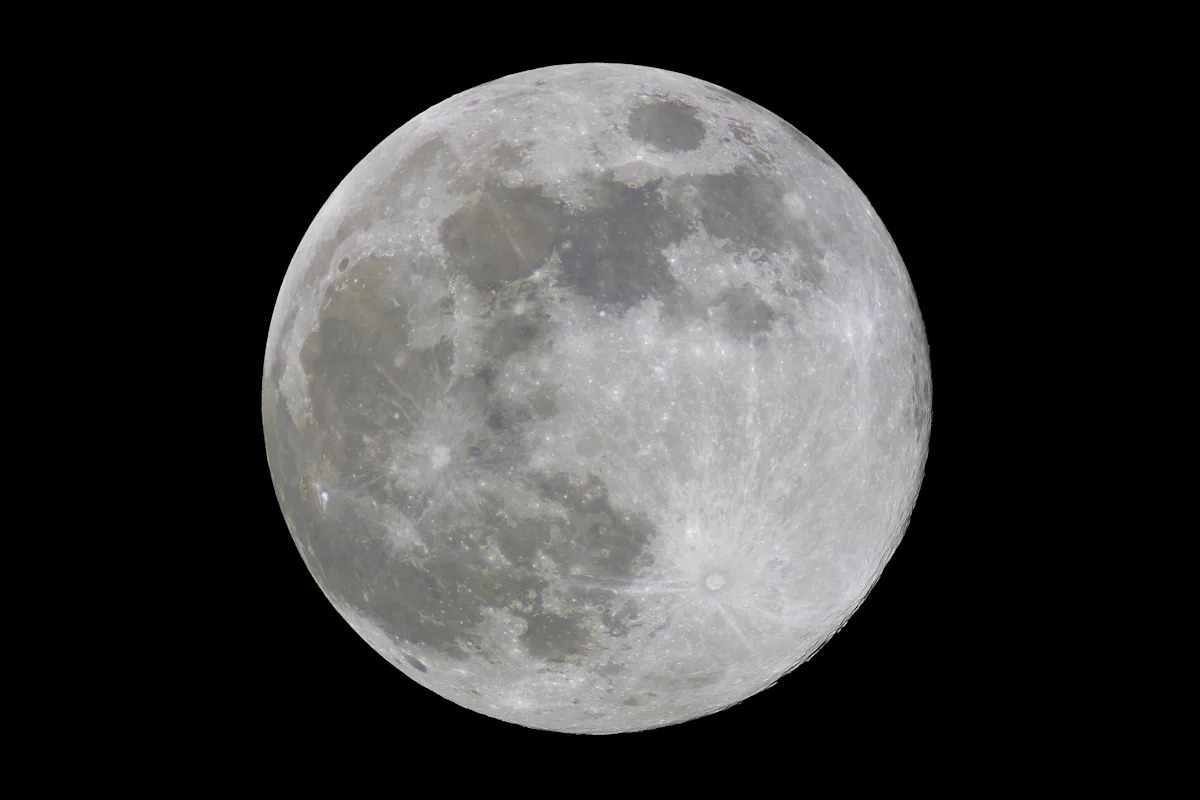
People will be treated first supermoon The 2026 wolf moon will occur early in the new year and peak on January 3rd.
The first full moon of the year, which peaks at 10:03 a.m. GMT, will also be the year's first supermoon, which will be larger and brighter than usual.
Supermoons occur when the Moon is closest to Earth, and this makes the Moon appear about 14% larger than a normal full Moon, although we can't always see the difference.
This moon is known as the “wolf moon,” a name given to it in Native American and European traditions, reflecting the time of year when wolves were often heard howling outside villages during the winter.
It will also coincide with the Quadrantids meteor shower, which peaks Friday evening into Saturday morning, although the moon's brightness will mean people will see fewer meteors per hour, according to the American Meteor Society.
When is the best time to see the wolf moon?
The Wolf Moon will peak on Saturday (January 3) at 10:03am in the UK or 5:03am in areas falling under AEDT.
Even if conditions aren't ideal when the moon reaches its peak, it will still look full all night.
In-the-sky.org said: “The exact moment of the full moon is defined as the time when the ecliptic longitude of the Moon is exactly 180° from the ecliptic longitude of the Sun as observed from the center of the Earth.
“However, at this point in time the moon does not appear to be anything special, and the full moon can be seen at any time of the night.”
Supermoon usually appears larger than the normal moonbut can also appear even larger when seen against objects such as trees or buildings.
This means the best time to look for it is just after the moon rises, when it appears even larger due to its proximity to the horizon.
Why is it called the wolf moon?
The name “wolf moon” refers to the time of year when wolves could often be heard howling at the moon outside villages.
Its name comes from Native American and European traditions linking it to the frequent howling of wolves in the dead of winter when they called, although it is now known that wolves often howl for a variety of reasons other than hunger.
Other moon names, such as Snow Moon and Strawberry Moon, are also often associated with traditional calendars and natural events.
NASA explains what a supermoon is and how it looks different. (NASA)
What is a supermoon?
Supermoon occur when the Moon is closest in its orbit to Earth, making it appear larger and brighter than usual.
The Moon has an elliptical orbit around the Earth rather than a perfect circle, so when it is closest to the Earth, the full Moon appears brighter and is known as a “supermoon.”
Supermoons can appear 14% larger and 30% brighter than regular full moons. according to NASA.
The term was coined in 1979 when NASA stated: “When the full moon appears at perigee [its closest point to Earth] it's a little brighter and larger than a normal full moon—and that's where we get a “supermoon.”
There are set to be three supermoons in 2026: a wolf moon in January, followed by two more later in the year. The so-called “Super Beaver Moon” will be visible on November 24, followed by a “Cold Super Moon” on December 24.
This year there will also be two lunar eclipses in March and August.



