An international team of astronomers from Chile, Europe, the United States, Canada and New Zealand has captured the most detailed spectroscopic image yet of an interstellar comet traversing our solar system. Using spectroscopic data from two instruments on ESO's Very Large Telescope (VLT), they detected emissions of atomic nickel and cyanogen from 3I/ATLAS, only the third confirmed interstellar object on record.
This image of interstellar comet 3I/ATLAS was taken by Hubble's Wide Field Camera 3 (WFC3) on December 27, 2025. Image courtesy of NASA/ESA/CSA/Hubble.
3I/ATLAS was discovered by the NASA-funded ATLAS (Asteroid Terrestrial-impact Last Alert System) research telescope on July 1, 2025.
The interstellar visitor, also known as C/2025 N1 (ATLAS) and A11pl3Z, arrived from the constellation Sagittarius.
At that time, the comet was at a heliocentric distance of 4.51 astronomical units (AU) with an eccentricity of 6.13.
“Describing the volatile composition of interstellar objects passing through the solar system provides unique insight into the chemical and physical processes occurring in distant star systems,” said Dr Rohan Rahatgaonkar from the Pontifical Catholic University of Chile and colleagues.
“Interstellar objects retain traces of the chemical and physical processes occurring in their natal protoplanetary disks, potentially modified by the interstellar environment.”
“When heated by solar radiation, cometary interstellar objects release solids and gas due to cometary activity.”
In July and August, astronomers conducted a high-resolution spectroscopy campaign as 3I/ATLAS reached distances of 4.4 to 2.85 AU. from the Sun.
To obtain the spectra of the comet, they used the VLT X-Shooter and Ultraviolet Visual Echelle Spectrograph (UVES) instruments.
Observations show that a comet's coma—the hazy cloud of gas and dust enveloping its core—is dominated by dust, with a consistently red optical continuum indicating organic-rich material.
This reddish hue is reminiscent of both the solar system's comets and some of the most primitive Kuiper Belt bodies, hinting at common physical processes across all planetary systems.
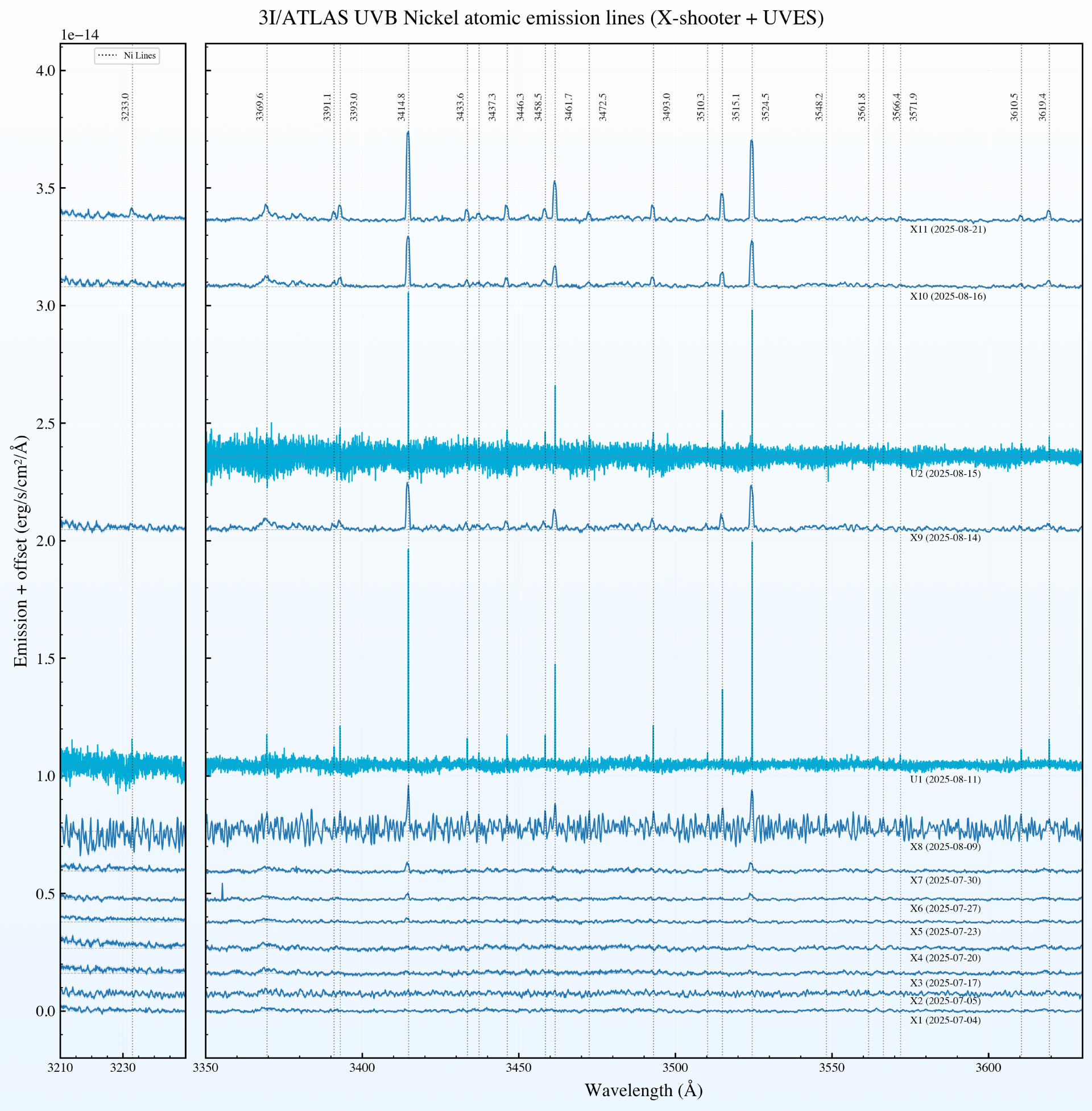
UV/blue continuum-subtracted 3I/ATLAS spectra showing Ni I emission during 11 VLT/X-Shooter visits (blue) and two VLT/UVES visits (cyan). Image credit: Rahatgaonkar etc.., doi: 10.3847/2041-8213/ae1cbc.
As 3I/ATLAS approached the Sun, researchers detected emission from cyanogen (CN)—a simple molecule of carbon and nitrogen commonly observed in the atmospheres of comets—and numerous lines of neutral nickel (Ni).
In contrast, no iron (Fe) was detected, suggesting that nickel is efficiently released from coma dust grains by solar radiation.
The scientists found that production rates of these species increased sharply as the comet approached the Sun, with the evolution of CN and Ni emissions following a strict power-law relationship with heliocentric distance.
These trends suggest that the processes that release these atoms may involve low-energy mechanisms such as photon-stimulated desorption or the breakdown of complex organic matter rather than direct sublimation of ices—a nuance that distinguishes this interstellar visitor from many solar system comets.
This ghostly fingerprint represents more than just a snapshot of a passing visitor.
Interstellar comets such as 3I/ATLAS are pristine samples of material formed around other stars. Because they have not been heavily processed during repeated orbits around the Sun, they retain clues about the composition of distant protoplanetary disks—the spinning disks of gas and dust from which planets are born.
Previous interstellar objects, such as 'Oumuamua in 2017 and 2I/Borisov in 2019, showed surprising diversity: 'Oumuamua behaved more like an inert rock, while 2I/Borisov was rich in carbon monoxide and complex ice.
New research suggests 3I/ATLAS adds another chapter to this growing cosmic story: a dust-rich body that reveals molecular signatures in a way that blurs the line between familiar comet behavior and new physics.
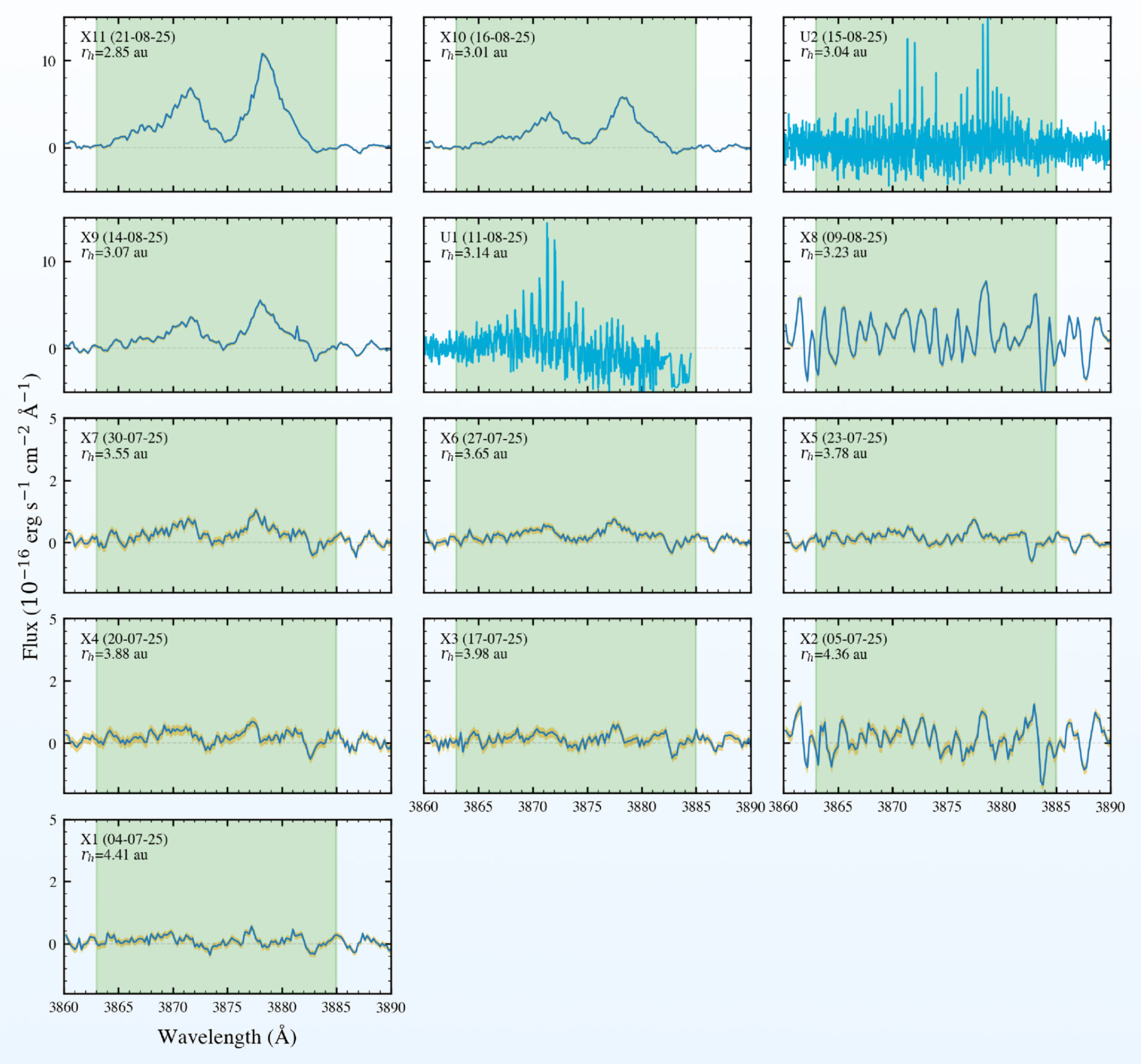
3I/ATLAS continuum subtraction spectra in the CN violet region obtained during a monitoring campaign that lasted from July 4 to August 21, 2025. Image credit: Rahatgaonkar etc.., doi: 10.3847/2041-8213/ae1cbc.
“If 3I/ATLAS continues to demonstrate Ni without Fe through perihelion, this will be the first clear case where interstellar cometary metal emission is decoupled from classical refractory emission,” the authors say.
“This result may argue for a distinct low-temperature organometallic (or nanophase) pathway for Ni formation in extrasolar comets and may open a new window into how disk chemistry, metallicity, and irradiation history influence the microphysics of planetesimals.”
“Although 3I/ATLAS's parent star is likely to be metal-poor compared to other interstellar object progenitor stars, it is unlikely to be half as metal-rich as the Sun, meaning there is no contradiction between the estimated age of 3I/ATLAS and the presence of an iron peak element such as Ni.”
“Regardless of which scenario prevails, 3I/ATLAS offers a crucial time-sensitive experiment linking metal emission to volatile activation and grain physics in an interstellar object.”
“The measurements described above will transform nickel from a curiosity to a calibrated indicator of both parent chemistry and galactic origin, setting the standard for fast spectroscopy of interstellar objects in the era of the Rubin Observatory and ESO's Extremely Large Telescope.”
conclusions were published on December 10, 2025 in the magazine Letters in an astrophysical journal.
_____
Rohan Rahatgaonkar etc.. 2025. Observations of interstellar comet 3I/ATLAS with the Very Large Telescope. II. From quiescence to glow: a sharp increase in Ni i emission and the beginning of CN degassing at large heliocentric distances. ApJL 995, L34; doi: 10.3847/2041-8213/ae1cbc