This article was prepared National Geographic Traveler (United Kingdom).
“We have reached the point of no return,” says my guide Julio Llancay. It should sound ominous, but with that ever-present grin stretched across his face, it sounds more like a punch line than a warning.
I'm standing at 11,411 feet on a dusty highway in the Sacred Valley, a few hours after the Quarry Trail. This 17-mile trail was created by Intrepid in collaboration with local Peruvians as a quieter, less traveled alternative to the Inca Trail. Tomorrow we'll climb even higher, reaching 14,600 feet on a three-day route that takes us up the mountainside above the historic city of Ollantaytambo.
“Haku!” (“Let’s go”) Julio gestures as he leads us past scenes of bucolic Peruvian life. Men bend low under bales of straw, and sleeping pigs snore along the path. Overhead, bright blue skies are punctuated by red limestone cliffs.
As I carefully make my way down the rocky slope, Julio points out a series of small caves carved into the mountainside. This is the Cory Song'o – or Heart of Gold – a pre-Incan burial site where mummified bodies once rested. Scattered skulls still lie in the voids, and their empty eye sockets seem to watch me as I pass. Julio explains that the pre-Inca people deliberately shaped their skulls, lengthening them from a young age. Some believe it was a spiritual practice meant to bring them closer to the astral plane, while others think it reflected the shape of sacred glaciers or was simply seen as a way to increase the brain's capabilities.
I reflect on this bizarre tradition as we continue: the area transforms from cultivated farmland to mountainous bushland. Ahead, steep climbs lead to Perolnijok Falls, a towering 165-foot vessel that delivers the lifeblood of glaciers to the towns below.
The Andean condor is one of the world's largest flying birds, capable of soaring for hours without flapping its wings. Photography by Sebastien Lecoq; Alami
A dark figure circles the sky above us as we reach Rakaipata, an impressive Inca village believed to have served as a military base, astrological observatory and religious site. Julio confirms that it is a condor, one of the largest flying birds in the world. Along with pumas and snakes, condors formed the sacred triumvirate of animals in Inca culture and were one of the reasons why black was a revered color – a symbol of eternity and the limitless night sky. Their enormous wingspan, sometimes reaching ten feet, cast shadows that once awed Andean peoples.
“Condors have a bad reputation these days,” says Julio. “The locals think they're killing their animals, but in reality they're just scavengers. They're killing cougars.”
That night the sky was dotted with more stars than I had ever seen, cut through by the cloud band of the Milky Way. This luminous arc, known in the local Quechua language as Mayu, meaning “river”, has deep meaning in Andean beliefs. It is said to reflect the sacred rivers below, creating balance between heaven and earth.
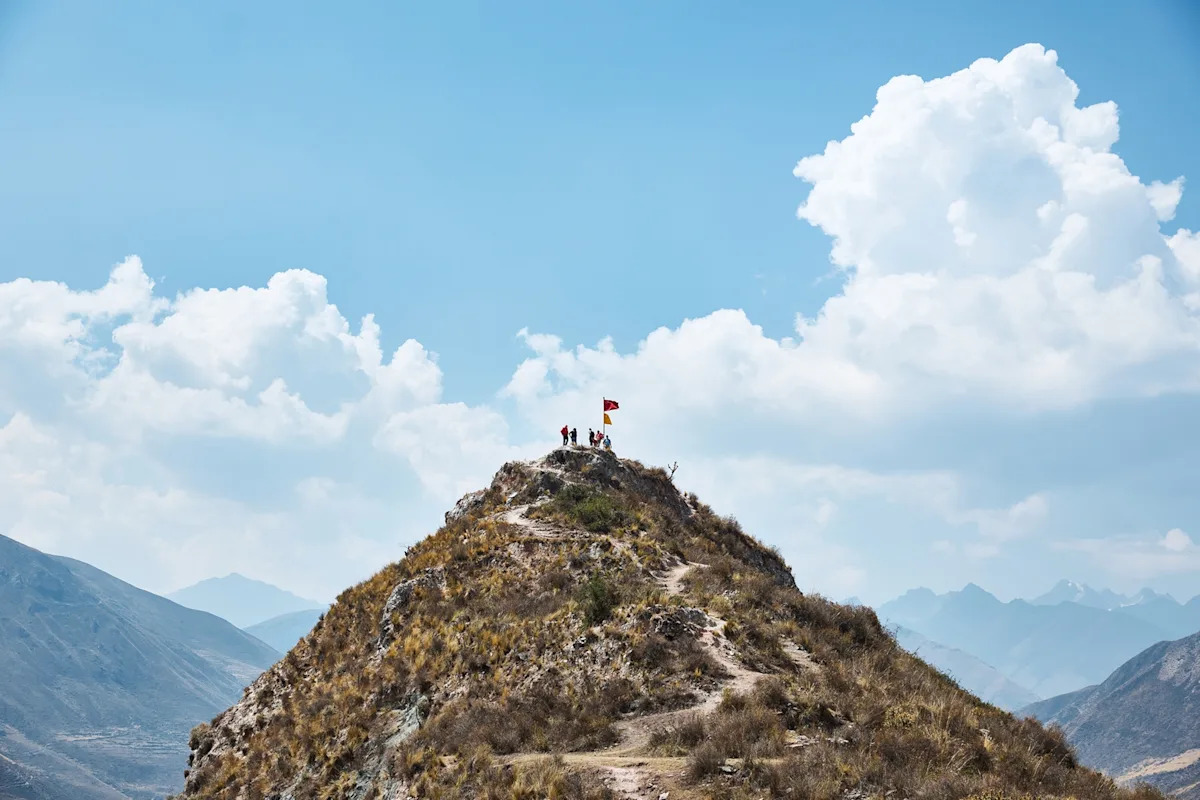
The next morning I wake up at 5:30 am to a cold, dark world and gratefully clutch the cocoa tea one of the guides handed me. Today we hike two miles of winding trails, climbing nearly 3,300 feet to our first mountain pass, Pukakasa.
As the hike continues, the shift in elevation changes the landscape. Along the slopes thickens golden ichu grass, a hardy plant that was once used for making rope and is now a vital source of food for the llamas and alpacas that graze nearby. Chicon Glacier sparkles in the distance, and at my feet the ground is dotted with towering American agave and the delicate laulli flower, whose spiny stems were once shaped into ridges by Inca women.
After several hours of climbing, we climb the last hill and the land drops into the valley below. The Urubamba River winds through farmland dominated by La Veronica, its triangular, glacier-covered peak standing out against the azure sky.

Ollantaytambo is the only Incan site inhabited since the 15th century. Photography by Jennifer Bachman; Getty Images
During a much-needed pit stop, Julio shares the legend of Ukuku, a mythical half-man, half-bear figure who carried water from the glaciers to help the villagers below. The story is said to be inspired by the spectacled bear, a unique species native to South America that represents both strength and gentleness. Many now recognize his resemblance to Paddington Bear, the beloved literary character whose fictional journey from Peru to London reflects the real-life creature's enduring connection to the Andes.
After a long descent down a loose shale slope, the roofs of our campsite finally open up—a welcome sight after a day on the road. Ahead lies the Inti-Punku Sun Gate, a stunning stone doorway that perfectly frames the majestic Veronica Peak beyond. The spectacle is incredible, and I pause for a moment to take it all in—the vastness, the silence, and the feeling of rising into the sky itself.
We return to base through the quarry of the same name, where the Incas mined stone for the incredible structures of Ollantaytambo. Huge holes are left in the mountainside, and my group pauses at the ancient rubble as Julio explains the methods used to make them: the Incas cut grooves in the boulders, inserted wooden pegs, then filled them with water so they would expand, eventually cracking the stone.
As we descend into the town of Ollantaytambo, the view of the valley becomes clearer. Below lies a triangular patchwork of fields of barley, strawberries and potatoes, designed so that their tops line up perfectly with the Qorikancha (Temple of the Sun) – something I would never have noticed from the ground.
Soon my feet are walking on the ancient slabs of a city built more than 500 years ago. It's not Machu Picchu, but it felt like the perfect end to a journey that took me deep into Inca history. I peered into the darkness where the dead travel to the underworld, and rose so close to the astral plane that my hands almost touched the heavens. I also explored a part of the Sacred Valley hidden from the thousands of people pursuing the Inca Trail, where silence speaks louder than the crowd and the past breathes through every stone.
Published in Collection of impressions 2026 To National Geographic Traveler (United Kingdom).
To subscribe to National Geographic Traveler (UK) magazine click Here. (Available in select countries only.)