

This past week boasted many overhyped AI breakthroughs, but the healthiest one was the fierce repudiation of a contemptuous McDonald’s ad.
Abandon all hope, ye who watch: a still from the doomed McDonald’s AI-generated holiday ad.
(Screenshot from X)
With the news that the Disney media empire is bringing its stable of characters to OpenAI’s short-video platform, Sora, we appear to be on the verge of the long-touted AI revolution in video. With politicians and online spammers adopting crude versions of the technology to thus far underwhelming effect, an infusion of the film industry’s most beloved, family-friendly characters might seem to offer a valuable reset to the legions of utopian-minded AI promoters promising culture-wide deliverance and directing America’s investment economy.
But to get a more realistic sense of what this particular revolution likely holds in store, it’s instructive to look away from the handiwork of the Magic Kingdom and toward that of another legendary family-friendly American brand: McDonald’s. This week also saw the release of a feverishly touted AI-generated video from the Netherlands arm of the Golden Arches colossus, extolling the pleasures of fast food amid runaway holiday-season stress—and the end result was an unmitigated disaster. The ad was built around the idea that the holiday season is “the most terrible time of the year” and featured a hackneyed array of holiday-season mishaps, accidents, and misfortunes, all presented as cringe-laden set pieces of the emerging AI aesthetic: streamlined, garishly artificial, and in no way redolent of Yuletide adversity as actual living and breathing humans endure it.
Within days of the ad’s debut, a bitter chorus of criticism and online vituperation ensued, assailing the fast-food giant, together with the ad’s producers. The ad agency and production company responsible for the debacle went swiftly from promoting their project as the future of visual storytelling to yanking the spot in humiliation—along with the overheated press releases touting their achievement.
Good. It’s nice to know that the wariness and fear around AI may be galvanizing into something like a collective immune response to AI slop. So far, we’ve chiefly encountered visions of AI obliterating millions of jobs adjacent to the Information Age, from bookkeepers and proofreaders to rooms of flannel-shirted Wilco-fan creative directors whiteboarding ad briefs.
Never mind that replacing junior copywriters, junior counsel, or junior bankers with a blinking cursor would be a death warrant for members of the already underemployed and underappreciated Gen Z and the generation coming up behind them—the fulsome embrace of AI in the workplace would also dry up future employment pipelines by eliminating the entry level altogether.
Yet this labor economy Armageddon isn’t likely to descend on what are euphemistically known as the creative industries if the end product is as repellant as the McDonald’s spot. And even in the technology’s initial grunt-work iteration—the “large language model” now routinely hymned on LinkedIn and in savvy tech consulting shops—many of the applications likewise have a decidedly perfunctory-to-hideous feel. So far, AI is simply a faster Google—a crude toy for a ketamine-addled Elon Musk to wave in peoples’ faces, and a C+ headline writer.
Current Issue
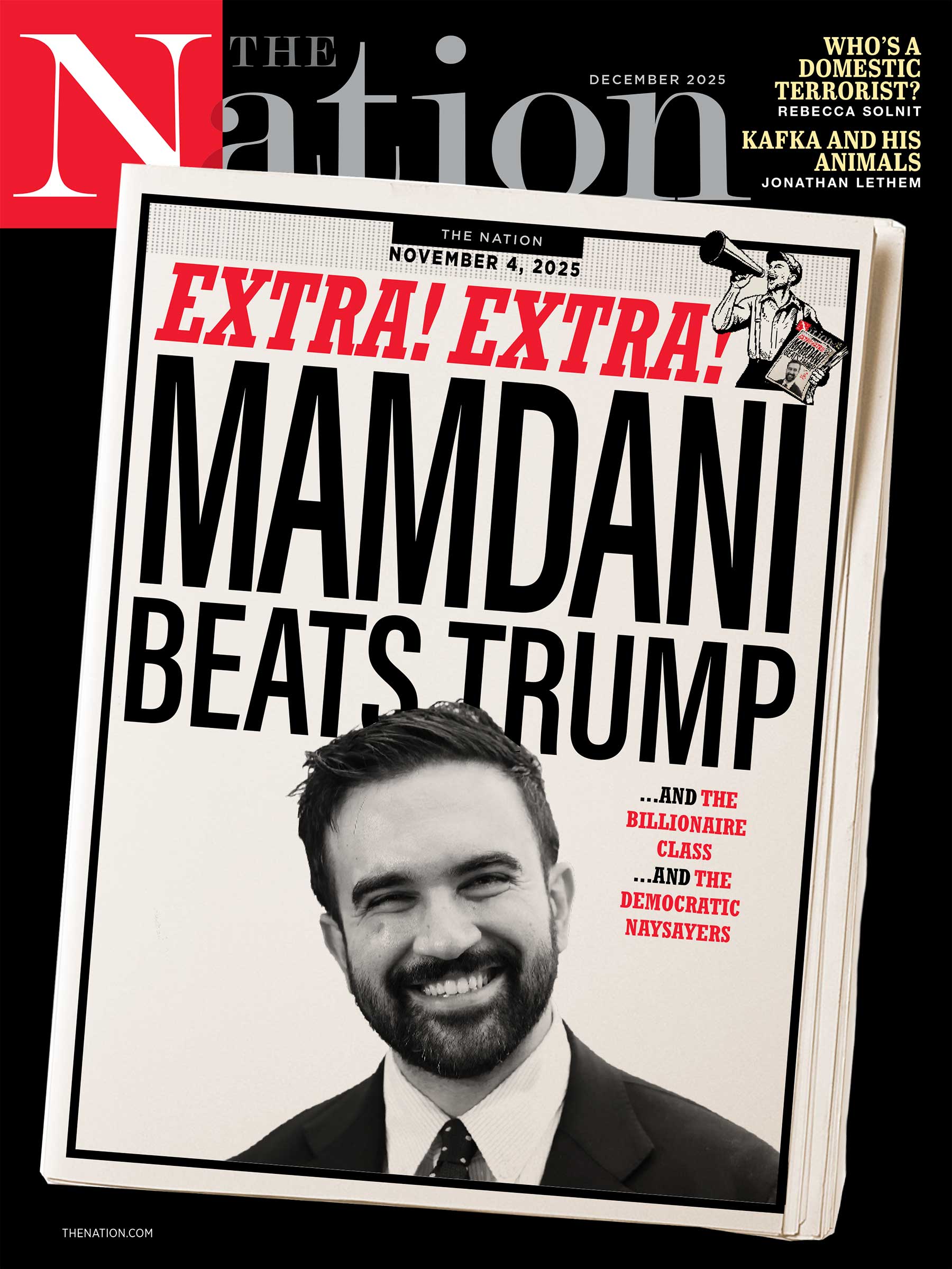
These limitations all came into excruciating focus with the debut of the Dutch McDonald’s ad—it could well represent a landmark moment in the repudiation of the broader effort to force-feed us an AI aesthetic that’s little more than the crudest imaginable simulacrum of human experience.
If you hunt down an archived version of it, you will instantly recognize the McDonald’s ad as unadulterated AI slop. It’s got that weird soft-light patina on faces and a host of twitchy character movements that earmark it as hygienic fakery. If you freeze-frame it at any point, you’ll spy an odd background “actor” taking up space for no discernible reason, or a Library of Babel set design that no sane human being would occupy. And as with most popular AI videos, there’s also the uncanny lack of an implied moment before or after. The cascading sequences in the ad are all atemporal—Santa on a sleigh stuck in traffic, a woman caught in a tram’s closing doors and violently whipped offscreen, kitchen spills, anthropomorphic cookies burning in an oven—and, for some reason, crying.
In other words, instead of using AI as Coca-Cola has, to make a shittier version of a thing it already makes, McDonald’s sought to harness AI as a mode of storytelling. McDonald’s and its agency partner Sweetshop (a cutting-edge image shop that probably should have swapped out a vowel to become “sweatshop,” as a suitable evocation of the AI work dystopia) are not giving us a gloopier, gloppier type of animation, nor are they obviously replacing paid actors with cheaper and glitchier virtual alternatives. The guiding pitch here wasn’t so much “We want to tell the story of McDonald’s feeling like home” as “Let’s immerse viewers in the most busy and non-signifying version of this untested technology we can conjure.”
In a frequently mangled quote, media theorist Marshall McLuhan observed that humans shape our tools, which then come to shape us. This ad could serve as Exhibit A in the perils entailed in that transformation. Instead of using tools to execute a solution that a human brain came up with, the errant minds behind this project let the tools run amok. The AI prompt here was “gimme an ad,” not “I have an idea; help me make it.”
As a result, nothing on screen is the result of constraint, accident, budget, time, or any other human response. Militantly disregarding one of the most basic principles of text editing—kill your darlings—the ad’s creators have presided over a riot of darlings. A cat tackling a Christmas tree? Crying cookies in the oven? They’re all here, in an off-putting holiday blizzard.
Of course, ads aren’t art—but they are strong cultural indicators in a social order driven by marketing mandates. Put a bit less elegantly, advertising sniffs and paws at the ass-end of culture, which is why the massive ad outlays for Super Bowl broadcasts qualify as a moment of collective psychic introspection. Ads reveal What We’re All Up To—or at least the central cultural ideas that corporate marketing accounts are willing to attach to their biggest brand plays.
The kind of AI slop showcased by McDonald’s still isn’t as conspicuous as, say, 2022’s Super Bowl deluge of cryptocurrency ads. But we’re getting there. Witness Salesforce—excuse me, Agentforce—telling viewers that that if they don’t use its suite of AI products they might be stupid and helpless enough to sit outside in the rain. As all major corporations adopt similar fuck-you approaches to the cartelized obliteration of cultural creation for cash—and when Time magazine hails the progenitors of AI as 2025’s persons of the year—the far from subtle takeaway, as Mountain Goats frontman John Darnielle observes, is for the rest of us to “learn to endure it, or give up.”
That mission statement is only going to gain deeper and more painful traction as AI pitches continue to accelerate into hyperspace. Just this week, Nvidia CEO Jensen Huang staged an in-studio pep rally on Joe Rogan’s podcast, and Sam Altman submitted to prostration at the altar of the feckless NFT promoter Jimmy Fallon. Altman’s aw-shucks suggestion that you can’t change a diaper without asking a chatbot for help is but a slight variation on the parodic Christmas miseries coughed out by the McDonald’s team, or the rudderless tech-determinist bullying of Agentforce. It’s also, happily, a sign that the American public may be tiring of this glorified pattern of abuse and betrayal from the AI mogul set. No one wants Microsoft Copilot in every empty second of their workday, any more than any compos mentis person has asked for the ability to FaceTime their dead grandmother.
The challenge ahead is to make the repudiation of the AI aesthetic more pointed, precise, and far-reaching. When you recoil at that uncanny patina sheen of a far-from-human face or the odd drone of an AI voice, you’re being fed the judgment, aesthetic, and taste of people who don’t give a shit about how things look or sound. We see slop because the people making it are a class of losers who like slop. If they didn’t prefer slop, we’d have different outputs. So when anyone with taste and judgment accedes to slop, we concede power to people who don’t give a shit.
Whether Skydance tech scion David Ellison strong-arms his way into a takeover of Warner Bros. Discovery or Netflix folds the legacy studio arm of the business into a glorified content provider for a company that makes high-quality slop, we are increasingly immersed in a world that’s becoming devoid of things people make. We will endure the world’s first AI actress, they tell us, and we will endure a number-one country hit sung by a bot. It’s my hope that these proposals begin to feel like affronts, that “clanker” becomes our only acceptable slur, and that we continue, despite the urgings of Wall Street and our self-appointed culture barons, to process AI slop as disrespectful. May Copilot and Claude someday be the asbestos or lead paint we need to remove from all our digital infrastructure.
Many critics have described AI videos, incorrectly, as Lynchian, but David Lynch’s great trick was that his oddness, horror, and humor were affirmations of human experience. Shit got weird in Lynch, but you saw the world in his work. The most significant irony in the McDonald’s ad is that the message is, essentially, It’s brutal out there, during the holidays. Why not come inside, to the place you know and love? How perverse that a pitch intended to evoke restorative recovery (if not comfort and joy) could be rendered into a result so completely bereft of humanity.
It’s notable that Sweetshop’s chief executive defended the production process and output using the language of the film shoot or developer crunch, saying their team “hardly slept,” creating “thousands of takes” to shape something into the gruesome edit that got booed off the Internet. What she misses is that creating things has its own inherent value. Charged with the thankless task of upholding the aesthetic worth of issuing an endless stream of AI prompts, she’s left only with the suffering of the worker as her evidence of the work’s value.
Popular
“swipe left below to view more authors”Swipe →
That’s a key lesson to heed as we brace ourselves for the bot-generated horrors sure to assail us during the two-minute ad breaks of the next Super Bowl. Much as the 2022 barrage of crypto spots aired months ahead of a massive crypto meltdown, let’s hope that these contemptuous, overcapitalized mobilizations of nonwork and nonthought continue to get rebuffed and rejected. And let’s hope that the work—even the work of making ads—goes back to people who make shit, not make shit.
Over the past year you’ve read Nation writers like Elie Mystal, Kaveh Akbar, John Nichols, Joan Walsh, Bryce Covert, Dave Zirin, Jeet Heer, Michael T. Klare, Katha Pollitt, Amy Littlefield, Gregg Gonsalves, and Sasha Abramsky take on the Trump family’s corruption, set the record straight about Robert F. Kennedy Jr.’s catastrophic Make America Healthy Again movement, survey the fallout and human cost of the DOGE wrecking ball, anticipate the Supreme Court’s dangerous antidemocratic rulings, and amplify successful tactics of resistance on the streets and in Congress.
We publish these stories because when members of our communities are being abducted, household debt is climbing, and AI data centers are causing water and electricity shortages, we have a duty as journalists to do all we can to inform the public.
In 2026, our aim is to do more than ever before—but we need your support to make that happen.
Through December 31, a generous donor will match all donations up to $75,000. That means that your contribution will be doubled, dollar for dollar. If we hit the full match, we’ll be starting 2026 with $150,000 to invest in the stories that impact real people’s lives—the kinds of stories that billionaire-owned, corporate-backed outlets aren’t covering.
With your support, our team will publish major stories that the president and his allies won’t want you to read. We’ll cover the emerging military-tech industrial complex and matters of war, peace, and surveillance, as well as the affordability crisis, hunger, housing, healthcare, the environment, attacks on reproductive rights, and much more. At the same time, we’ll imagine alternatives to Trumpian rule and uplift efforts to create a better world, here and now.
While your gift has twice the impact, I’m asking you to support The Nation with a donation today. You’ll empower the journalists, editors, and fact-checkers best equipped to hold this authoritarian administration to account.
I hope you won’t miss this moment—donate to The Nation today.
Onward,
Katrina vanden Heuvel
Editor and publisher, The Nation
More from The Nation
Trump’s tariffs and immigration raids are driving the latest farm crisis. White farmers have stood by him year after year—and still do.

In a text exchange, Border Patrol Commander Gregory Bovino calls his operation a “massive disturbance” in the making.

A coming filing with the ICC accuses FIFA’s Gianni Infantino and UEFA’s Aleksander Čeferin of crimes against humanity for their financial support of settlement clubs.
It's time we stopped flinching at the assaults of the far right—and started fighting back.
.jpg?width=1200&height=630&fit=crop&enable=upscale&auto=webp&w=150&resize=150,150&ssl=1 "Developers at Microsoft-owned Doom studio id Software form union with CWA “to take back control of the industry we love”")



