A team of researchers from the US and Japan analyzed an extract from a sample of near-Earth asteroid (101955) Bennu collected by NASA's OSIRIS-REx (Origins, Spectral Interpretation, Resource Identification and Security-Regolith Explorer) spacecraft and identified several bioessential sugars, including ribose (an RNA sugar) and glucose (a metabolic substrate).
This mosaic image of asteroid Bennu consists of 12 images taken on December 2, 2018, by the Osisiis-rex polycamera from a distance of 15 miles (24 km). Image credit: NASA/NASA Goddard Space Flight Center/University of Arizona.
“The OSIRIS-REx mission returned 121.6 g of regolith (unconsolidated granular material) collected from Bennu to Earth on September 24, 2023, under carefully controlled conditions,” said Tohoku University researcher Yoshihiro Furukawa and colleagues.
“Samples were stored in a high-purity nitrogen atmosphere at NASA's Johnson Space Center.”
“Early studies indicated that Bennu has mineralogical and elemental characteristics similar to carbonaceous chondrites; enriched in carbon and nitrogen compared to most meteorites, but resembles disaggregated carbonaceous chondrites; and underwent extensive water changes.”
“Bennu samples analyzed to date contain soluble organic compounds, including amino acids, amines, carboxylic acids, aldehydes, nucleic bases, polycyclic aromatic hydrocarbons, and a diverse mixture of soluble molecules consisting of carbon, hydrogen, nitrogen, oxygen and sulfur.”
“We took advantage of this pristine asteroid material to search for extraterrestrial bioessential sugars.”
The authors discovered the five-carbon sugar ribose and, for the first time in an extraterrestrial sample, the six-carbon glucose.
While these sugars are not evidence of life, their discovery, along with previous discoveries of amino acids, nitrogenous bases and carboxylic acids in Bennu samples, shows that the building blocks of biological molecules were widespread throughout the solar system.
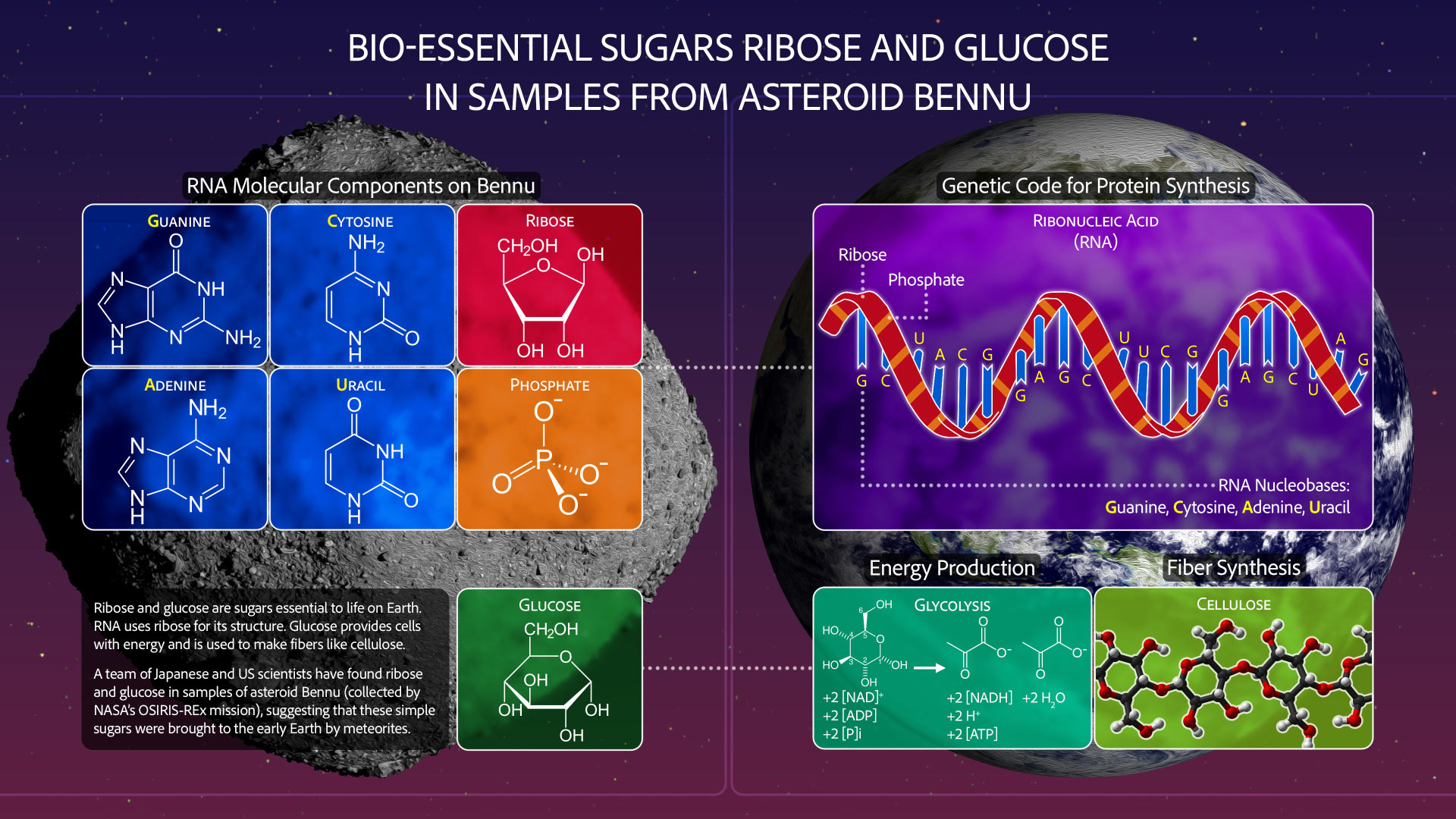
Furukawa etc.. The vital sugars ribose and glucose have been discovered in samples of the near-Earth astroid bennu collected by NASA's Osiris-Rex mission. Image credit: NASA/Goddard/University of Arizona/Dan Gallagher.
For life on Earth, the sugars deoxyribose and ribose are key building blocks of DNA and RNA, respectively.
DNA is the main carrier of genetic information in cells. RNA has many functions, and life as we know it could not exist without it.
Ribose in RNA is used in the sugar-phosphate “backbone” of the molecule, which connects the chain of nucleic bases that carry information.
“All five nucleobases used to build DNA and RNA, as well as phosphates, have already been detected in Bennu samples returned to Earth by OSIRIS-REx,” Dr. Furukawa said.
“The new discovery of ribose means that all the components that make up the RNA molecule are present in Bennu.”
“The discovery of ribose in asteroid samples is not completely unexpected.”
“Ribose was previously discovered in two meteorites found on Earth.”
“What's important about the Bennu samples is that the researchers didn't detect deoxyribose.”
“If Bennu is any indication, it means ribose may have been more abundant than deoxyribose in environments of the early solar system.”
The researchers believe that the presence of ribose and the absence of deoxyribose supports the “RNA world” hypothesis, which posits that early life forms relied on RNA as the basic molecule to store information and carry out chemical reactions necessary for survival.
“Modern life is based on a complex system organized mainly by three types of functional biopolymers: DNA, RNA and proteins,” Dr. Furukawa said.
“However, early life may have been simpler. RNA is a leading candidate for the first functional biopolymer because it can store genetic information and catalyze many biological reactions.”
“The Bennu samples also contained one of the most common forms of 'food' (or energy) used by life on Earth, the sugar glucose, providing the first evidence that an important source of energy for life as we know it was also present in the early solar system.”
A paper the findings were published this week in the journal Nature.
_____
Y. Furukawa etc.. Bioessential sugars in samples from asteroid Bennu. Nat. geonakipublished online December 2, 2025; doi: 10.1038/s41561-025-01838-6