

For Maria Perez, participating in a project to reduce food waste in Washington was more than just a job. Her journey with Duwamish Valley Sustainability Association (DVSA) began when she was 14 years old and enrolled in a youth program that sparked her interest in fighting climate change. Six years later, the association hired her to manage a program to recycle waste from the Seattle area into liquid plant food.
The innovative program in the South Park area was launched by DVSA in 2021 in partnership with not-for-profit organizations including Food life line, Sustainable SeattleAnd Farmers Black Staras well as the company slurp – which is building small biorefineries as part of the initiative.
Perez spent hours studying how the sealed container uses bacteria to reduce emissions while growing food for the predominantly Latino area. She spoke to the residents, teaching the young people who stood where she once stood. Her enthusiasm for the project was unmistakable—she talked about it constantly, sharing details with everyone in her life. “It was just really exciting. [to see] how everything came into the circular economy,” Perez said.
The sealed containers, slightly smaller than a shipping container, function much like a cow's four-chambered stomach, housing microbes that can turn 25 tons of rotting food into 5,400 gallons of fertilizer each year. It also creates biogas, a renewable energy source that can be used to produce electricity or fuel.
“We have started developing a new project [focused on] Organic waste, because when we worked in the South Park area, we saw a lot of trash on the street,” said Edwin Hernandez, executive director of the association. In a series of public meetings, DVSA asked local residents and businesses how they wanted to solve the area's trash problem. The answer was a biorefinery, with added benefits including creating sustainable infrastructure and green jobs, Hernandez said.
The idea was developed with the support EPA grantalong with money from the city of Seattle. Faculty from the University of Washington helped develop a feasibility study for the project. The coalition later received government support, including being selected to participate in the government's new sustainable innovation program. NextCycle Washingtonalong with seed funding from the Department of Commerce.
The value of the biodigester, Hernandez said, is that it can turn trash such as eggshells and banana peels into a resource that can help grow food locally.
More than a third of the US food supply becomes food wasteAccording to USDA estimates. “There are better ways to deal with food waste than sending it to our landfill,” said Adrian Tan, policy and market development manager for King County Solid Waste, which supported the project. “Can food waste be prevented from appearing in our trash, donated, composted, or used for other beneficial purposes?”
Although Seattle is in King County, the state's largest county, the city has its own waste management system, Tan said. The company collects food and other organic waste through a composting service and sends it to two commercial composting facilities. However, food scraps thrown in the trash are transported by rail to a landfill in Oregon. Emissions from moving across state lines are compounded by the fact that when food waste breaks down in landfills, it releases methaneA powerful greenhouse gas.
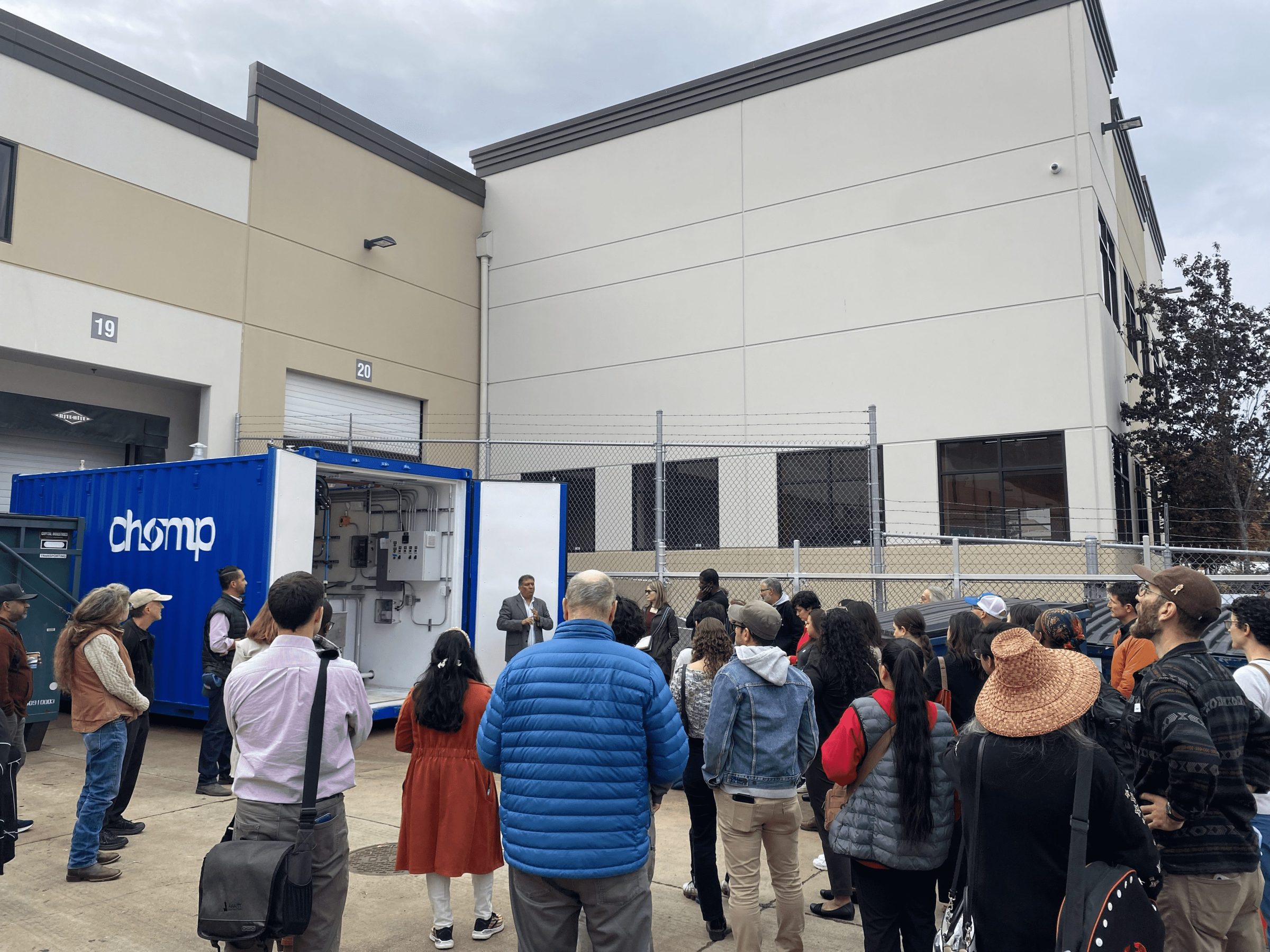
Biodigesterones, on the contrary, store waste locally. Ian Allen, CEO of Chomp, was inspired to create the biorecycling company because he wanted to eliminate the need for diesel trucks and their associated pollution, a common way of transporting waste.
“Chomp is based on the desire to eliminate the delivery of food into a community and the removal of garbage outside of a community,” Allen said. “So we're really trying to create a circular economy based on food, food waste, energy and growing fresh food locally.”
Allen says working directly with local communities to solve common problems sets his company apart from other technology solutions. Their biodigesterones are based on biomimicry and inspired by nature. “We try to make it as simple as possible, [with] minimal moving parts,” Allen said. “We've actually figured out how to get microbes to compress the gas for us, so we're making innovative solutions so we don't have too many cars.”
As project manager, Perez provided training on biorefinery to local restaurants, as well as other city waste reduction programs, so they could learn how to turn trash into resources. Every Tuesday, Perez and the young volunteers split into groups. “We weighed the participants' compost and accumulated data,” Perez said. When the biodigesters finish processing, Perez explained, “we will return the liquid soil amendment back to the community.”
DVSA also provided training to area residents in Spanish, English and Khmer, the official and national language of Cambodia. Hernandez says the main challenge facing the project now is distributing the liquid amendment to the soil and “providing an open area where we can install more bioreactors,” increasing the amount of biogas that can be created. So far, more than 30 residents and 5 restaurants have registered to participate in the program. The DVSA wants to sign up for more.
Although Perez recently abandoned the project to focus on her college studies, she is encouraged by the progress she has made and is proud that it continues to benefit the community.
“I'm happy that this happened because now a lot of people know about this project and how it affects South Park,” she said. “It just brings everyone together.”
This story was produced in collaboration with Communities of Opportunity, a growing partnership that believes every community can be a healthy, thriving community. Communities of Opportunity is a unique community, private foundation and government partnership that invests in community development in King County, Washington.



