

Metroid Prime 4: Beyond has been a long time coming.
The latest entry in Nintendo’s historic sci-fi action-adventure series was first unveiled way back at E3 2017 in a brief teaser trailer. After no real updates the following year, Nintendo announced in early 2019 that development on the game had been restarted at Metroid Prime maker Retro Studios. (Even if the majority of those original developers had left in the years since.)
Considering how secretive the gaming industry tends to be, it was honestly refreshing to see Nintendo’s candor about the original version of Prime 4 not living up to its standards. And sure enough, Nintendo has commendably stuck with the game ever since, ultimately re-revealing it last year with a gameplay trailer that confirmed a 2025 release window.
Now, that nearly 10-year saga has come to an end with the arrival of Metroid Prime 4: Beyond. Any such prolonged and highly-publicized development cycle would understandably draw attention, and that’s before you consider the reverence and legacy that the Metroid Prime series has cultivated over the years. Given all of that baggage, then, it’s easy to see how much pressure has been on Retro to deliver with Prime 4.
So, does it deliver? Well, the answer is a bit complicated depending on what you want from the game. How I view Metroid Prime 4 is in the context of its own series, which is to say that it’s not unlike what The Force Awakens did for Star Wars in 2015. Here, the emphasis is mostly on playing the hits instead of introducing anything all that new, and so someone who’s been avidly waiting for nearly 10 years and expects something groundbreaking might be disappointed.
But thinking about Prime 4 like The Force Awakens, as a new entry in a long-dormant franchise, I’m not too bothered by it mostly playing it safe. To quote the beginning of that 2015 Star Wars film: “This will begin to make things right.” All of that is to say that if you go into Prime 4 with the right expectations, you’ll get an overall solid and satisfying experience, albeit one with a few sizeable hiccups.
Our Nintendo queen is back at last
In Metroid Prime 4: Beyond, you play as the long-running Metroid hero Samus Aran as she’s stranded on the mysterious planet Viewros, forcing her to uncover the secrets of the alien race known as the Lamorn as part of her quest to find a way home. Along the way, she’ll face off against the rival bounty hunter Sylux, who was teed up in both Prime 3 and the 3DS Prime spin-off Federation Force as a major antagonist.
But while that premise suggests that you need to have played at least some of the previous Prime games, the reality is that Beyond works perfectly as a standalone experience. (This is a particularly good thing since Nintendo rather frustratingly has only made the original Prime available on modern hardware through 2023’s stellar Remastered version; the rest of the trilogy remains left behind.) And honestly, Beyond does little with Sylux, anyway. The villain only has a small presence in the game until the very end, meaning his deep-seated hatred for Samus and the Galactic Federation barely registers.
Sylux and his goons.
Having said that, those who have played the original Prime may be at a disadvantage to some degree because they’ll find Beyond‘s overall structure rather familiar. Like that original 2002 classic, Beyond has Samus stuck on a foreign planet and learning more about the events that led to the ruination of an alien species, travelling to environmental-themed biomes such as those based on fire and ice along the way. And while Prime had you locating 12 artifacts to unlock the finale, Beyond‘s MacGuffins are five keys required to enter the cryptic Chrono Tower. Again, this is the Force Awakens-ization at play, a nostalgic framework to usher in fans and newcomers alike.
And to be fair, Beyond isn’t without its own compelling twists to this well-trodden territory. Where the first Prime had more of a spiritual slant due to the metaphorical and literal ghosts of the forlorn Chozo, Beyond goes in an almost magical direction through its focus on striking purple-hued psychic abilities. In addition to giving Samus some nifty new telekinetic powers (more on those later), they also create some trippy moments in which Samus receives messages from the absent Lamorn and, even, painful flashbacks to an enigmatic war. But ultimately, most of the narrative is still delivered through environmental storytelling by scanning objects, just like in the previous Prime games.
All of that helps Beyond (mostly) preserve one of the Prime series’ most important tenets: atmosphere. As I explore Viewros, coming across dilapidated Lamorn architecture brought to life through lush visuals (especially in 4K on Switch 2) and eerie electronic music, I’m immediately reminded of what makes the Prime games so special. The series’ darker sci-fi tone is unlike anything else from Nintendo — or, really, many other developers, for that matter. With Samus being a silent protagonist, I find myself projecting my own thoughts onto her discoveries into the tragedy of the Lamorn and everything they fought for in an ultimately futile effort.
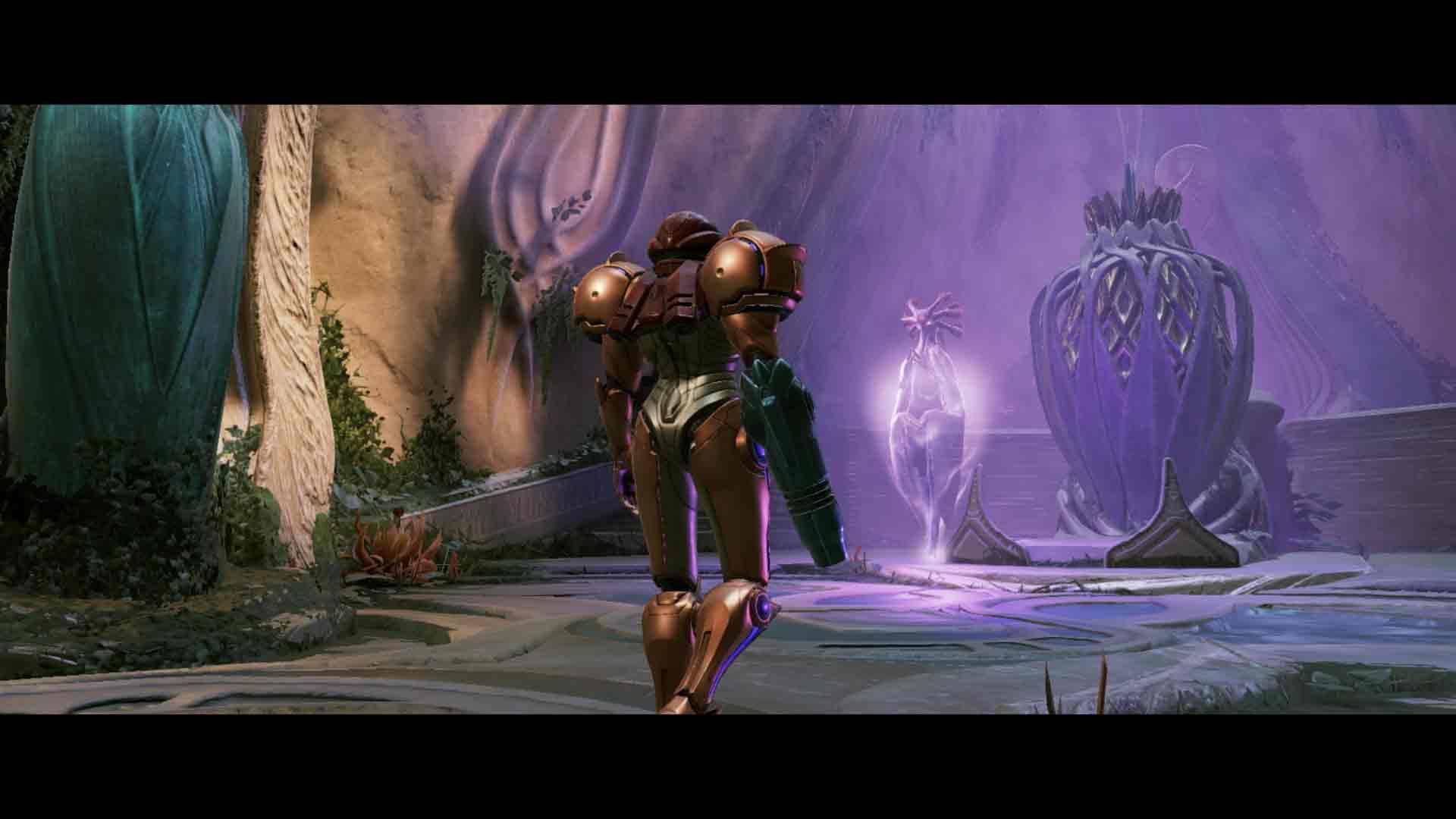
Samus will come across all sorts of remnants of Lamorn civilization in Beyond.
And when I encounter enemies through the lens of Samus’ spiffy high-tech visor, raising my arm cannon to blast them with alternating flurries of rapid shots, powerful charged bursts and homing missiles, I really do feel like the galaxy’s toughest bounty hunter. It’s not some colourful fantasy adventure like Mario, Zelda or Kirby — there’s a level of grit and groundedness that’s simply intoxicating. (You can also use the Switch 2 Joy-Cons’ mouse controls, which is a neat option but one I didn’t find comfortable for prolonged play.) All of this makes the signature Metroid power-ups feel weightier than the upgrades you’d find in other games. As Samus, I’m effectively waging a one-woman war against the deadliest alien threats, and these suit enhancements are all that’s keeping me alive on my perilous quest.
Truthfully, most of Beyond‘s power-ups hail from previous games, so I would have appreciated even a few more newer ones. But the aforementioned psychic abilities still offer some welcome gameplay wrinkles. For environmental puzzles, you’ll have to manipulate “motes” of energy between statues and other objects, and once you re-acquire the Morph Ball (in classic Metroid fashion, Samus’ arsenal resets in the intro), you can drop small bomb charges that can then be telekinetically lobbed. And in combat, my favourite new ability is Control Beam, which slows down time to let you freely aim three interlocking shots. (This is used in such creative ways as reaching inaccessible switches for puzzles and overcoming enemy shields — to say nothing of the exciting boss fights I don’t want to spoil.)
Beyond is at its best when it carefully paces out the solemn ambience of exploring Lamorn ruins and the frenetic white-knuckle combat encounters. This balance is most pronounced in the Ice Belt, a frigid research facility containing remnants of freakish experiments. The contrast between the stillness of the dimly lit blue hallways, cragged icicles and frozen alien corpses and the whirring of the otherworldly machinery as I search for ways to power them creates a palpable sense of unease. Metroid has often taken plenty of inspiration from the Alien series, but the horror elements feel especially potent here, and it’s a real highlight of Beyond.
Miles (and Myles) of emptiness

Biiiiiicycle, biiiiiicycle, biiiiiicycle.
Above, you may have noticed that I said the game mostly preserves the Prime series’ signature impeccable vibes. Unfortunately, I had to make that distinction because there are a few things that get in the way of Beyond fully embodying it.
First, there’s the game’s quasi-open-world hub area, the desert wasteland known as Sol Valley. To navigate this sandy expanse, you’re given Vi-O-La, a high-tech bike that gets you across in no time. The vehicle’s handling is remarkably smooth, allowing you to boost, make sharp turns and even sideswipe incoming enemies. The problem, however, is that there’s really not much to do in Sol Valley otherwise. You have the occasional hidden object or mini-shrine, but on the whole, it’s just a whole lot of emptiness. (Incidentally, Mario Kart World also suffered from this.) It begs the question of why this bloat was added in the first place in favour of a single, intimately connected map like the original Prime.
This feeling of superfluousness extends to Beyond‘s supporting cast. During the game’s recent preview period, a common point of criticism surrounded Myles Mackenzie, a Galactic Federation scientist who helps Samus early on. Given that Samus’ isolation is a key part of what creates Metroid‘s engrossing atmosphere, people were understandably upset that this extremely talkative nerd with Marvel-esque dialogue was playing such an apparently major role.
Having now played the full game, I can say those concerns were sadly proven valid, but for decidedly different reasons. Admittedly, Myles isn’t actually in the game that much, and so Samus generally still finds herself alone for long stretches of the game. That’s good! But when he does show up, it’s in rather annoying ways. After meeting Myles, Beyond has him hanging back at a base camp and calling Samus on a radio for support throughout the rest of her journey. Maddeningly, he keeps calling you, over and over.
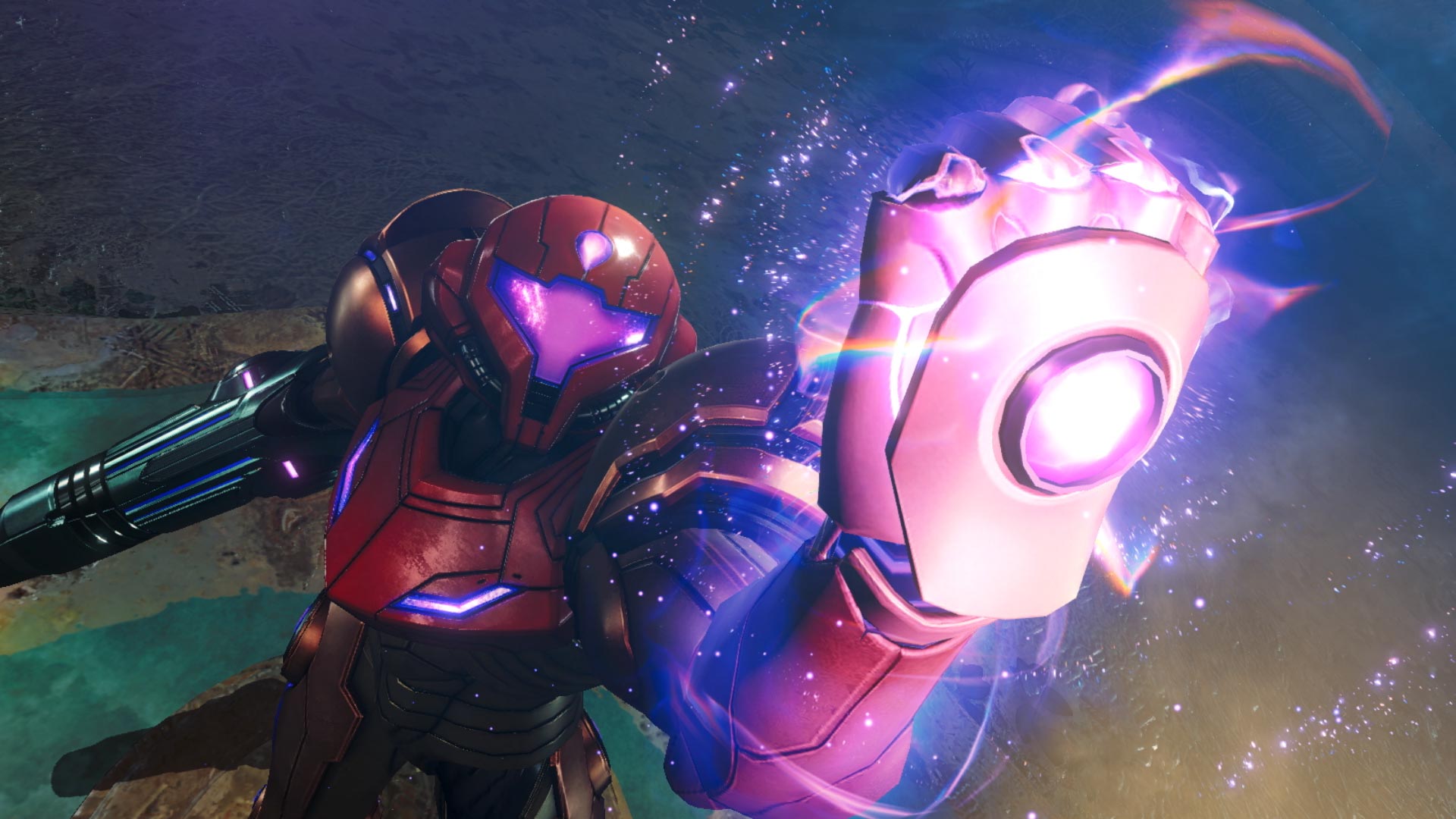
Me cursing Myles’ existence every time he called.
Often, he’ll give you a ring after you acquire a new item that will unlock a previously inaccessible area, which, obviously, is something you’ll be doing a lot in a Metroid game. Now, it would be one thing if he was just hitting you up for some more disposable banter, but it’s far worse than that. Instead, Myles will regularly tell you in no uncertain terms where you should go to use your latest upgrade, with the game then prompting you to open your map so it can mark the location for you. This will even happen every time you obtain new chips that Myles can use to enhance Samus’ arm cannon with elemental shots, as if you suddenly forgot about him and the base camp.
Given that the game already establishes that you can manually call the radio at any time, that would have been the perfect way to make hints optional for players who want them while not pestering everyone else. Indeed, one of the highlights of Metroid is figuring out this sort of thing on your own, and so I grew increasingly annoyed as I was in the midst of parsing through maps and markers I’d placed to recall where I could revisit, only to have Myles spell it out for me. Thankfully, the game generally disables the radio once you’ve entered sections like the aforementioned snowy lab, but I still desperately wish that extended to Sol Valley.
Compounding these issues is the fact that Myles isn’t the only Federation officer you meet. These other NPCs, while not quite as annoying as Myles from both a dialogue and hand-holding perspective, still feel unnecessary. In particular, later sections of the game have them regularly accompanying you, which, of course, diminishes the feeling of isolation. Take your visit to a lava-filled factory, the majority of which sees you teaming up with both a Federation sergeant and one of his soldiers.
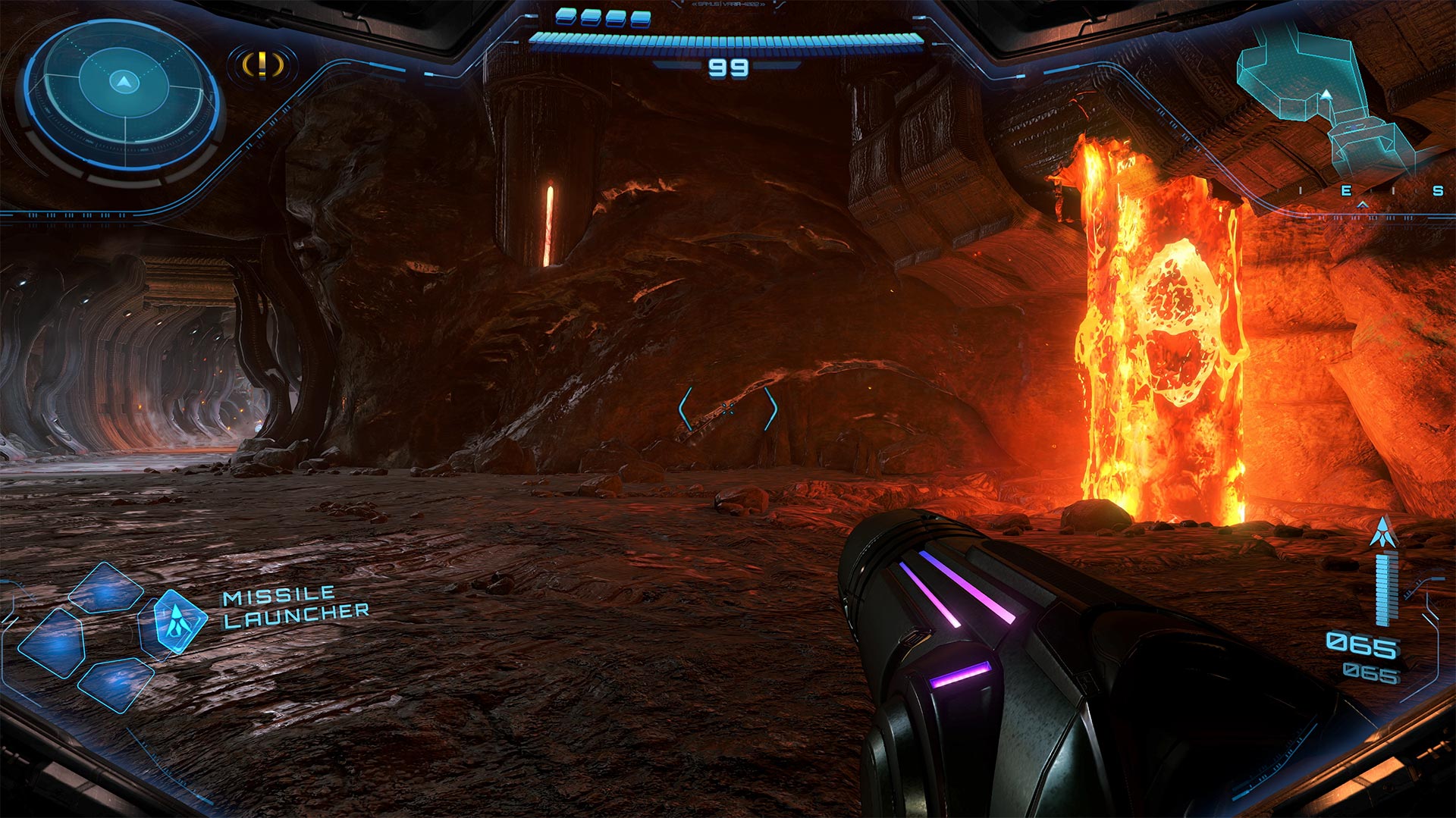
One of the only times you’re alone in the lava area.
Sure, not every section of the game needs to be as spooky as the aforementioned wintry lab; variety is important. But these NPC ally-filled segments just make Beyond feel like a more generic sci-fi shooter, especially since the characters in question, while well-acted, are just so thinly written. The sergeant is your standard cool, badass commander, while his troop is a plucky cadet who fangirls over Samus. That’s all I can tell you about them. I wouldn’t even have minded a heavier presence of these kinds of companions if they at least had a little bit of depth or helped flesh out the Federation that’s such a big part of the Metroid series, but as they are, they’re just forgettable. There are some other Federation allies you meet, and they’ll all play a prominent role in the final stretch of the game, but in the end, none of them prove memorable.
And on that note, the pacing of those closing hours is rather wonky. After obtaining all of the Chrono Tower keys, you’re then sent on another fetch quest which, in all fairness, will be clear to you by this point if you’ve spent any time in Sol Valley. But following this, the game then forces you to collect enough of a certain kind of energy by smashing green crystals in the overworld. Even though I broke as many of these as I passed over the course of my 15-plus hours with Beyond, I still had only reached about half progress, meaning I needed to spend nearly two more hours monotonously driving around in circles looking for these glowing gemstones.
It absolutely kills the momentum heading into what should be one of the most exciting moments of your journey: the endgame. And if that weren’t enough, the events of the finale itself also feel somewhat rushed, especially when compared to the pointlessly dragged-out sequence preceding it. It’s certainly not enough to ruin the game, but it nonetheless had me sorely missing earlier sections, like the meticulously well-crafted Ice Belt.
Don’t call it a comeback

Samus has never looked better.
Metroid Prime 4: Beyond is a fascinating game. After a development history that spans nearly a decade, the finished product is an experience that can simultaneously feel overly familiar and needlessly different from its beloved predecessors. But beneath all of that is the ever-absorbing and wholly unique core Metroid Prime loop of rewarding exploration, snappy gunplay and rich atmosphere. That beating heart remains strong, even if uneven pacing and excessive handholding sometimes bog it down.
At long last, Samus has returned, and it’s good to have her back. You’ve been missed.
Metroid Prime 4: Beyond will launch on December 4 on Nintendo Switch and Switch 2.
Image credit: Nintendo
MobileSyrup may earn a commission from purchases made via our links, which helps fund the journalism we provide free on our website. These links do not influence our editorial content. Support us here.



