

A senior US Navy admiral has ordered a second round of strikes against a suspected Venezuelan drug ship, the White House has confirmed.
The Sept. 2 “double whammy” strike drew intense bipartisan scrutiny from U.S. lawmakers. The Washington Post recently reported that two people survived the first explosion and were still clinging to the burning ship when they were killed, raising new questions about the legality.
White House press secretary Caroline Leavitt said Monday that Defense Secretary Pete Hegseth authorized the strikes but did not order a “kill all,” as the report said.
“Admiral (Frank) Bradley acted well within his authority and within the law” in ordering the additional strike, Leavitt said.
A series of similar strikes in the Caribbean have killed more than 80 people since early September. Each statement by U.S. officials is usually accompanied by grainy video, but with no evidence of the alleged drug trafficking and few details about who or what was aboard each vessel.
The Trump administration says it is acting in self-defense by destroying ships carrying illegal drugs into the United States.
Both Republican and Democratic lawmakers have expressed concern over the reported Sept. 2 incident and vowed to Congress to look into the strikes.
“President (Donald) Trump and Secretary Hegseth have made clear that presidentially designated narco-terrorist groups are subject to lethal attack under the laws of war,” Leavitt said during a press briefing Monday.
The spokesman would not confirm that two people survived the first attack, or whether the second attack was aimed at killing them.
Media reports that Hegseth ordered the killing of everyone aboard the ship during the Sept. 2 strike have renewed concerns about the legality of U.S. military strikes on suspected drug ships in the Caribbean.
Hegseth rejected the allegations in the report, calling them “fabricated, inflammatory and derogatory.” On Monday, he tweeted that Admiral Bradley “is an American hero, a true professional and has my 100% support.”
“I support him and the combat decisions he made—on the Sept. 2 mission and in all others since then.”
In recent weeks, the US has expanded its military presence in the Caribbean as part of a so-called counter-narcotics operation.
On Thursday, Trump warned that U.S. efforts to stop drug trafficking in Venezuela “overland” would begin “very soon.”
Over the weekend, the Senate Armed Services Committee said it would “conduct careful oversight to determine the facts” related to the Sept. 2 strikes.
The committee's Republican chairman, Sen. Roger Wicker, said Monday that lawmakers plan to interview “the admiral who was in charge of the operation.” He added that the company is also looking for audio and video to “see what the orders were.”
The House Armed Services Committee also said it would undertake a “bipartisan effort to obtain a full report on the operation under review.”
The chairman of the Joint Chiefs of Staff, the body made up of the most senior officers in the U.S. military, met with the House and Senate Armed Services committees over the weekend.
Discussions centered around operations in the region and “the intent and legality of missions to disrupt illicit trafficking networks,” the group said.
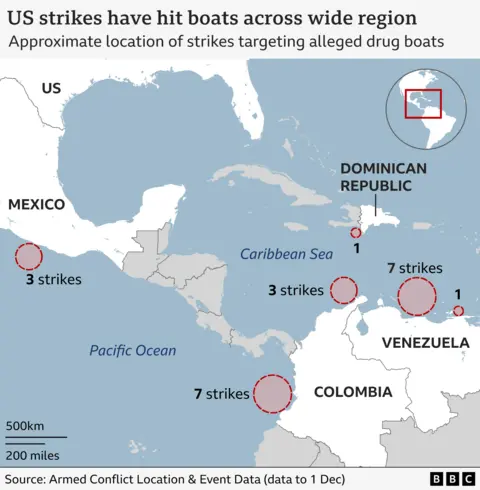
Many experts who spoke to the BBC expressed serious doubts that a second strike on suspected survivors could be considered legal under international law. Survivors could benefit from the protection afforded to shipwrecked sailors or those provided to troops found unable to continue fighting.
The Trump administration has said its operations in the Caribbean constitute a non-international armed conflict with suspected drug traffickers.
The rules of engagement in such armed conflicts, as set out in the Geneva Conventions, prohibit attacking wounded participants, stating that these participants should instead be detained and treated.
Under former President Barack Obama, the U.S. military came under scrutiny for using multiple drone shots in practice. known as “double tap”which sometimes led to civilian casualties.
On Sunday, Venezuela's National Assembly condemned the boat strikes and promised a “strict and thorough investigation” into the Sept. 2 strikes.
The Venezuelan government has accused the US of stoking tensions in the region with the aim of overthrowing the government.
In an interview with BBC Newsnight on Monday, Venezuelan Attorney General Tarek William Saab said Trump's accusations stemmed from “great envy” of the country's natural resources.
He also called for direct dialogue between the US and Venezuelan governments “to clean up the toxic atmosphere we have witnessed since last July.”
On Sunday, Trump confirmed he had a brief phone call with Venezuelan President Nicolas Maduro, during which he pressured him to resign and leave Venezuela with his family.
During a phone call last month, Trump reportedly told Maduro that he could travel to a destination of his choosing, but only if he agreed to go immediately. After he refused, Trump wrote on social media that the airspace over Venezuela should be considered “totally closed.”
Maduro has demanded an amnesty for his top aides and permission to continue control of the military after leaving government. Trump rejected both demands, according to The Miami Post and Reuters, and the BBC has not confirmed the information.
US officials say Maduro himself is part of a “terrorist” organization called the Cartel of the Sun, which they say includes senior Venezuelan military and security officials involved in drug trafficking. Maduro has denied these accusations.
With additional reporting by Lucy Gilder and Thomas Copeland.


:quality(85):upscale()/2025/12/01/720/n/1922729/29500804692dbfc0629639.11875359_.jpg?w=150&resize=150,150&ssl=1 "Anthony Ramos Is Making Running a Community Conversation")

