Toronto gets a lot of hate for being unattractive.
“It’s not a good-looking town,” the late, great chef Anthony Bourdain once famously quipped, adding that the city looked as if it had fallen victim to all the worst architectural fads of the 20th century.
But 2025 has been an outstanding year for architecture in Toronto, ranging from a vast new park that proved the power of community, to new public buildings that broke old rules, to a condo project unlike anything the city has seen and an office tower that added diamonds to the sky.
The Star asked experts in architecture to nominate seven of the best.
Biidaasige Park
Mark Wilson was 39 when he founded the movement to renaturalize the Don River. More than 35 years later, his dream has come true.
Nick Lachance/Toronto Star
Part of an extraordinary civil engineering project 35 years in the making, Biidaasige Park, which opened this year, has crushed all expectations.
It is an attraction that succeeds in layers: as a playground for children, as a naturalized park and wetland, as a source of Indigenous inspiration, culture and art, and as a place to walk, cycle, paddle, fish, picnic and see the city from a fresh vantage point on a newly created island, Ookwemin Minising.
Michael Van Valkenburgh Associates Inc. led the design and master-planning of the $1.3-billion flood protection project, restoring the Don River where it meets Lake Ontario, and designed Biidaasige Park.
“It meets and exceeds our dreams,” said Mark Wilson, 75, a founder of the citizens movement in 1989 to renaturalize the Don River, when it was a polluted wasteland.

Waterfront Toronto and the Toronto Region Conservation Area ensured that vegetation planted in and around the new river valley carved out of the Portlands, built along with Biidaasige Park, are all native to the area.
TRCA
“You can’t go down there and not be moved.”
Wilson was 39 when he started work on the idea, with a group of fellow residents. The project was right for the times, and drew support from key players, including Toronto’s former mayor, David Crombie, who led a Royal Commission on the Future of Toronto’s Waterfront, which concluded by championing the plan.
“We tried to approach this as a city-building exercise, not a flood-protection exercise,” said Chris Glaisek, Waterfront Toronto’s chief planning and design officer.
The site will evolve. Ookwemin Minising (formerly Villiers) will one day be home to 15,000 people.
“It took a whole lot of folks, and it’s the kind of project that got inside people’s souls and hearts and they committed to it and wouldn’t let it go,” said Wilson.
Limberlost Place
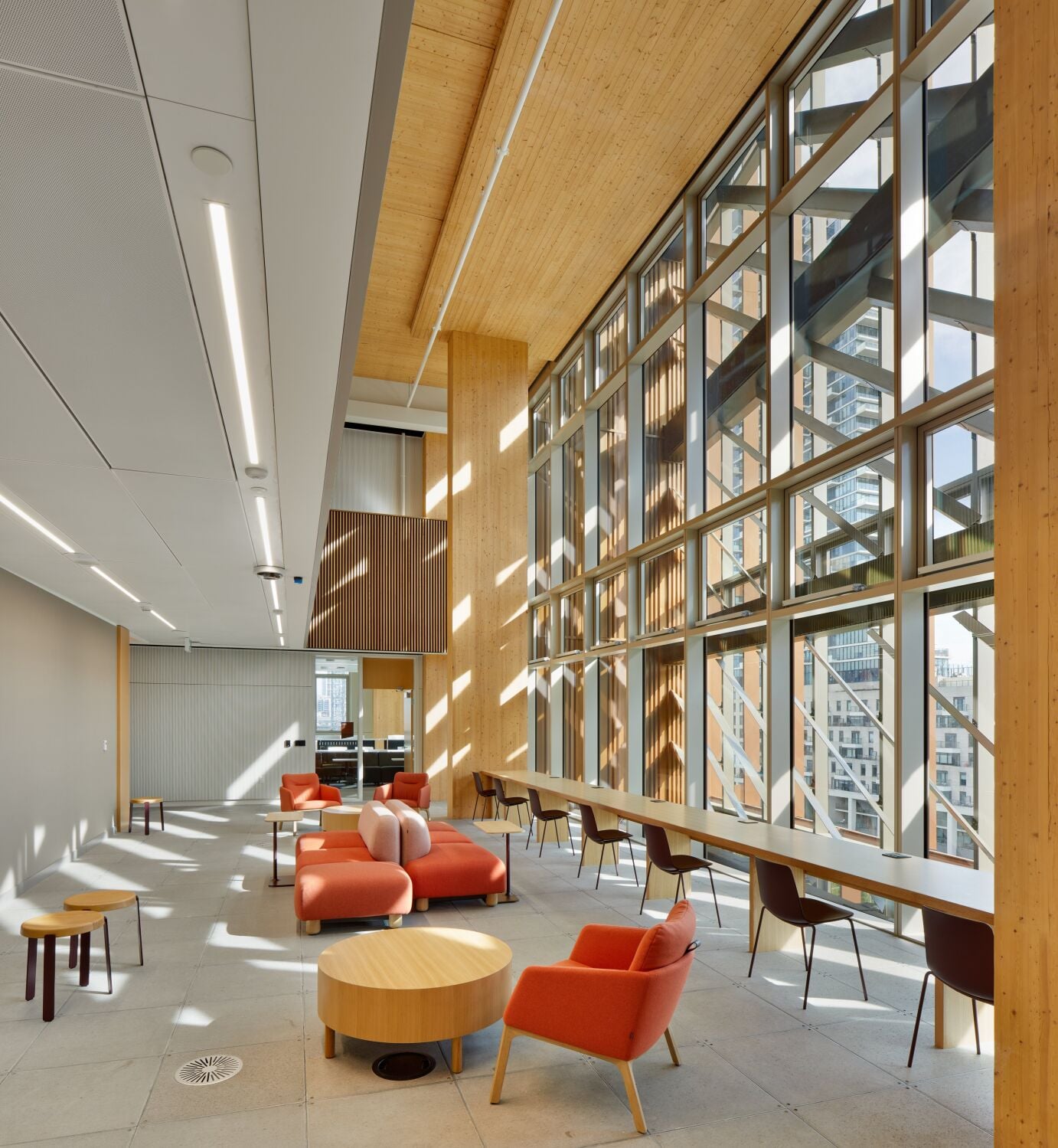
The interior of Limberlost Place at George Brown College was designed to maximize natural light and air flow.
Tom Arban
Standing in the atrium of Limberlost Place at George Brown Polytechnic, it’s immediately clear this building is different.
You’d know it with your eyes closed.
It smells like wood, because it was built using mass timber, eroding a 100-year dependence on steel and concrete that began after a series of devastating fires in North American cities, including a blaze in Toronto in 1904 that gutted the downtown.
Wood construction became limited, increasingly replaced by non-combustible materials: brick, steel and concrete.
Limberlost represents a return to more ecologically friendly wood construction, using mass timber, made by binding layers of wood with glues, dowels or nails.
While wood is combustible, mass timber is highly fire-resistant.
Steven Craft, a principal at CHM Fire Consultants Ltd., compares it to trying to start a campfire with a match.

Architect Carol Phillips in the atrium of Limberlost Place.
Andres Valenzuela Toronto Star
The massive timber that holds up Limberlost would take two hours to catch fire. Limberlost also features a strong sprinkler system, and pressurized stairwells to keep smoke out so people could escape safely.
It took six years and innumerable negotiations with city planners, structural engineers, code engineers, sustainability engineers, the client, builders and the trades to get Limberlost built, said Carol Phillips, design leader and partner at Moriyama Teshima Architects, which collaborated with Acton Ostry Architects on the project.
The firms had to prove to the city that a 10-storey, exposed mass-timber building would be safe.
“Building Limberlost Place was like landing a person on the moon,” Phillips said.
“We entered into a kind of active negotiation with the city of Toronto, to the point where I consider them part of the team.”
There is no fossil-fuel-fired equipment in Limberlost. It uses natural air ventilation, two solar chimneys and electrically operated fans to warm, cool and distribute the air in the building, which means it has a net-zero impact on the environment.
“This building convinced bureaucracy to change,” said Ian Chodikoff, founder and leader of the consultancy Chodikoff & Ideas, “and I think that is a big win.”
Aqualuna Condos

The site for the Aqualuna condos was rectangular. Architect Audun Opdal of 3XN, broke out of the box with an imaginative design, featuring curving balconies that suggest waves on a shoreline.
Steve Russell/Toronto Star file photo
The biggest challenge facing the Scandinavian architects who designed the curving Aqualuna Condos on Queens Quay East was the shape of the site.
It was exceptionally long and rectangular.
“The building actually was supposed to be more like a flat, long building,” said Audun Opdal, senior partner and head of design at 3XN Architects in Copenhagen.
Instead, Opdal and his team proposed a swooping design that suggests waves breaking on a shore. The building has two towers, with an amenity and social space in the centre, including a pool, to encourage community among residents.
The city of Toronto’s East Bayfront Community Recreation Centre, including a basketball court and elevated running track, will operate from the east side of the building.
The building was executed in monochromatic copper to evoke the industrial history of the harbour.
“When the sun hits this building at sunset, it feels like it’s glowing,” said Opdal.
The idea for the spacious, sweeping balconies sprang from the desire to create an exciting outdoor space connected to every unit.
“Then we started to play with the geometry — we really wanted to create a wave effect, flowing in and out,” said Opdal.
The balconies have thermal breaks to prevent them from transferring cold in winter and heat in summer into the condo units.
“It’s not very common in Scandinavia to be vocal about how proud you are of stuff,” said Opdal.
“But we are really proud of this building.”
Supportive Housing

The colour of the cladding on the new low-income supportive housing on Ossington Street was meant to echo the traditional red brick that used to be used for building in the area.
Liron Weissman
From a patch of grass and surface parking, this housing for 25 homeless people grew.
Each 250-square-foot unit includes a kitchenette and bathroom, and — most importantly — a door that locks to provide privacy and security. The rent is $542 a month.
The client was St. Clare’s Multifaith Housing Society, a social justice landlord and developer.
It was designed by the Toronto-based firm Smart Density.
“Research tells us that people who experience homelessness don’t care how small the space is as long as they can close the door behind them,” said Naama Blonder, an architect and urban designer who co-founded Smart Density.
“So we went as small as possible.”
The ground floor is entirely accessible.
Working with prefab mass timber, delivered in panels to be assembled at the site, was a requirement of the contract.
“What you get is a simple box,” said Blonder. “As an architect it’s really challenging.”
The benefit of mass timber is its low environmental impact.
With a tight budget, Blonder used the colour orange to bring joy and life to the street.
“Colour definitely evokes emotions and we wanted a happy place,” said Blonder.

Supportive housing at 1120 Ossington: A detail of the windows by artist Leo Krukowski.
Liron Weissman
Artist Leo Krukowski designed elegant openwork screens that project from the building to provide visual interest, shadow and privacy.
Stefan Novakovic, former senior editor at Azure magazine, which is dedicated to architecture and design, said the building succeeds on numerous levels, pointing out that it took 17 days to assemble the internal structure once the parts arrived on the site.
“From this very modest kit of parts, they’ve put together some really lovely, dignified, affordable and accessible housing,” he said.
Anishnawbe Health Toronto

Interior detail of the Anishnawbe Health Toronto Indigenous Community Health Centre on Cherry Street.
James Brittain
It curves like a river and is wrapped in a cladding meant to represent an Indigenous shawl, with a stainless steel fringe that chimes in the wind.
A clear outer coating reflects the changing light of the sky, lending it a soft glow. The lobby smells like sage.
The new Anishnawbe Health Toronto Indigenous Community Health Centre on Cherry Street, adjacent the Distillery District was crafted from Indigenous beliefs, values and healing practices, and enshrines and supports them.
“The building resonates with the spirit of the Indigenous community,” said architect Matthew Hickey, of the firm Two Row, an Indigenous-owned business operated from the Six Nations of the Grand River First Nation.
Joe Hester, executive director of the health centre for 30 years, died last January.
“It was his life’s work to make this happen,” said Hickey.
Importantly, from the entrance of the centre, one can see right through the windows at the back of the building, to the urban forest planted there, part of a raised ceremonial garden.
“We have been systemically treated poorly by health-care systems, so a lot of people have this fear of going to the doctor, getting treatment,” said Hickey, himself a Mohawk from the Grand River First Nation.
“To be able to see in and see what’s going on, and see right through the building, into a raised forest, is really kind of an exciting way to enter a health-care system or a wellness centre. You get the ability to not be afraid of what’s behind that.”
Until the new centre launched this year, the services it provides had been operating out of two old buildings: a bank on Queen Street East, and a yellow brick Victorian townhouse on Gerrard Street East.

The exterior of Anishnawbe Health Toronto is meant to suggest a shawl. The fringe chimes in the wind. “I’d love to see more of this kind of kinetic features in our built environment,” said Elsa Lam, editor-in-chief of Canadian Architecture magazine. “It’s a real moment of delight.”
James Brittain
“They were hand-me-downs, cast-off buildings,” said Suzanne Crysdale, an architect with Stantec Architecture Ltd., and project manager for the centre.
“This is really extraordinary, to build something that is purpose-built for the Indigenous community.”
Two Queen Street West

2 Queen Street West ”shows how existing buildings can act as prototypes,” says architect Philip Evans, principal, ERA Architects Inc.
Adrien Williams
Two Queen West began its reign at the heart of Toronto’s downtown as a men’s clothing store in 1895, and over 130 years served as a bank, a record store, a Woolworth’s and an outdoor gear retailer.
Every tenant made their own modifications to the elegant Renaissance Revival building, at the corner of Yonge Street, which was the principal challenge for ERA Architects Inc. when it began adapting the property for 2025 retail.
“We had to make sense of a building that had been altered and adapted for more than a century,” said Philip Evans, the ERA architect who led the restoration for client Cadillac Fairview.
The original terra cotta failed almost immediately after construction in 1895, the bricks were melting off the face of the facade following sandblasting and portions of the building had been scraped off.
ERA painstakingly restored the building’s facade and added three glass storeys on top to blend seamlessly with the more modern surroundings, including the pedestrian bridge over Queen Street, between the former Hudson’s Bay store and the north side of the Toronto Eaton Centre.
That symmetry is no accident — Zeidler Architecture Inc. partnered with WilkinsonEyre to design the pedestrian bridge and was the lead architect for the overall revitalization of 2 Queen West, in collaboration with ERA.
A restaurant with a terrace crowns the new space.
“It really makes that corner of Yonge and Queen feel a lot more alive,” said Novakovic.
“The way the glass sits on top of it and kind of disappears into the sky — it’s quiet and deferential. It adds new density to the building, but it doesn’t diminish the older building below it.”
CIBC Square
The challenge facing architect Dominic Bettison with the new CIBC Square was building a large development in one of the most densely developed areas of the city, adjacent Union Station.
He had to transform an old parking lot opposite the Scotiabank Arena and an outdoor bus terminal into two separate towers and somehow span the rail corridor between them.
“How do you integrate such a big development right next to Union Station, Canada’s largest rail station, and do that in a kind of way that is generous and gives back to the city?” said Bettison, director of the London-based WilkinsonEyre.
The first tower, 49 storeys at 81 Bay St., opened in 2021.
In 2025, the second, 50-storey tower at 141 Bay St. was topped out, meaning the last, highest piece of structure was added to the building.
“Our challenge was to unify the southern part of the site with the north, to try and heal this scar that is the rail corridor,” said Bettison.
The solution was a one-acre park, open to the public, that will include year-round programming, including a skating rink in winter. The park creates a campus between the two towers, and provides acoustic cover from the trains rattling below.
But for Toronto residents who will never set foot in the tower, or even the park, the most striking thing about the buildings are the beveled diamond designs on the cladding that refract sunlight.
Bettison said he was inspired by the horizontal ribbon windows and spandrels of the TD Centre by Ludwig Mies van der Rohe, the towers in the Financial District that brought International Style Modernism to the city’s skyline in the late 1960s.
The horizontal motif was repeated by other buildings in the district.
“It needed a refresh, someone needed to come do something a bit different,” said Bettison.
“I saw an opportunity to do something a bit more dynamic.”
He applied a three-dimensionality to the diamond pattern that captures and reflects changing light conditions.
“The two towers on either side of the Gardiner play off each other, at different times of the day and night,” said architect and urban designer Ian Chodikoff, who leads his consultancy Chodikoff & Ideas.
“I think it’s a really great statement.”